
Is Bulk Workwear Purchasing Worth It for Construction?


Table of Contents
- Bulk Workwear Purchasing vs Retail: The Real Cost Comparison
- The Benefits of Bulk Workwear Procurement Beyond Price
- How Bulk Orders Support AS/NZS 4602.1 Compliance
- Custom Logo Embroidery for Workwear: Branding Your Bulk Order
- Workwear Replacement Cycles for Trade Teams: Sizing Your Order
- Hidden Costs and Risks of Bulk Workwear Purchasing
- Verdict: When Bulk Workwear Purchasing Makes Sense for Your Site
- Frequently Asked Questions
Last Updated: September 9, 2026
Procurement managers often assume buying workwear in bulk automatically saves money, yet the real calculation depends on crew size, replacement frequency, and compliance requirements. For construction companies weighing whether bulk workwear purchasing is worth it, the answer comes down to one question: can you manage sizing, storage, and replacement cycles efficiently enough to capture the per-unit savings?
Bulk workwear purchasing is the practice of ordering large quantities of high-visibility garments, pants, and accessories in a single transaction to secure volume pricing and consistent branding. Most construction firms find that buying in volume reduces cost per unit, but only when they avoid over-ordering sizes that never get worn.
Bulk Workwear Purchasing vs Retail: The Real Cost Comparison
The gap between retail and wholesale pricing narrows once you factor in freight, storage, and the cost of tying up capital in inventory. At retail prices, you pay a premium for flexibility: buy one shirt today, another next week, and you never hold excess stock. Bulk workwear purchasing flips that trade-off, rewarding you with a lower cost per unit in exchange for a larger upfront order.
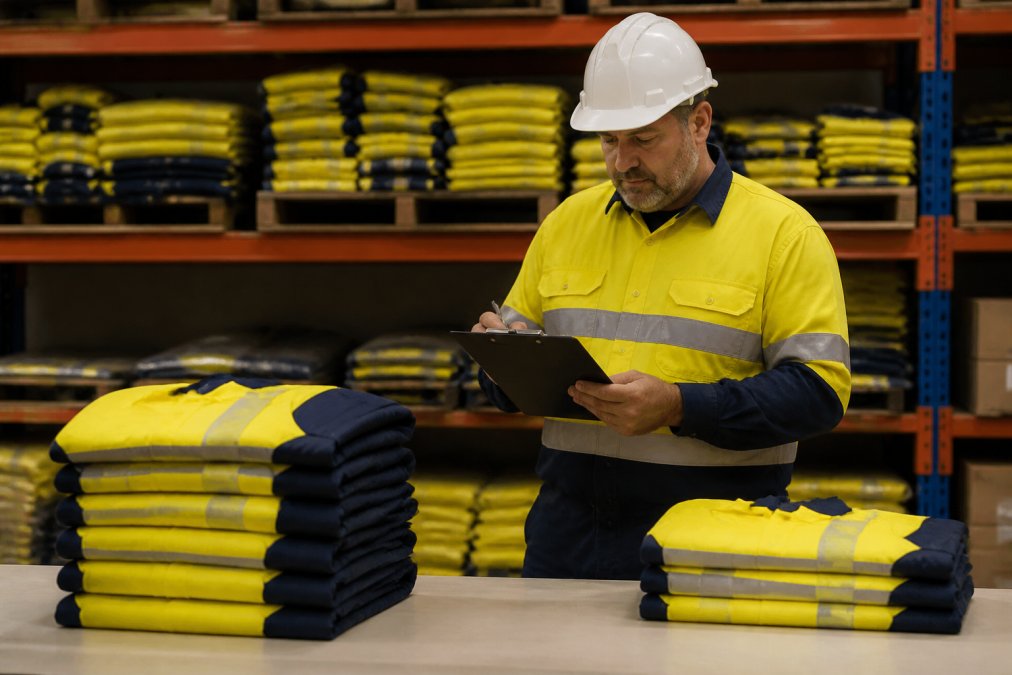
For most construction companies, the decision hinges on predictable demand. If you hire in waves, replace worn garments on a set schedule, and have space to store stock, the volume discount outweighs the retail premium.
Cost per unit analysis for a 20-person crew
A 20-person crew needing two shirt-and-pants combos per person per year gives you a baseline order of 40 sets. At retail, buying each combo separately at $79.00 per set through Hi Vis Work Clothes would cost $3,160.00 for the year.

Ordering the same 40 sets in one bulk purchase locks in identical fabric dye lots, consistent reflective tape placement, and uniform sizing across the crew. It also reduces administrative time: one purchase order, one delivery, one invoice instead of dozens of small transactions.
The Benefits of Bulk Workwear Procurement Beyond Price
Price per unit tells only part of the story. The operational advantages of bulk workwear procurement often deliver more value than the discount itself.
Standardisation is the quiet winner here. When every worker wears the same high-visibility garments from the same production batch, you eliminate the patchwork look from mixing retail purchases over time. This matters for professional image, but more for safety: consistent reflective tape placement and fabric performance mean every garment meets the same standard on site.
Inventory management also improves. A single bulk order lets you hold a buffer of common sizes, so a new hire on Monday wears compliant gear on Tuesday rather than waiting weeks for a retail restock.
How Bulk Orders Support AS/NZS 4602.1 Compliance
Australian construction sites require high-visibility garments that meet AS/NZS 4602.1, the standard governing hi-vis safety wear for daytime and night-time use. Bulk purchasing supports compliance because it lets you verify that every garment meets the standard before it reaches your workers.
When you buy retail, you assume each purchase is compliant. When you order in bulk from a supplier who sources against the standard, you can request certification documentation for the entire batch at once, simplifying your audit trail.
The standard specifies requirements for fluorescent background material, retroreflective tape placement, and garment design. A bulk order allows you to standardise on one compliant configuration across the whole crew, rather than managing a mix of garments that may differ in tape width or placement. Standards Australia guidance on AS/NZS 4602.1 provides the technical detail your procurement team should reference when vetting suppliers.
Custom Logo Embroidery for Workwear: Branding Your Bulk Order
Custom logo embroidery for workwear transforms a compliance expense into a branding asset. Ordering in bulk lets you add your company logo to every garment in one production run, ensuring consistent placement, thread colour, and finish across the team.
Hi Vis Work Clothes offers custom printing or embroidery with your logo and branding, so your crew presents a professional, unified image on site and when clients visit.
The branding benefit extends beyond aesthetics. A clearly identified crew reduces the risk of unauthorised personnel accessing your site, and it reinforces your company name every time a worker stops for fuel, coffee, or a site meeting.
Workwear Replacement Cycles for Trade Teams: Sizing Your Order
Workwear replacement cycles for trade teams typically run 12 to 24 months depending on the work environment. A crew doing heavy welding or abrasive work will wear through garments faster than a site supervisor team, so your bulk order quantity should reflect your actual replacement interval.
Sizing is where bulk orders go wrong. Ordering 40 sets in a size ratio that does not match your workforce leaves you with dead stock and workers in ill-fitting gear. Survey your crew before ordering, recording the size distribution across men's and women's ranges, then order a small buffer of the most common sizes.
Safe Work Australia guidance on personal protective equipment selection emphasises that PPE must fit properly to provide protection. Garments that are too tight restrict movement and cause discomfort; garments that are too loose create snagging hazards. A bulk order sized accurately to your team avoids both problems and reduces the chafing and overheating complaints that drive workers back to retail alternatives.
Hidden Costs and Risks of Bulk Workwear Purchasing
Bulk purchasing carries risks that do not appear on the invoice. Storage is the first: a pallet of workwear needs clean, dry space, and garments stored in damp conditions can develop mould or degrade reflective tape before they are worn. But the deeper financial risks, how the tax office treats your stock, how its value depreciates, and what happens if your supplier fails, are the ones most guides overlook.
The tax treatment most guides ignore
Workwear that is distinctively branded with your company logo and required for your trade is generally claimable as a business expense. However, the distinction between an immediate deduction and a depreciating asset matters. A bulk order of standard hi-vis shirts consumed within a year is typically an operating expense. Durable jackets or specialised gear with a useful life beyond 12 months may need to be capitalised and depreciated over its effective life.
Australian Taxation Office guidance on clothing and laundry expenses provides the current ruling on what qualifies as protective clothing. The key test is whether the garments are specific to your occupation and not conventional everyday clothing. A plain hi-vis shirt may be treated differently from one with your company logo and your crew's names embroidered on the chest. Keeping the purchase order, the supplier invoice, and a record of the branding specifications is important to substantiate the claim, but the depreciation schedule for higher-value items can be complex.
The real cost of capital tied up in inventory
A bulk order commits capital upfront that could otherwise fund tools, fuel, or wages. The true cost is not just the invoice total, it is the opportunity cost of that cash sitting in a warehouse. If your crew size fluctuates seasonally, you risk holding stock that does not match your actual headcount.
A common pattern is a company ordering 12 months of inventory to secure a volume discount, only to find that 15 per cent of the order sits unused because a major contract finished early. That dead stock is capital that could have earned interest, funded a hire, or covered a sudden invoice. Before any bulk order, run the carrying cost calculation: the value of the inventory multiplied by your cost of capital, multiplied by the average time the stock sits before it is worn. For a $10,000 order held for six months at a 10 per cent cost of capital, that is $500 in carrying costs alone, enough to erode a modest volume discount.
Supply chain risk: what happens when your supplier fails
Relying on a single bulk supplier creates a concentration risk that few companies price into their decision. If your sole supplier goes into administration, faces a factory fire overseas, or loses its AS/NZS 4602.1 certification, your crew could be left without compliant gear for weeks.
A practical mitigation is to split your annual volume between two approved suppliers, even at a slightly higher per-unit cost on the secondary order. Another is to structure your bulk purchase with staged deliveries rather than one full upfront payment, so you are not exposed to the full value of the order if the supplier fails mid-contract. Verify that your supplier holds current certification documentation for the specific garments you are ordering.
:::warning Supply chain risk
Before committing to a single bulk supplier, check their trading history, ask for references from other construction firms, and confirm their ability to supply replacement stock on short notice.
| Consideration | Retail Purchasing | Bulk Workwear Purchasing |
|---|---|---|
| Cost per unit | Higher, no volume discount | Lower with negotiated volume pricing |
| Sizing flexibility | Order as needed per worker | Requires accurate crew survey upfront |
| Branding consistency | Varies between batches | Uniform across the full order |
| Compliance verification | Per-purchase documentation | Batch-level certification available |
| Storage requirement | Minimal | Needs clean, dry warehouse space |
| Cash flow impact | Spread across the year | Committed upfront |
| Tax treatment | Simple per-item deduction | May require depreciation schedule for durable items |
| Supplier risk | Low, switch suppliers easily | High, single point of failure |
Verdict: When Bulk Workwear Purchasing Makes Sense for Your Site
Bulk workwear purchasing makes sense when you have predictable crew numbers, adequate storage, and a replacement cycle you can forecast. For a stable 20-person crew ordering on a set schedule, the cost per unit savings, branding consistency, and simplified compliance documentation justify the upfront commitment. But the decision should also factor in what happens to those garments at the end of their working life.
The sustainability gap: where your old workwear goes
The construction industry generates a significant volume of textile waste, and high-visibility workwear is a notable contributor. Garments that are worn, faded, or have lost their reflective properties cannot simply be donated to charity, they are no longer compliant for site use. Thousands of tonnes of hi-vis clothing end up in landfill each year.
A bulk purchasing strategy that ignores end-of-life disposal is incomplete. Some suppliers offer take-back programs where old garments are recycled into insulation, carpet underlay, or industrial wipes. Before placing your next bulk order, ask your supplier whether they offer a disposal or recycling service. If they do not, factor the cost of responsible disposal into your total cost of ownership calculation.
A decision framework for your next order
Rather than a simple yes-or-no verdict, run your situation against these four tests before committing to a bulk order:
- Crew stability test, Is your headcount within 10 per cent of your forecast for the next 12 months? If not, the risk of dead stock outweighs the volume discount.
- Storage test, Do you have clean, dry, pest-free space to hold the full order? Garments stored in a damp shipping container will degrade before they are worn.
- Cash flow test, Can you absorb the upfront capital commitment without affecting your ability to fund tools, fuel, or wages? If cash flow is tight, a staged delivery arrangement may be a better fit.
- End-of-life test, Have you planned how the garments will be disposed of or recycled when they reach the end of their replacement cycle? If not, add that cost to your total.
Bulk purchasing is not the right call for every site. If your crew size fluctuates dramatically between projects, if you lack storage space, or if cash flow is tight, retail purchasing offers flexibility without the risk of dead stock. The optimal strategy for many companies is a hybrid: bulk order the core uniform items your crew wears daily, and buy replacements at retail as needed.
For construction companies ready to standardise, Hi Vis Work Clothes supplies durable, high-visibility apparel suitable for teams and groups, with reflective tape options and all-weather jacket choices. Business.gov.au guidance on uniform and clothing expenses notes that eligible uniform expenses may be claimable, so check the current rules with your accountant before finalising your order.
The decision ultimately comes down to your crew's stability, your ability to manage inventory, and your plan for the garments when they wear out. A well-planned bulk order reduces cost per unit, strengthens your professional image, simplifies compliance, and, when paired with a responsible end-of-life strategy, keeps your site's environmental footprint in check. A poorly planned one leaves you with boxes of unused sizes, cash tied up in storage, and a pile of old hi-vis gear with nowhere to go.
Frequently Asked Questions
What are the primary benefits of buying workwear in bulk for construction teams?
Bulk workwear purchasing lowers the cost per unit, ensures sizing consistency across your crew, and simplifies compliance with AS/NZS 4602.1 high-visibility standards. You also get a single point of reordering, which cuts administrative time. For a 20-person crew, ordering complete pant-and-shirt combos in one go means every worker starts with the same compliant, branded gear rather than piecing together retail items that may vary in quality.
How does bulk buying reduce the long-term cost of workwear replacement?
Bulk purchasing reduces long-term replacement costs in two ways. First, the lower cost per unit frees budget for higher-grade fabric and reflective tape that lasts longer. Second, buying a full replacement cycle upfront means you have stock on hand when a shirt tears or reflective striping fades, avoiding emergency retail purchases. For trade teams, planning around a 12-to-18-month replacement cycle keeps workers in compliant gear without last-minute premium pricing.
How does custom logo embroidery hold up compared to printed logos on workwear?
Custom logo embroidery for workwear generally outlasts printed logos because the thread is stitched into the fabric rather than sitting on the surface. Embroidery resists peeling and cracking through industrial washing, which matters for high-visibility gear cleaned frequently. For a bulk order, embroidery adds a professional finish that supports your corporate branding on site. Ask your supplier about thread colour matching to ensure your logo stays recognisable against hi-vis yellow or orange backgrounds.
What is the minimum order size for bulk workwear purchasing?
Minimum order sizes vary by supplier, but many workwear providers accommodate small trade teams of 10 to 15 workers as well as large construction firms. The key is to calculate your full replacement cycle, not just current headcount. If you expect 15 new hires next month, factor those sizes into your initial bulk order so you are not paying retail rates for a second small batch. Ask your supplier about sizing distribution support for crews across multiple sites.
Get a quote from Hi Vis Work Clothes for your next bulk order, and our team will help you size your crew accurately, apply your logo with custom embroidery, and deliver compliant, durable workwear ready for the demands of your site.
Recent Blogs
September 09, 2026
Is Bulk Workwear Purchasing Worth It for Construction?
Is bulk workwear purchasing worth it for construction companies? Compare...
September 09, 2026
Is Bulk Workwear Purchasing Worth It for Construction?
Is bulk workwear purchasing worth it for construction companies? Compare...
September 09, 2026
Is Bulk Workwear Purchasing Worth It for Construction?
Is bulk workwear purchasing worth it for construction companies? Compare...