
High Visibility Clothing Standards Australia: Complete 2024 Guide


Table of Contents
- What Are High Visibility Clothing Standards in Australia?
- Understanding AS/NZS 4602.1:2011 and the 2024 Update
- Hi-Vis Clothing Classes in Australia: Classification and Requirements
- Approved Hi-Vis Colours in Australia and Visibility Requirements
- Fluorescent Fabric Coverage and Background Material Impact
- Maintaining Hi-Vis Compliance: Care, Testing and Durability
- Industry-Specific Risk Assessment and Garment Selection
- Compliance Certification and Regulatory Responsibility
High Visibility Clothing Standards Australia: Complete 2024 Guide
Last Updated: July 31, 2026
High visibility clothing standards australia exist to protect workers in hazardous environments where visibility can mean the difference between a safe shift and a serious incident. At Hi Vis Work Clothes, we help organisations navigate these critical safety requirements, ensuring teams stay compliant whilst maintaining comfort on the job. Understanding the current regulations and how they've evolved is essential to protecting your workforce.
What Are High Visibility Clothing Standards in Australia?
High-visibility clothing standards australia define the minimum requirements for protective garments designed to make workers visible in low-light or hazardous conditions. These standards specify fluorescent fabric coverage, retroreflective tape placement, and photometric performance.
In Australia, the primary standard is AS/NZS 4602.1:2011, which classifies garments into three risk-based categories. The 2024 revision introduced significant updates affecting how organisations select and maintain their hi-vis inventories.
The standard combines two visibility mechanisms: fluorescent colours that work during daylight by converting ultraviolet light into visible light, and retroreflective materials that bounce light back to its source at night. Together, these create a layered visibility system that keeps workers visible across all lighting conditions.
Why Standards Matter for Workplace Safety
Workplace visibility incidents happen in seconds. A worker steps into a blind spot. A reversing vehicle operator doesn't see movement. These moments can be prevented entirely through compliance with high-visibility clothing standards australia.
The Australian Work Health and Safety Act 2011 places a legal duty on employers to provide safe work environments, which explicitly includes appropriate personal protective equipment. When a visibility-related incident occurs and investigation reveals non-compliant hi-vis clothing, employers face regulatory penalties from Safe Work Australia and workers' compensation claims.
Standards exist because they've been tested against real-world hazard scenarios. The photometric performance requirements in AS/NZS 4602.1 are based on research into how far away a driver needs to see a worker to stop safely and how colour perception changes under different lighting conditions.
Safe Work Australia guidance on personal protective equipment
Understanding AS/NZS 4602.1:2011 and the 2024 Update
AS/NZS 4602.1 has been the regulatory foundation for high-visibility safety garments since 2011. The 2024 revision tightened requirements across multiple dimensions, aligning Australian standards more closely with international best practice.
Key Changes in the 2024 Revision
The 2024 update introduced stricter photometric performance requirements for retroreflective materials and lowered the threshold for tape degradation, requiring organisations to replace garments sooner. Fluorescent colour specifications became more precise, with narrower acceptable chromaticity ranges for orange, yellow, lime-yellow, and pink.
Coverage requirements for upper torso visibility increased in Class 2 and Class 3 garments, requiring larger continuous areas of fluorescent material on the front and back. The 2024 revision also introduced explicit guidance on how logos and text affect compliance, giving organisations clear rules about customisation without compromising safety.

Transitioning to the 2024 Standard
Start by auditing your current inventory and identifying which garments were manufactured before the 2024 standard took effect. When ordering new garments, specify that they meet AS/NZS 4602.1:2024 and request documentation of compliance, including test reports showing photometric performance.
For organisations with custom branding, work closely with your supplier during the transition. The 2024 standard's rules on logo placement mean that designs that worked under the old standard might need adjustment. Hi Vis Work Clothes offers custom printing and embroidery services with full compliance documentation.
Hi-Vis Clothing Classes in Australia: Classification and Requirements
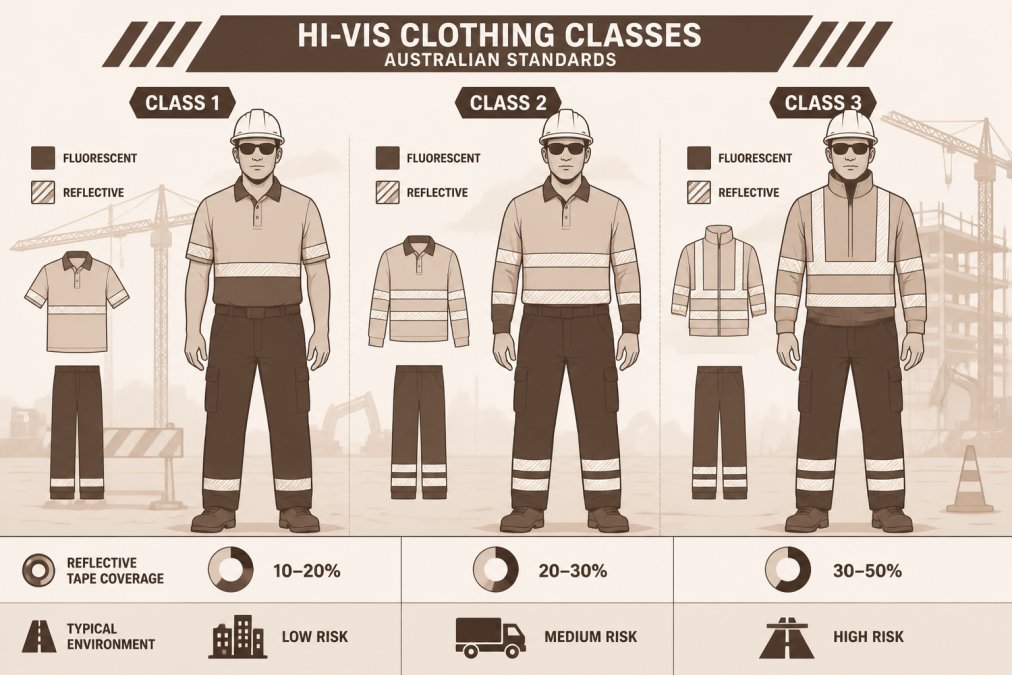
The AS/NZS 4602.1 standard classifies high-visibility clothing into three risk-based categories. Each class specifies minimum fluorescent fabric coverage, retroreflective tape placement, and photometric performance.
Class 1, 2, and 3 Coverage Requirements
Class 1 garments are designed for low-risk environments where workers are visible during daylight hours and hazard speeds are moderate. Class 1 requires a minimum of 0.14 square metres of fluorescent material and 0.10 square metres of retroreflective tape. A typical Class 1 garment is a safety vest, suitable for parking attendants or warehouse staff in well-lit environments.
Class 2 garments step up visibility for moderate-risk scenarios. Class 2 requires 0.50 square metres of fluorescent material and 0.13 square metres of retroreflective tape, distributed across the upper torso and legs. Class 2 garments are appropriate for construction sites, roadside workers, and logistics operations where vehicle speeds are higher.
Class 3 represents the highest visibility standard for extreme-risk environments. Class 3 requires 0.80 square metres of fluorescent material and 0.20 square metres of retroreflective tape, with specific placement on the upper torso, lower torso, and legs. Class 3 is mandatory for highway workers, airport ground crew, and any role where workers are regularly near moving vehicles at high speeds.
Choosing the Right Class for Your Industry
Selecting the correct class depends on vehicle speed in your work environment, proximity to hazard sources, and lighting conditions during work hours.
Construction sites typically require Class 2 as a minimum, upgrading to Class 3 if your site operates during low-light hours or has significant night-shift activity. Logistics and warehousing operations depend on the specific role: warehouse staff working indoors under consistent artificial lighting may meet requirements with Class 1 or Class 2 vests, whilst ground crew working around moving vehicles and forklifts need Class 2 minimum.
Roadside and traffic management roles universally require Class 3. When in doubt, choose the higher class, the incremental cost is far outweighed by the risk reduction.
Approved Hi-Vis Colours in Australia and Visibility Requirements
The AS/NZS 4602.1 standard specifies which fluorescent colours can be used and defines their chromaticity requirements. Approved colours are fluorescent orange, fluorescent yellow, lime-yellow, and pink. Compliance isn't about aesthetics; it's about measurable light reflection and visibility performance.
Daytime vs Night-Time Visibility Performance
Daytime visibility relies primarily on fluorescent material, which absorbs ultraviolet light and re-emits it as visible light, making the garment appear to glow. Night-time visibility shifts entirely to retroreflective materials, which bounce vehicle headlights back toward the driver's eyes.
This is why higher-risk standards require both materials. A Class 3 garment has large areas of fluorescent material for daytime visibility and multiple bands of retroreflective tape for night-time visibility. When a worker wears Class 3 gear, they're visible whether a hazard source approaches at midday or midnight.
Retroreflective Material Specifications and AS/NZS 1906.4
Retroreflective materials used in high-visibility garments must comply with AS/NZS 1906.4, which defines performance requirements for retroreflective materials. The 2024 revision tightened the minimum performance grades required, meaning better visibility performance and longer durability before replacement becomes necessary.
Glass-bead retroreflective tape is the most common and cost-effective option. When specifying retroreflective tape, work with manufacturers who can provide test data showing compliance with AS/NZS 1906.4. Budget for periodic replacement of retroreflective materials, as even high-quality tape degrades over time due to UV exposure and washing.
Fluorescent Fabric Coverage and Background Material Impact
The fluorescent fabric in a high-visibility garment is a carefully engineered component with specific performance requirements. Coverage requirements specify minimum areas of fluorescent material, but placement matters equally, fluorescent material must be positioned where it's most likely to catch the eye of a hazard source.
Upper Torso Coverage Requirements
The upper torso is the most critical visibility zone. Class 1 requires minimum coverage on the front and back of the torso. Class 2 adds shoulder coverage, addressing a visibility gap when a worker is at an angle or partially obscured. Class 3 requires even larger upper torso coverage areas with specific minimum dimensions for front, back, and shoulder panels.
Dark backgrounds enhance the contrast of fluorescent colours, making them appear brighter. This is why most high-visibility garments use dark (navy, black, or charcoal) base materials for non-fluorescent areas.
How Logos and Text Affect Compliance
Custom branding is common in modern workwear. However, logos and text can compromise visibility if not positioned carefully. The 2024 revision addressed this directly with explicit rules: logos and text can cover up to a certain percentage of the required fluorescent material coverage area, but only in specific zones.
Retroreflective tape cannot be covered by logos; if a logo is positioned where retroreflective tape would normally be placed, the tape must be repositioned to maintain required total coverage.
Hi Vis Work Clothes offers custom printing and embroidery services with full compliance documentation, ensuring professional branding without sacrificing compliance.
Australian Standards AS/NZS 4602.1:2024 specifications
Maintaining Hi-Vis Compliance: Care, Testing and Durability
Purchasing compliant high-visibility garments is only the beginning. Maintaining compliance over the garment's working life requires proper care, regular inspection, and timely replacement when degradation occurs.
Maintenance and Care Instructions for Longevity
Wash garments in warm (not hot) water with mild detergent. Avoid bleach and optical brighteners. Air drying is preferable to machine drying. Store high-visibility garments in a cool, dry location away from direct sunlight when not in use. Address minor damage promptly, small tears can be repaired with standard stitching, whilst peeling retroreflective tape should be replaced rather than re-glued.
Identifying Counterfeit and Non-Compliant Gear
Check the manufacturer's label for compliance documentation. Reputable manufacturers include a label stating the applicable standard (AS/NZS 4602.1:2024). Examine the retroreflective tape by shining a flashlight on it; genuine material produces a bright, sharply defined reflection. Verify the supplier by purchasing from established workwear retailers who can provide compliance documentation and test reports.
Inspection Schedules and Replacement Triggers
For daily-use garments, a quarterly inspection schedule is reasonable. Inspect the fluorescent fabric for colour fading, discolouration, or damage. Inspect the retroreflective tape for peeling, lifting, or delamination. Replacement triggers should be established based on inspection findings: significant fading of fluorescent material, peeling or missing retroreflective tape, or large tears are replacement triggers.
If more than 10-15% of the retroreflective tape is damaged or missing, the garment no longer meets the standard's coverage requirements and should be retired.
Industry-Specific Risk Assessment and Garment Selection
Different industries face different visibility hazards. A construction site, a logistics warehouse, and an airport ground crew have distinct risk profiles that demand different approaches to high-visibility clothing selection.
Construction and Infrastructure Applications
Construction sites present multiple visibility hazards: reversing vehicles, crane operations, machinery movement, and often chaotic layouts. For general construction work, Class 2 is the minimum acceptable standard. If your site includes high-speed vehicle movement, night-shift work, or complex machinery operations, upgrade to Class 3.
The Work Shirt HiVis Long Sleeve Reflective Tape from Hi Vis Work Clothes is a popular choice for construction teams, available in orange and yellow with Class 2 visibility. For roles requiring full-body protection, such as site supervisors or workers in particularly high-risk zones, Class 3 jackets and pants are appropriate.

Logistics, Warehousing and Ground Crew Requirements
Logistics operations involve constant movement of vehicles, forklifts, and machinery in indoor and outdoor environments. For indoor warehouse environments with controlled lighting and lower vehicle speeds, Class 2 vests or shirts are typically sufficient. For outdoor loading bays, ground crew operations, and high-speed forklift environments, Class 3 becomes necessary.
Airport ground crews work in close proximity to aircraft and ground support vehicles moving at significant speeds. Class 3 jackets and pants ensure visibility from all angles. Customisation is particularly important in logistics operations where teams are large and distributed across multiple sites.
Hi Vis Work Clothes offers printing and embroidery services that allow you to brand garments with company logos, department identifiers, or worker names whilst maintaining full compliance.
WorkSafe Victoria guidance on high-visibility clothing selection
Compliance Certification and Regulatory Responsibility
Understanding your legal obligations under Australian workplace health and safety law is essential to ensuring your organisation maintains compliant high-visibility clothing practices.
Employer Obligations Under Australian Workplace Health and Safety Law
The Work Health and Safety Act 2011 places a duty on employers to provide and maintain safe work environments, which explicitly includes appropriate personal protective equipment. Employers must conduct a risk assessment to identify visibility hazards, then select high-visibility clothing that addresses those hazards. Employers must also ensure that workers understand how to use the equipment correctly and maintain it properly.
Documentation is critical. Maintain records of the risk assessment that led to your high-visibility clothing requirements and keep documentation of the standards your garments meet, including test reports or compliance certificates from manufacturers.
Verification and Documentation Best Practices
When sourcing high-visibility garments, request compliance documentation from your supplier. Reputable manufacturers provide test reports showing that their products meet AS/NZS 4602.1 and AS/NZS 1906.4 requirements. For custom-branded garments, ensure that the supplier can provide documentation showing that the finished product still meets compliance requirements.
Maintain a record of which garments are in use across your organisation. For large teams, a simple spreadsheet tracking worker names, garment types, issue dates, and inspection results provides accountability. Work with suppliers who understand the regulatory landscape. Hi Vis Work Clothes provides compliance documentation with every product and can support your transition to the 2024 standard.
Selecting and maintaining compliant high-visibility clothing is a non-negotiable part of workplace safety management. The 2024 update to AS/NZS 4602.1 represents a genuine step forward in visibility performance, but it requires organisations to actively transition their inventory and procurement practices.
Hi Vis Work Clothes specialises in durable, compliant high-visibility apparel that meets current standards. With custom printing and embroidery options, professional team branding, and products specifically designed for construction, logistics, and field maintenance applications, Hi Vis Work Clothes delivers the visibility performance and durability your team needs. Get a quote today and ensure your workforce is protected with gear that meets 2024 standards.
Frequently Asked Questions
What are the current Australian standards for high visibility clothing?
The primary standard is AS/NZS 4602.1, which specifies requirements for high-visibility clothing in Australia and New Zealand. This standard covers fluorescent fabric coverage, retroreflective material specifications (aligned with AS/NZS 1906.4), and visibility performance for both daytime and night-time conditions.
The 2024 revision updates chromaticity and luminance requirements, colour options, and garment design specifications. Compliance is mandatory for workplaces identified as high-risk under Australian workplace health and safety regulations.
What are the different classes of hi-vis clothing in Australia and how do I choose?
AS/NZS 4602.1 defines three garment classification levels based on fluorescent fabric coverage and retroreflective tape placement. Class 1 offers basic visibility for low-risk roles; Class 2 is standard for most construction and logistics work; Class 3 provides maximum coverage for high-risk applications like highway work.
Selection depends on your industry-specific risk assessment. Construction, infrastructure, and ground crew operations typically require Class 2 or 3. Consult your workplace health and safety officer to determine the appropriate class for your team's duties.
What colours are approved for high visibility clothing in Australia?
AS/NZS 4602.1 approves fluorescent yellow-green, fluorescent orange-red, and fluorescent red as compliant background colours. The 2024 update introduced approved pink and green options in certain classifications. Night-time visibility relies on retroreflective material meeting AS/NZS 1906.4 specifications, which performs independently of colour.
Your choice should reflect your workplace environment, yellow-green is most visible in most conditions, while orange-red and red suit specific industrial settings. Verify your selected colour meets the photometric performance requirements for your risk classification.
How does custom logo printing affect high visibility clothing compliance?
Logos and text can reduce compliant fluorescent fabric coverage if they cover required areas. AS/NZS 4602.1 specifies minimum coverage percentages for fluorescent material and retroreflective tape placement. Logos must not obscure retroreflective bands or reduce upper torso fluorescent coverage below standard thresholds.
Professional suppliers ensure printing is positioned to maintain compliance. When ordering custom-branded workwear, confirm with your supplier that logo placement and size comply with the standard. Poor placement can invalidate compliance certification and expose your organisation to liability.
How often should high visibility clothing be inspected and replaced?
Regular inspection is essential for maintaining hi-vis compliance. Fluorescent fabric fades with UV exposure, washing, and wear; retroreflective tape can peel, crack, or lose reflectivity. Inspect garments monthly for visible damage, fading, or tape deterioration.
Replace items showing significant wear, colour loss, or tape separation immediately. Most quality high-visibility clothing lasts 12-24 months under normal use, depending on environmental exposure and care. Document inspections and replacements for workplace health and safety audits. Proper maintenance and care instructions extend garment life and ensure continued compliance.
What is the difference between AS/NZS 4602.1 and AS/NZS 1906.4?
AS/NZS 4602.1 sets overall requirements for high-visibility safety garments, including design, coverage, colour, and visibility performance. AS/NZS 1906.4 specifically covers retroreflective material (reflective tape) used in those garments, its photometric performance, durability, and light-reflecting properties.
Together, they ensure garments meet both daytime fluorescent visibility and night-time reflectivity standards. When sourcing compliant clothing, ensure both standards are met: the garment design complies with 4602.1, and the retroreflective tape meets 1906.4 specifications.
What are my employer responsibilities regarding high visibility clothing compliance in Australia?
Under the Work Health and Safety Act 2011 and state-based workplace regulations, employers must conduct hazard identification and risk assessment to determine if high-visibility clothing is required. If required, you must provide compliant garments at no cost to employees, ensure proper fit and comfort, train staff on correct use and care, and maintain documented evidence of compliance certification.
You are responsible for inspecting garments regularly, replacing damaged items promptly, and keeping records for audits. Failure to provide compliant hi-vis clothing can result in regulatory penalties and liability for workplace injuries.
This article was written using GrandRanker
Recent Blogs
July 31, 2026
High Visibility Clothing Standards Australia: Complete 2024 Guide
Master Australian high visibility clothing standards. Learn AS/NZS 4602.1, classes,...
July 31, 2026
High Visibility Clothing Standards Australia: Complete 2024 Guide
Master Australian high visibility clothing standards. Learn AS/NZS 4602.1, classes,...
July 31, 2026
High Visibility Clothing Standards Australia: Complete 2024 Guide
Master Australian high visibility clothing standards. Learn AS/NZS 4602.1, classes,...