
Procurement Guide for Safety Workwear: 7 Steps


Table of Contents
- Step 1: Understand Your WHS Obligations and Regulatory Framework
- Step 2: Conduct a Hazard Assessment and Risk Mitigation Strategy
- Step 3: Select Compliant PPE Against AS/NZS 4602.1 High Visibility Safety Garments
- Step 4: Build a WHS Procurement Checklist for Your Team
- Step 5: Implement Inclusive PPE Procurement for a Diverse Workforce
- Step 6: Establish a Workwear Maintenance and Replacement Policy
- Step 7: Manage Your Procurement Lifecycle and Vendor Accountability
- Conclusion
Last Updated: August 5, 2026
Step 1: Understand Your WHS Obligations and Regulatory Framework
Work health and safety compliance is a legal requirement in Australia that protects your team and your business. Every organisation must provide safe working conditions, including appropriate personal protective equipment, under the Work Health and Safety Act 2011 (Cth) and state-based WHS legislation.
Your procurement strategy must be built on hazard assessment, not budget constraints or competitor practices. You must identify hazards, assess risks, and implement control measures, with PPE as the last line of defence.
Different industries face different hazard profiles. Construction workers need high-visibility garments meeting AS/NZS 4602.1 standards for visibility in traffic and low-light conditions. Warehouse staff require durable, breathable clothing for repetitive movement. Electrical workers need arc-rated protection. Your procurement process must reflect these differences.
According to Safe Work Australia's guidance on PPE selection, organisations must ensure selected PPE is suitable for the hazard, properly maintained, and that workers receive appropriate training. This creates three obligations: select the right gear, keep it in good condition, and ensure your team knows how to use it correctly.
Document your current WHS policy and existing procurement procedures. If you lack written procedures, establish them now. Your procurement guide should be a formal document your team references consistently, reducing ad-hoc decisions that might miss compliance requirements.
Step 2: Conduct a Hazard Assessment and Risk Mitigation Strategy
Before purchasing workwear, identify what hazards your team faces. Most organisations skip this step and order what they think they need, often ending up with unsuitable gear.
A proper hazard assessment identifies specific risks your workers encounter. Do they work in low-visibility conditions requiring high-visibility clothing? Are they exposed to sharp objects, chemicals, or extreme temperatures? Do they work at heights, in confined spaces, or around moving machinery? Each hazard demands different protection.
Walk the job site and talk to your workers, they know the real risks better than anyone. Ask what discomforts they experience and what gear actually works. This information becomes input for your risk mitigation strategy.
Risk mitigation follows a hierarchy: engineering controls first (can you eliminate the hazard?), administrative controls next (can you change how work is done?), and PPE only when these aren't feasible. Your procurement guide should reflect this hierarchy, ensuring you're not relying on clothing to solve problems that engineering or procedure changes could address.
For high-visibility risk, the standard AS/NZS 4602.1 high visibility safety garments defines visibility requirements based on traffic speed and ambient light conditions. If your team works near roads or in low-light environments, this standard is your baseline.
Create a risk matrix for each role or work area, listing hazards, rating likelihood and consequence, and specifying required PPE. This becomes your procurement specification document.
Step 3: Select Compliant PPE Against AS/NZS 4602.1 High Visibility Safety Garments
High-visibility clothing is the most common workwear requirement in Australia, particularly for construction, traffic management, and utility work. AS/NZS 4602.1 sets out exactly what visibility performance is required based on traffic conditions and ambient light.
The standard defines visibility through retroreflectivity (how much light bounces back to the source) and fluorescent colour properties. It specifies three classes of high-visibility garments suited to different risk environments. Class 1 is minimum for low-speed traffic or daytime work. Class 2 is for medium-speed traffic or mixed conditions. Class 3 is for high-speed traffic or poor visibility conditions.
Your hazard assessment determines which class you need. If your team works on motorways, Class 3 is non-negotiable. If they work on construction sites with internal traffic at low speeds, Class 1 may be sufficient.
When selecting garments, check the certification label. Australian suppliers must provide documentation proving their gear meets AS/NZS 4602.1. Demand the standard reference and test data. Hi Vis Work Clothes provides certified high-visibility workwear with reflective tape options that meets these requirements, with clear product specifications for each garment class.

Consider fabric composition carefully. A 45% cotton, 55% polyester blend offers breathability for comfort while maintaining durability. Heavier fabrics resist tearing but retain more heat; lighter fabrics breathe better but wear out faster. Your choice depends on actual work conditions.
Reflective tape width and placement matter too. Five-centimetre-wide reflective tape provides better visibility than narrower options, particularly at night. Tape placement on shoulders, torso, and legs ensures visibility from multiple angles.
Step 4: Build a WHS Procurement Checklist for Your Team
A WHS procurement checklist transforms your hazard assessment and compliance requirements into an actionable document your team can use every time they order workwear. Without a checklist, procurement decisions become inconsistent and compliance gaps emerge.
Your checklist should include:
- Hazard verification: Does the order address documented hazards for this role or work area?
- Standard compliance: For high-visibility garments, does the product meet AS/NZS 4602.1? For other PPE, what Australian standard applies?
- Size and fit: Are sizes specified to prevent one-size-fits-all ordering?
- Durability specification: How many washes or months of use should the garment withstand?
- Supplier verification: Is the supplier accredited? Do they provide test certificates?
- Quantity and timeline: Is the order quantity realistic and is lead time acceptable?
- Cost approval: Does the order stay within budget?
- Maintenance requirements: What cleaning and care instructions apply?
The checklist prevents common mistakes: ordering the wrong visibility class, selecting unsuitable garments, or buying from suppliers who can't provide compliance documentation.
For construction teams, a typical checklist might specify Class 2 or 3 high-visibility shirts and pants for traffic-exposed work, long-sleeved options for sun and abrasion protection, and breathable fabrics for hot climates. For smaller trade businesses, the checklist might be simpler: Class 1 visibility garments, durable fabric, and professional branding.

Share the checklist with everyone involved in procurement: safety officers, team leads, purchasing staff, and workers.
| Checklist Element | Purpose | Who Verifies |
|---|---|---|
| Hazard match | Ensures gear addresses documented risks | Safety Officer |
| Standard compliance | Confirms legal requirements are met | Procurement Officer |
| Size specification | Prevents fit issues that reduce protection | Team Lead |
| Durability requirement | Ensures gear lasts through expected use | Operations Manager |
| Supplier accreditation | Verifies source reliability and documentation | Procurement Officer |
| Maintenance plan | Confirms team can maintain gear properly | Safety Officer |
Step 5: Implement Inclusive PPE Procurement for a Diverse Workforce
One of the most overlooked aspects of workwear procurement is fit. Standard sizing often doesn't accommodate the full range of body shapes, sizes, and mobility needs in a diverse workforce. When gear doesn't fit properly, workers avoid wearing it and protection is compromised.
Inclusive PPE procurement means selecting suppliers and garments that offer genuine size range and consider mobility, accessibility, and cultural preferences. Some workers prefer longer sleeves or higher necklines; some need adaptive features for disabilities.
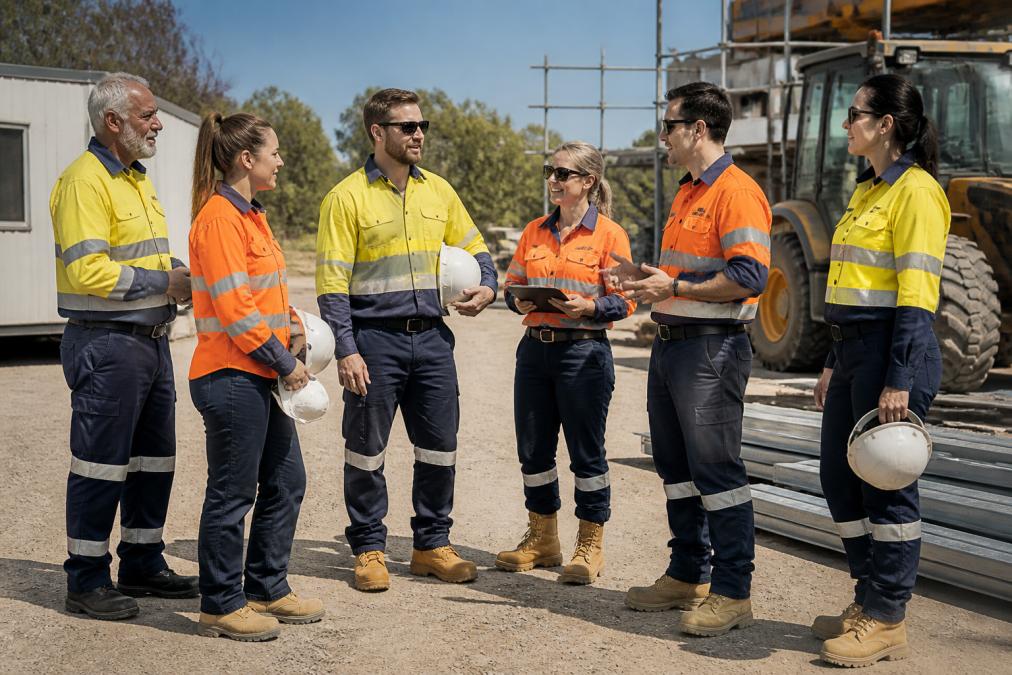
Survey your actual workforce to understand what sizes and features your team members need. When evaluating suppliers, ask about size range and customisation options. Hi Vis Work Clothes offers customisation through printed or embroidered logos, allowing you to order gear that reflects your team's identity while meeting safety standards. This increases buy-in, workers are more likely to wear gear they feel represents their workplace.
Inclusive sizing also reduces waste. When you offer genuine size range, gear actually gets worn rather than discarded or replaced with non-compliant alternatives.
Step 6: Establish a Workwear Maintenance and Replacement Policy
Workwear doesn't stay protective indefinitely. Reflective tape fades with UV exposure and washing. Fabric tears, seams split, and zips fail. Your procurement guide must include a clear maintenance and replacement policy that keeps gear effective throughout its lifecycle.
Different fabrics require different washing temperatures and methods. Reflective tape can peel if washed in hot water or dried at high heat. Provide clear, written care instructions with every garment. Include care labels on the actual gear so workers see instructions every time they wash.
Establish replacement triggers based on actual wear patterns. For high-visibility garments, reflective tape effectiveness typically lasts 12-18 months of regular use. Fabric durability depends on the work, rough handling shortens life; light-duty work extends it. Document what you observe and schedule replacement on that cycle rather than waiting for failure.
Track replacements systematically. When a worker reports damaged gear, record what failed and why. This data informs future procurement decisions. If zips consistently fail, prioritise suppliers with heavy-duty zips. If reflective tape peels, you need higher-quality tape or better washing practices.
Budget for replacement as an ongoing cost, not a one-time purchase. Most organisations find that annual replacement of 20-30% of their workwear inventory maintains compliance and worker satisfaction.
Step 7: Manage Your Procurement Lifecycle and Vendor Accountability
Effective procurement is a relationship, not a transaction. Your vendor selection, contract terms, and ongoing management directly affect whether you receive compliant gear on time at fair prices with reliable support.
Start vendor evaluation with documented criteria. Beyond price, assess: compliance documentation (do they provide test certificates?), lead times (can they deliver when needed?), quality consistency (do they maintain standards across batches?), customisation capability (can they add your logo?), and customer support (do they respond to issues?).
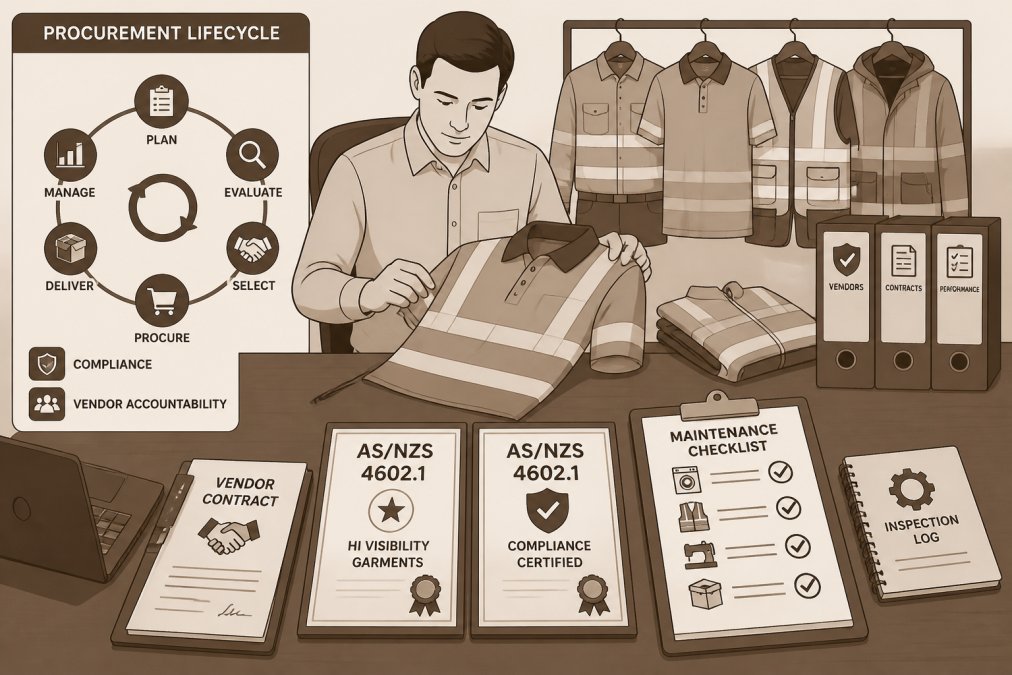
Request references from other organisations using the same supplier. Ask specifically about quality consistency, delivery reliability, and complaint handling.
Establish clear contract terms specifying:
- Exact product specifications (fabric composition, reflective tape width, colour, size range)
- Compliance requirements (which standards must be met; what documentation you require)
- Lead times and quality standards (acceptable defect rates; what happens if gear doesn't meet spec)
- Pricing and volume discounts
- Customisation terms (logo printing or embroidery; turnaround time)
- Warranty and returns (what happens if gear fails prematurely)
For custom printing or embroidery, request samples before committing to large orders. Verify durability, does embroidery survive washing without fraying or peeling? Hi Vis Work Clothes offers custom printing and embroidery services; confirm their turnaround time and durability guarantees before ordering large quantities.
Manage the vendor relationship actively. When gear arrives, inspect it against your specifications. Check that sizes are correct, colours match your order, and compliance documentation is included. Report issues immediately.
Schedule regular reviews with your vendor to discuss quality, delivery, pricing, and emerging needs. A good vendor becomes a partner in your safety strategy.
Conclusion
Building a procurement guide for safety workwear is a practical investment in your team's safety and your business's compliance. By following these seven steps, understanding your WHS obligations, conducting hazard assessment, selecting compliant PPE, building a procurement checklist, implementing inclusive sizing, establishing maintenance policies, and managing vendors actively, you create a consistent system.
The best workwear procurement strategy is one your team actually uses. When processes are clear, gear fits properly, and quality is reliable, workers wear their PPE without complaint. This is where safety becomes real.
At Hi Vis Work Clothes, we understand that procurement is about building a safety culture. Our range of high-visibility workwear, from breathable long-sleeve shirts to waterproof all-weather jackets, is designed to meet Australian compliance standards whilst delivering the durability and comfort your team needs. Whether you're outfitting a large construction crew or a small trade business, we offer customisation options with printed or embroidered logos to ensure your team looks professional whilst staying protected. Get a quote today and let us help you implement a procurement strategy that works.

Frequently Asked Questions
What Australian standards apply to safety workwear procurement?
AS/NZS 4602.1 is the primary standard governing high-visibility safety garments in Australia. This standard specifies minimum reflective tape width, placement, visibility class requirements, and material durability. Your procurement guide for safety workwear must reference this standard to ensure all ordered items meet legally required visibility and performance thresholds. Check that vendors provide certification confirming compliance with AS/NZS 4602.1 before purchase.
How often should safety workwear be replaced?
Replacement frequency depends on use intensity and environmental conditions. High-visibility garments exposed to regular washing, UV exposure, or abrasion typically require replacement every 12-24 months. Establish a workwear maintenance and replacement policy that specifies inspection intervals and triggers for retirement. Document condition checks quarterly and retire items when reflective tape fades, seams fail, or visibility degrades below AS/NZS 4602.1 standards.
What is the difference between PPE and standard workwear?
Personal protective equipment (PPE) is certified to protect against specific hazards and must meet regulatory standards like AS/NZS 4602.1. Standard workwear provides comfort and branding but offers no certified hazard protection. High-visibility jackets, pants and vests are classified as PPE when they meet certification requirements. Your procurement guide should distinguish between these categories: order certified PPE for hazard-prone roles and standard workwear for low-risk administrative tasks.
How do I ensure my workwear procurement meets WHS requirements?
Follow a systematic WHS procurement checklist covering hazard identification, risk assessment, standard compliance, vendor vetting, and quality assurance. Document your procurement policy, require vendors to provide AS/NZS 4602.1 certification, conduct material testing where applicable, and maintain an inventory audit trail. Schedule compliance reviews annually and after any significant workplace incident. Assign a single person responsibility for procurement governance to ensure consistent application.
How do I choose inclusive PPE for a diverse workforce?
Inclusive PPE procurement requires sizing across extended ranges, ergonomic design for different body shapes, and accessibility considerations. Consult your team on fit and comfort before bulk ordering. Request samples in multiple sizes and conduct fit trials. Work with vendors offering inclusive sizing (XS to 5XL, tall and petite options) and consider gender-neutral cuts. Document feedback and adjust future orders based on wear patterns and staff complaints about chafing or mobility restrictions.
What should I look for when vetting safety workwear vendors?
Evaluate vendors on AS/NZS 4602.1 certification provision, turnaround times for bulk orders, customisation (logo printing/embroidery) durability guarantees, and material testing documentation. Request references from comparable organisations and confirm they can handle your order volume. Ask about inventory holding capacity, sizing distribution support, and warranty terms. Verify their quality assurance processes and request samples before committing to large orders.
How do I balance cost with quality in workwear procurement?
Higher-quality workwear reduces replacement frequency, staff complaints about comfort, and potential heat stress incidents. Calculate total cost of ownership over 2-3 years, not just unit price. Premium gear with better breathability and durability often justifies higher upfront cost through lower turnover and fewer safety-related absences. Request cost-benefit comparisons from vendors and track staff feedback on comfort and durability to demonstrate ROI to management.
This article was written using GrandRanker
Recent Blogs
August 05, 2026
Procurement Guide for Safety Workwear: 7 Steps
Procurement guide for safety workwear: 7 steps to select compliant,...
August 05, 2026
Procurement Guide for Safety Workwear: 7 Steps
Procurement guide for safety workwear: 7 steps to select compliant,...
August 05, 2026
Procurement Guide for Safety Workwear: 7 Steps
Procurement guide for safety workwear: 7 steps to select compliant,...