
Workwear Ink vs RSEA Safety: 2026 Comparison


Table of Contents
- Workwear Ink vs RSEA Safety: What Buyers Need to Know
- How to Choose a Workwear Supplier: Evaluation Criteria
- Uniform Onboarding Process for Trade Teams
- Custom Logo Embroidery for Trade Uniforms
- AS/NZS Compliant High-Visibility Clothing
- Pricing, Bulk Ordering and Procurement Solutions
- Conclusion: Making the Right Workwear Comparison
- Frequently Asked Questions
Last Updated: September 28, 2026
Workwear Ink vs RSEA Safety: What Buyers Need to Know
A workwear comparison for trade teams usually starts with two names. Workwear Ink and RSEA Safety both appear in most procurement shortlists, and both sell into the same market: branded trade uniforms, safety gear and bulk orders for crews working outdoors.
Here's the part most buyers miss. The real decision isn't which supplier has the bigger catalogue. It's which one can get compliant, branded gear onto your crew without chewing up your admin time.
This guide from Hi Vis Work Clothes breaks down what actually matters when you compare workwear suppliers: evaluation criteria, onboarding, embroidery quality, AS/NZS compliance and bulk pricing. Below, we'll show you exactly how to run that comparison so the decision holds up six months later.
The two businesses sit at different ends of the market. Workwear Ink is primarily an online custom workwear and embroidery operation. RSEA Safety runs a large retail and trade network with stores across the country. Neither approach is wrong. They just suit different buyers.
How to Choose a Workwear Supplier: Evaluation Criteria
Start with five criteria, because most buyers default to price alone and regret it later.
- Compliance: Can they show AS/NZS certification for high-visibility garments and footwear?
- Branding quality: How does the logo hold up after repeated industrial washing?
- Sizing spread: Can they cover a crew with mixed fits without you coordinating every item?
- Turnaround: What's the real lead time on a branded bulk order?
- Aftercare: How easy is it to reorder a single replacement shirt in month eight?
Run every supplier through the same five questions. The answers separate a genuine trade supplier from a catalogue that happens to sell safety gear.
A common mistake is scoring suppliers on range size. Range doesn't matter if the one shirt your crew actually wears is out of stock in three sizes.
Uniform Onboarding Process for Trade Teams
A uniform onboarding process for trade teams is the sequence that takes a new crew from "no branded gear" to "fully kitted and compliant." Get it right once and every future hire slots into the same system.

Here's a workable sequence:
- Collect sizes across the whole crew, including short, regular and long leg lengths.
- Confirm the compliance standard each role requires.
- Approve logo artwork and digitisation before production starts.
- Place the bulk order with a sizing breakdown per site.
- Distribute by crew or location, not by individual.
- Set a reorder trigger for replacements and new hires.
Step five is where most operations managers lose hours. If you order in bulk and let the supplier pack by site rather than by name, distribution becomes a one-hour job instead of a week.
For teams spread across multiple states, build the size matrix first.
Custom Logo Embroidery for Trade Uniforms
Custom logo embroidery for trade uniforms lives or dies on two things: digitisation quality and stitch density. A cheap digitised file produces a logo that cracks, puckers or peels within a few washes.
- Embroidery works best for chest logos, names and small text on woven fabrics.
- Printing suits large graphics, fine detail and synthetic performance fabrics.
AS/NZS Compliant High-Visibility Clothing
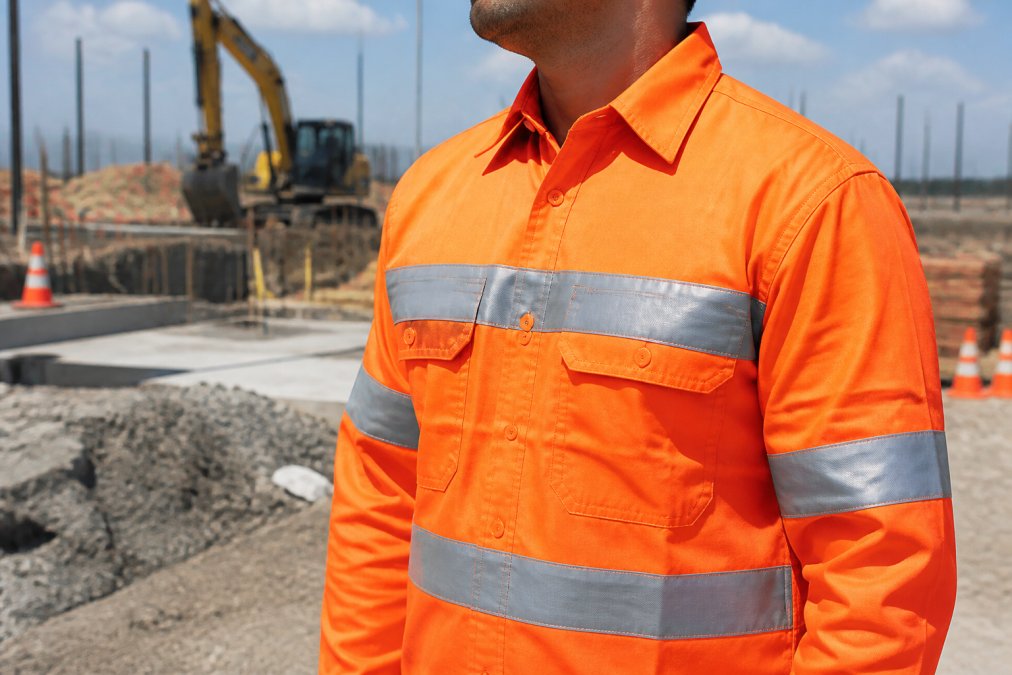
AS/NZS compliant high-visibility clothing is garments tested and certified against the Australian and New Zealand standards for high-visibility safety materials. For most trade work, that means the AS/NZS 4602.1 standard for high-visibility garments and AS/NZS 1906.4 for the retroreflective materials used on them.
Work Shirt HiVis Long Sleeve Reflective →
The Three Garment Classes Buyers Confuse
AS/NZS 4602.1 separates high-visibility garments into classes based on when they can be worn:
- Day (D): fluorescent fabric only. Suitable for daylight work where there is no risk of poor visibility from artificial light or dusk.
- Night (N): retroreflective tape only. Used where the wearer is seen primarily by reflected light from vehicle headlights or task lighting.
- Day/Night (D/N): fluorescent fabric plus retroreflective tape. The default for most trade and construction work because it covers both daylight and low-light conditions.
Tape Class, Width and Placement
Two details decide whether a garment actually complies:
- Tape class: Day/night garments need retroreflective tape, not just fluorescent fabric. The tape itself is tested under AS/NZS 1906.4.
- Tape width and placement: The standard specifies minimum widths and configuration. A common configuration is 50mm tape, but the required width and pattern depend on the garment type and the class claimed.
When you compare suppliers, ask for the certification reference on the specific garment, not the brand. Certification applies per garment, and a compliant jacket does not make the matching shirt compliant. A supplier that cannot produce the test reference for the exact style and colour you are ordering is asking you to take compliance on trust.
How to Verify Compliance Before a Bulk Run
- Ask for the test report or certificate number for the specific style code.
- Check the garment label for the AS/NZS 4602.1 class (D, N or D/N) and the AS/NZS 1906.4 tape reference.
- Confirm the tape width and placement match the class claimed.
- Wash a sample five times and inspect the tape edges for lifting or delamination.
- Confirm the certification still applies after your logo is embroidered, because embroidery can affect the garment if it penetrates the tape or the reflective area.
That last point is the one most buyers miss. Embroidery placed over or through retroreflective tape can compromise the rating of the garment. A supplier who understands this will position your logo away from the tape and confirm the placement before production.
Pricing, Bulk Ordering and Procurement Solutions
Bulk ordering and procurement solutions come down to transparency. Ask for a per-unit price at your order volume, the digitisation cost, and the freight cost, all in writing. Some suppliers bury the real cost in setup fees or minimum order quantities. Others quote a headline unit price and add branding charges later. Get the full landed cost before you compare.
| Buying Route | Best For | Branding Method | Typical Lead Time | Sizing Control | Reorder Friction |
|---|---|---|---|---|---|
| Online custom workwear | Small to mid crews, fast turnaround | Embroidery or print | Short, order-by-order | You manage the matrix | Low if digitised file is held |
| Large retail network | Single-item top-ups, urgent replacements | Limited in-store branding | Immediate for stock items | In-store fitting | Low for stock, high for branded |
| Direct bulk supplier | Whole-crew rollouts, multi-site teams | Embroidery with digitisation | Longer, planned in advance | Supplier packs by site | Low once size matrix is set |
Bulk-Buy Cost-Benefit for a 12-Person Crew
For a 12-person plumbing outfit, the maths is straightforward. A branded bulk order through a direct supplier costs more per unit than off-the-shelf gear, but it removes the sizing chaos and gives you one reorder point. The comparison is not unit price against unit price. It is unit price against the admin hours you stop spending.
- Unit cost: the garment price at your volume, including any volume break.
- Branding cost: digitisation (one-off) plus per-unit embroidery or print.
- Admin cost: the internal hours spent chasing sizes, replacements and reorders across the year.
What to Ask Before You Commit
- What is the per-unit price at 12, 50 and 100 units?
- Is digitisation a one-off or charged per order?
- Who holds the digitised file, and can you take it if you leave?
- What is the freight cost to each site, not just to head office?
- What is the lead time on a reorder of a single size?
Get those five answers in writing. They turn a vague quote into a comparable landed cost.
Conclusion: Making the Right Workwear Comparison
The Workwear Ink vs RSEA Safety decision isn't really about the two names. It's about matching a supplier's model to how your team buys, sizes and replaces gear.
Frequently Asked Questions
What factors should businesses consider when choosing a workwear supplier?
Focus on AS/NZS compliance, fabric durability, custom branding capability, and supply chain reliability. Check that reflective tape meets industrial standards and that the supplier can handle bulk ordering with consistent sizing. Also assess the uniform onboarding process for trade teams, including turnaround times and sizing distribution across multiple locations. A supplier who understands workplace compliance requirements will reduce reordering headaches and keep your crew protected.
Does custom logo embroidery hold up after repeated washing?
Quality embroidery outlasts printed logos because the thread is stitched into the garment rather than sitting on the surface. Look for suppliers who use digitisation files tailored to your logo and test stitch density on sample garments. Ask about turnaround times for bulk orders and request a wash-test guarantee. Properly digitised embroidery on durable fabrics like cotton-polyester blends typically maintains appearance through dozens of industrial wash cycles.
What is the importance of AS/NZS standards in workwear procurement?
AS/NZS standards set the minimum requirements for high-visibility clothing, including reflective tape width, colourfastness, and garment design. Non-compliant gear puts workers at risk and may breach workplace health and safety obligations. When comparing suppliers, verify that garments carry current certification and that reflective tape is rated for the intended environment. Compliance is not optional for construction, logistics, or utility teams.
How can I streamline the uniform onboarding process for new trade staff?
Build a standardised sizing kit for each trade role, keep a buffer stock of common sizes, and set up a branded portal or order form for team leads. Work with a supplier who offers bulk ordering with individual size distribution and clear turnaround times. Confirm embroidery or printing requirements upfront so new hires receive branded gear on day one rather than plain substitutes.
Recent Blogs
September 29, 2026
Workwear Ink vs RSEA Safety: 2026 Comparison
Workwear comparison for Australian trade teams: explore uniform onboarding, custom...
September 29, 2026
Workwear Ink vs RSEA Safety: 2026 Comparison
Workwear comparison for Australian trade teams: explore uniform onboarding, custom...
September 29, 2026
Workwear Ink vs RSEA Safety: 2026 Comparison
Workwear comparison for Australian trade teams: explore uniform onboarding, custom...