
Australian Standards for High Visibility Clothing: A Complete Guide


Table of Contents
- Understanding Australian Standards for High Visibility Clothing
- AS/NZS 1906.4 High Visibility Materials: Fabric and Performance Standards
- Class D vs Class N Hi-Vis: Coverage and Application Differences
- High Visibility Clothing Compliance Requirements for Australian Workplaces
- Daytime vs Nighttime Visibility: Photometric Performance and Chromaticity
- Maintenance and Care to Preserve Compliance
- Industry-Specific Risk Assessments and Garment Selection
- Identifying Compliant vs Counterfeit High-Visibility Gear
Last Updated: August 3, 2026
Understanding Australian Standards for High Visibility Clothing
Australian standards for high visibility clothing keep workers safe in hazardous environments where visibility can mean the difference between going home and a serious accident.
The core standard governing high-visibility apparel in Australia is AS/NZS 4602.1:2011, which sets photometric performance requirements for fluorescent fabrics and retroreflective materials. A garment might meet the standard on paper and still fail in real working conditions if it's poorly maintained, incorrectly specified for the hazard, or counterfeit.
What AS/NZS 4602.1:2011 Requires
AS/NZS 4602.1:2011 defines performance criteria for high-visibility materials used in safety garments, specifying minimum luminance values, chromaticity coordinates, and colour fastness requirements. The standard applies to all high-visibility garments sold in Australia and New Zealand.
Compliance is not optional for workplace safety. Australian workplace health and safety legislation requires employers to provide appropriate PPE, and high-visibility garments must meet the standard if specified as part of a worker's protective equipment.
Why Standards Matter in Your Workplace
A worker wearing non-compliant or poorly maintained high-visibility clothing faces genuine risk. In construction and infrastructure environments, visibility directly affects whether approaching vehicles or machinery operators can detect and avoid the worker. Standards create a level playing field for procurement.
When you specify AS/NZS 4602.1:2011 compliance, you're selecting from a defined pool of tested materials and garments rather than gambling on product effectiveness.
AS/NZS 1906.4 High Visibility Materials: Fabric and Performance Standards
AS/NZS 1906.4 addresses the material properties of high-visibility textiles themselves, defining how fluorescent base fabrics and retroreflective materials must perform under laboratory conditions.
Fluorescent Base Fabric Requirements
Fluorescent fabrics use pigments that absorb ultraviolet light and re-emit visible light, making them appear brighter than conventionally dyed textiles even in daylight. AS/NZS 1906.4 specifies minimum luminance values for fluorescent materials in orange-red, yellow, and yellow-green colour ranges.
The standard measures luminance coefficient, which quantifies how much light the fabric reflects back toward the observer. Higher luminance means better visibility.
Colour fastness is equally important, fluorescent pigments degrade under UV exposure and washing. The standard requires fabrics to retain a minimum percentage of their original luminance after simulated sunlight exposure and repeated washing cycles.
Fabric composition affects durability. Many high-visibility garments blend polyester with cotton to balance comfort, durability, and cost.

Retroreflective Tape Specifications
Retroreflective tape provides nighttime conspicuity by bouncing light directly back toward the source. When vehicle headlights hit retroreflective material, the material creates a bright reflection visible from distance.
AS/NZS 1906.4 specifies minimum luminance coefficient values for retroreflective materials, measured at angles simulating real-world viewing conditions.
Retroreflective tape comes in different grades. Standard grade tape meets basic compliance requirements. Higher-grade materials provide superior nighttime visibility but cost more. The choice depends on hazard level and environment.
Class D vs Class N Hi-Vis: Coverage and Application Differences
High-visibility garments are classified into two main categories based on unbroken surface area of fluorescent fabric and retroreflective tape. Class D garments prioritise daytime visibility with larger fluorescent coverage but minimal retroreflective tape. Class N garments balance daytime and nighttime visibility with both materials.
Class D: Daytime and Low-Speed Environments
Class D garments provide enhanced daytime visibility through larger areas of fluorescent fabric but include minimal retroreflective tape, typically only on the shoulders or upper torso. These garments suit workers in daytime-only environments or low-speed traffic scenarios where nighttime visibility is not a primary concern.
The Class D specification requires minimum unbroken surface area of fluorescent fabric. Class D garments work well for construction sites with controlled traffic patterns, daytime-only operations, or environments where vehicles move at low speeds.

Class N: Nighttime and High-Risk Applications
Class N garments incorporate both significant fluorescent fabric coverage and substantial retroreflective tape, providing visibility in both daytime and nighttime conditions. These garments are required for workers in high-risk environments, particularly those involving nighttime work, high-speed traffic, or complex hazards where visibility failure could result in serious injury.
Class N garments are essential for airport ground crews, utility workers performing nighttime maintenance, logistics workers in warehouses with vehicle traffic, and any role involving proximity to moving vehicles or machinery after dark.
High Visibility Clothing Compliance Requirements for Australian Workplaces
Compliance with Australian standards for high visibility clothing requires conducting risk assessments, specifying appropriate garments for identified hazards, ensuring workers understand how to use and maintain their gear, and verifying that purchased products actually meet the standards they claim to meet.
Unbroken Surface Area and Coverage Specifications
The term "unbroken surface area" refers to continuous sections of fluorescent fabric or retroreflective tape on a garment. A small patch of high-visibility material surrounded by non-compliant fabric doesn't count as the same unbroken area. AS/NZS 4602.1:2011 specifies minimum unbroken surface areas for different garment types and classes.
A Class D safety vest must have a minimum of 0.4 square metres of fluorescent fabric in unbroken sections on the front and back. Continuous unbroken coverage ensures consistent visibility from multiple viewing angles.
Upper Torso and Limb Visibility Requirements
The upper torso receives priority in high-visibility garment standards because it's the most visible part of the body from a distance and from vehicle operator eye level. AS/NZS 4602.1:2011 requires specific coverage of the shoulders and upper back, ensuring workers are visible from front, back, and side angles.
Limb visibility requirements vary by garment type. Full-body suits include retroreflective bands around arms and legs. Vests and shirts typically focus on torso coverage.
Daytime vs Nighttime Visibility: Photometric Performance and Chromaticity
High-visibility garments must perform across dramatically different lighting conditions. Daytime visibility relies on fluorescent fabric that appears bright in daylight. Nighttime visibility depends on retroreflective tape that reflects artificial light sources back toward approaching hazards.
Photometric performance is measured in laboratory conditions simulating both daytime and nighttime viewing scenarios. For daytime visibility, the standard measures luminance, the amount of light the material re-emits when illuminated by natural or artificial light. For nighttime visibility, the standard measures luminance coefficient under simulated vehicle headlight conditions.
Chromaticity defines the colour characteristics of visible light. AS/NZS 4602.1:2011 specifies acceptable chromaticity ranges for fluorescent materials, ensuring colours remain consistent across different manufacturers and batches.
Colour fastness testing verifies that materials maintain their photometric performance after exposure to UV light and washing. The standard requires materials to retain at least 70% of their original luminance after simulated sunlight exposure and repeated washing cycles.
Maintenance and Care to Preserve Compliance
A compliant high-visibility garment only remains compliant if properly maintained. Washing, UV exposure, and general wear all degrade fluorescent fabric and retroreflective tape.
Colour Fastness and Fabric Durability
Fluorescent fabrics lose brightness under UV exposure. A garment stored outdoors or left in direct sunlight will fade faster than one kept indoors. Washing also affects colour fastness. Hot water, harsh detergents, and bleach accelerate fading. Many high-visibility garments should be washed in cool water with mild detergent. Air drying in shade is gentler than machine drying and extends the garment's lifespan.
Retroreflective Tape Fade and Replacement Cycles
Retroreflective tape degrades through UV exposure, contamination, and mechanical damage. In high-UV environments, tape might need replacement every 12-18 months. In low-UV environments or indoors, tape might remain compliant for 24-36 months. The only reliable way to determine when replacement is needed is to visually inspect tape for visible degradation.
Contamination significantly affects retroreflective performance. Dust, mud, or other debris on tape surfaces reduces reflectivity. In some cases, cleaning the tape restores much of its reflectivity. Mechanical damage, peeling, cracking, or separation from the garment, requires immediate replacement.
Industry-Specific Risk Assessments and Garment Selection
Different industries and work environments present different visibility hazards. Effective garment selection requires understanding the specific risks workers face and specifying garments that address those risks.
Construction and Infrastructure Hazards
Construction sites involve heavy machinery, vehicle traffic, and complex work patterns. Hazards include approaching excavators, dump trucks, concrete mixers, and crane operations. A worker directing traffic at a construction site entrance needs maximum daytime visibility because approaching drivers must recognise them from a distance.
Class D or Class N garments, depending on whether work extends into low-light conditions, are appropriate. Quality construction with reinforced seams and durable fabric withstands construction site conditions.
Logistics, Warehousing, and Ground Operations
Warehouses and logistics facilities involve forklifts, pallet jacks, automated systems, and vehicle traffic. Class N garments are typically required because warehouses often have mixed lighting, some areas with natural light, others artificially lit or poorly lit.
Airport ground crews face unique hazards with aircraft movement, ground support vehicles, and equipment operation all requiring high visibility. Garments need regular cleaning and inspection, with workers having access to replacement garments if tape becomes contaminated or damaged.
Identifying Compliant vs Counterfeit High-Visibility Gear
The market for high-visibility garments includes counterfeit and non-compliant products. These products might look similar to compliant garments but fail to meet performance standards.
Certification Labels and Documentation
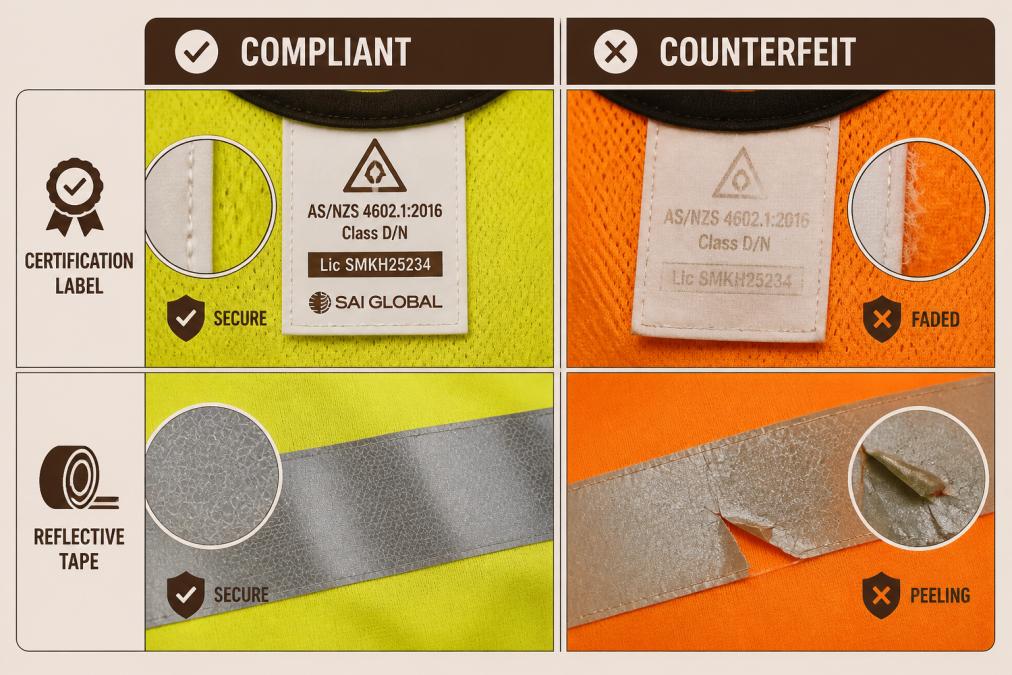
Compliant high-visibility garments carry certification labels indicating they meet AS/NZS 4602.1:2011. These labels should include the manufacturer's name, the standard reference, the garment class (D or N), and often a batch or lot number for traceability.
The label should be permanently attached to the garment and include clear, readable text. Manufacturers of compliant garments maintain documentation proving their products have been tested and approved. This documentation should be available to customers upon request.
Red Flags for Non-Compliant Products
Poor stitching and construction quality suggests non-compliance. Fluorescent fabric should be tightly woven. Seams should be even and secure. Loose threads, uneven stitching, or poorly finished edges indicate low-quality manufacturing. Retroreflective tape that peels, cracks, or separates easily is a major red flag. Genuine compliant tape is permanently adhered and remains secure through multiple wash cycles.
Fading or colour inconsistency in fluorescent fabric indicates low-quality materials. Labels that are missing, illegible, or easily removed are red flags. Supplier reputation and purchasing history matter. Established suppliers with track records of compliance are less likely to sell counterfeit products than unknown or new suppliers.
Frequently Asked Questions
What is the current Australian standard for high visibility clothing?
AS/NZS 4602.1:2011 is the primary Australian and New Zealand standard governing high-visibility clothing. It specifies requirements for fluorescent fabric coverage, retroreflective tape placement, unbroken surface area, and photometric performance.
The standard defines two main classifications: Class D for daytime visibility and Class N for nighttime and high-risk applications. Compliance with this standard is mandatory in Australian workplaces where visibility is a hazard control measure.
What is the difference between AS/NZS 1906.4 high visibility materials and AS/NZS 4602.1?
AS/NZS 1906.4 specifies the performance requirements for the materials themselves, fluorescent fabrics and retroreflective tape. It defines photometric performance, chromaticity, luminance, and colour fastness standards.
AS/NZS 4602.1, by contrast, applies these materials to complete garments and specifies how much fabric coverage, tape placement, and unbroken surface area is needed for different hazard levels. Think of 1906.4 as the material specification and 4602.1 as the garment design specification.
What are the requirements for Class D and Class N hi-vis clothing?
Class D hi-vis is designed for daytime visibility in lower-speed environments and requires a minimum fluorescent fabric coverage of 0.4 m² with retroreflective tape. Class N is for nighttime and high-risk applications, requiring 0.2 m² of fluorescent fabric but with significantly more retroreflective tape to ensure visibility under vehicle headlights and in low-light conditions.
Class N is mandatory for roadside work, airport operations, and night-shift roles. Class D may be sufficient for daytime-only construction or warehouse roles.
Do hi-vis vests need to be certified to meet Australian standards?
Yes, high-visibility clothing sold in Australia must comply with AS/NZS 4602.1 and be certified by an accredited testing body. Look for certification labels on garments indicating compliance.
Non-certified or counterfeit gear may not meet photometric performance, chromaticity, or durability requirements and will not provide adequate worker protection. Always verify certification documentation before purchasing bulk orders for your team.
How often should high visibility clothing be replaced for compliance?
Replacement frequency depends on use, washing, and environmental exposure. Retroreflective tape can fade and lose luminance after repeated washing, exposure to UV light, and weathering.
Most workplaces should inspect hi-vis garments monthly and replace them when tape shows visible peeling, fading, or when photometric performance drops below standard. Colour fastness of the fluorescent base fabric should also be checked; faded or discoloured garments may no longer meet chromaticity requirements and should be retired.
What colour options are compliant under Australian high visibility standards?
AS/NZS 4602.1 permits fluorescent yellow, fluorescent orange-yellow, and fluorescent orange as compliant base colours. Fluorescent yellow is the most common and offers excellent daytime visibility. Fluorescent orange is often chosen for higher-contrast environments.
All colours must meet specific chromaticity and luminance values defined in AS/NZS 1906.4. Retroreflective tape is typically white or silver and must meet luminance and colour fastness standards regardless of base fabric colour.
What should I look for to identify counterfeit or non-compliant hi-vis gear?
Genuine compliant garments display clear certification labels indicating AS/NZS 4602.1 compliance and the testing body's accreditation. Check for uneven or peeling retroreflective tape, poor stitching quality, faded or washed-out fluorescent colour, and missing or vague labelling.
Non-compliant gear often has inadequate tape coverage, thin or low-quality materials, and no verifiable certification. Request certification documentation from suppliers before purchasing bulk orders; legitimate manufacturers provide test reports and material specifications.
This article was written using GrandRanker
Recent Blogs
August 03, 2026
Australian Standards for High Visibility Clothing: A Complete Guide
Learn Australian standards for high visibility clothing, including AS/NZS 4602.1,...
August 03, 2026
Australian Standards for High Visibility Clothing: A Complete Guide
Learn Australian standards for high visibility clothing, including AS/NZS 4602.1,...
August 03, 2026
Australian Standards for High Visibility Clothing: A Complete Guide
Learn Australian standards for high visibility clothing, including AS/NZS 4602.1,...