
How to Implement a Workwear Budget Plan for Large Teams


Table of Contents
- Step 1: Set Budget Goals and Forecast Projected Costs
- Step 2: Build Your Workwear Budget Sheet and Cost Centres
- Step 3: Standardise Your Uniform Onboarding Process for Trade Teams
- Step 4: Set a Workwear Replacement Cycle Policy That Controls Costs
- Step 5: Unlock Bulk Workwear Ordering Benefits Through Procurement
- Step 6: Track Expenditure, KPIs and Your Audit Trail
- Step 7: Review Your Workwear Budget Plan Each Fiscal Year
- Frequently Asked Questions
Last Updated: September 13, 2026
Step 1: Set Budget Goals and Forecast Projected Costs
A workwear budget plan is a documented forecast and control system that links headcount, compliance requirements and replacement timing to a fixed annual spend. Procurement teams can waste money when they treat workwear as ad hoc purchasing rather than a planned cost centre.
Start with headcount, not last year's invoice. A common mistake is basing next year's budget on the previous year's total, which locks in overspend from emergency orders.
Build your forecast from four inputs:
- Current headcount by site, trade and state
- Expected new hires and departures across the fiscal year
- Compliance requirements for each role
- Standard issue quantity per worker
Then apply a realistic attrition rate. If you issue two shirts and one pair of pants per starter, 40 new hires means 80 shirts and 40 pants before you account for replacements (business.gov.au).
Step 2: Build Your Workwear Budget Sheet and Cost Centres
The most effective budget sheet separates fixed costs from variable costs, then assigns each line to a cost centre. This is what makes variance analysis possible later, and it is where most workwear budgets fail, because they treat every garment as a one-off purchase rather than a depreciating asset with a known service life.
Set up your sheet with these columns: item, unit cost, quantity, cost centre, projected cost, actual cost, variance, and, the column most teams omit, remaining service life. That last column turns your budget from a purchase log into a lifecycle model.
Group rows by site or division so a project manager can see their own spend without wading through the whole company. Then split each group into three cost pools:
- Initial issue, the standard kit a new starter receives on day one
- Cyclical replacement, items replaced on schedule as they reach end of life
- Exception replacement, early replacements triggered by damage, loss or compliance failure
Those three pools behave completely differently. Initial issue scales with headcount. Cyclical replacement scales with the size of the existing wardrobe divided by its service life. Exception replacement is the volatile one, and it is the pool that tells you whether your specifications are actually fit for purpose.
| Cost Centre | Item | Projected | Actual | Variance | Remaining Service Life |
|---|---|---|---|---|---|
| Site A - Civil | Hi-vis shirt and pants sets | 120 units | 118 units | -2 units | 8 months |
| Site B - Electrical | Replacement shirts | 60 units | 74 units | +14 units | 3 months |
| Warehouse | All-weather jackets | 30 units | 30 units | 0 units | 14 months |
That variance column is the whole point. A positive variance on replacements usually signals a quality problem, not a demand problem. A positive variance on initial issue usually signals a headcount forecast that missed.
For branded garments, custom printing or embroidery lets you consolidate orders around the cycle rather than buying in dribs and drabs. Reflective tape options across the range also mean you can standardise compliance without holding multiple stock lines.
If you run payroll or HR software, check whether it can hold a workwear allowance field against each employee record. Even a simple export of headcount by site and role, refreshed monthly, will keep your initial-issue pool accurate without manual rekeying.
Step 3: Standardise Your Uniform Onboarding Process for Trade Teams
A uniform onboarding process for trade teams is the sequence that takes a new starter from signed contract to correctly fitted, compliant gear on their first day. Standardising it removes the two biggest hidden costs: emergency single-item orders and wrong-size reissues.
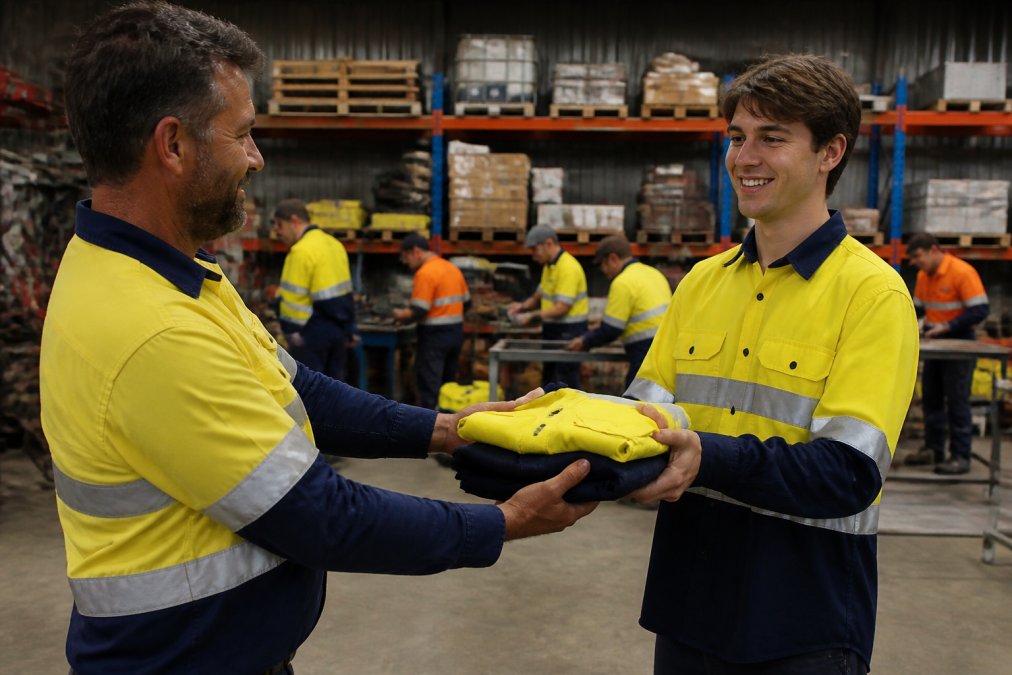
The process should run in six steps:
- Confirm role and required compliance level
- Collect sizes during induction, not after
- Raise one consolidated order per intake group
- Record issue date against the worker's profile
- Confirm fit within the first week
- Log the item in your asset register
The thing nobody tells you about onboarding is that size collection is the bottleneck. Chasing 15 people individually for sizes takes longer than the order itself. Collect sizes in a single induction session and you cut the lead time substantially.
Step 4: Set a Workwear Replacement Cycle Policy That Controls Costs
A workwear replacement cycle policy defines how long each item is expected to last and the conditions under which it gets replaced early. Without one, replacement becomes a judgement call made by whoever is on site that day.
Set the cycle by garment type and role, then document the early-replacement triggers. Common triggers include failed reflective tape, torn seams, permanent staining and lost items. Each trigger needs an approval path, or you will replace gear that should have been repaired.
For branded garments, custom printing or embroidery from Hi Vis Work Clothes lets you consolidate orders around the cycle rather than buying in dribs and drabs. Reflective tape options across the range also mean you can standardise compliance without holding multiple stock lines.
Step 5: Unlock Bulk Workwear Ordering Benefits Through Procurement
Bulk workwear ordering benefits come from three places: lower unit pricing, fewer freight charges and reduced administrative time per item. The gains compound when you align orders with your replacement cycle and onboarding intakes.
Consolidate orders around two or three fixed dates per year. Each order should combine onboarding needs, cyclical replacements and any project-specific requirements into one purchase order. This gives you a single invoice, a single delivery and a single point of reconciliation.
A procurement strategy for workwear should also address sizing distribution. If your crews are spread across multiple sites, ask suppliers to pack by site or by worker name. That one request removes hours of sorting and reduces the chance of gear sitting in a storeroom instead of on a worker.
Step 6: Track Expenditure, KPIs and Your Audit Trail
Expenditure tracking turns your budget sheet from a forecast into a control system. The KPIs worth watching are cost per worker, replacement rate per garment type, and percentage of orders placed outside the planned cycle, but the value comes from how you report them, not from the numbers themselves.
Build a one-page monthly dashboard with four lines:
- Cost per worker, total workwear spend divided by active headcount, split by site
- Replacement rate, units replaced per 100 workers per garment type, against the rate your cycle policy assumes
- Off-cycle order percentage, orders placed outside the two or three planned dates, as a share of total orders
- Compliance issue coverage, percentage of active workers with a current, recorded issue of every required item
That last metric is the one most teams forget, and it is the one a safety regulator will ask about (worksafe.qld.gov.au). If a worker is on site in non-compliant or unrecorded gear, your budget is not the only thing at risk.
Connect the audit trail to HR and payroll
This is where workwear budgeting diverges from generic project budgeting, and where most guides stop short. Your issue records should live against the same worker identifier your HR or payroll system uses, an employee number, not a name. That single decision unlocks three things:
- New starters trigger an initial-issue line automatically when their contract is processed
- Departing workers trigger a return-or-charge decision against their final pay
- Allowance models, individual or team-based, can be reconciled without a separate spreadsheet
A common pattern is a per-worker annual allowance held as a field in the HR system, with workwear issues drawn against it. Team-based allowances suit crews that share gear or rotate roles; individual allowances suit roles with fixed kit. Neither is right for every site, but both are far easier to administer once the identifier is shared.
Keep the audit trail defensible
Your audit trail matters for more than finance. Compliance records showing what was issued, when, and to whom are what you produce if a safety regulator asks questions after an incident. Keep issue dates, garment specifications, compliance markings and the worker identifier against each record, and keep them for as long as your obligations require, not just for the current fiscal year.
Review the numbers monthly, not annually. A quarterly review catches a runaway replacement rate while there is still budget left to correct it. A monthly dashboard catches it while there is still stock left to reallocate.
Step 7: Review Your Workwear Budget Plan Each Fiscal Year
Fiscal year planning should start with a variance review, not a fresh spreadsheet. Look at where actual spend diverged from projection and ask why before you set next year's figures.
Three questions drive the review:
- Which cost centres ran over, and was it volume or price?
- Which garment types were replaced ahead of cycle?
- Did any compliance requirements change?
Standardisation pays off here. If you have held the same garment specifications across sites, comparing performance between them is straightforward. If every site buys differently, you have no baseline to work from.
Two areas most budget plans ignore: lifecycle management of workwear as an asset, and integration with HR and payroll systems so new starters trigger an order automatically. Both reduce the manual coordination that quietly consumes procurement time.
Frequently Asked Questions
What are the key components of a corporate workwear budget plan?
A complete workwear budget plan covers five cost centres: initial uniform allocation for new starters, replacement garments, custom branding such as printing or embroidery, seasonal or weather-specific items, and PPE that must meet Australian standards. Add a contingency line of 5-10% for unplanned growth or damage. Track each of these separately so you can see where money actually goes, rather than lumping everything into one uniform line-item and losing visibility.
How do you calculate the annual cost of workwear per employee?
Divide total annual workwear spend by your average headcount. Include garments issued, replacement items, branding costs and any laundry or maintenance. For example, a combo work pants and shirt set at $79.00 issued twice a year gives a baseline of $158 per person before branding.
How can bulk workwear ordering benefits improve budget efficiency?
Ordering in bulk reduces per-unit pricing, cuts freight costs per garment, and locks in consistent sizing and colour across crews. It also minimises the administrative load of repeated small orders. Set a reorder trigger, such as when stock drops below two weeks of cover, so you buy at the right time rather than in a panic.
How often should a workwear budget plan be reviewed for large teams?
Review quarterly for expenditure tracking and variance analysis, then do a full rebuild at the start of each fiscal year. Quarterly checks catch overspending early, while the annual review lets you adjust for headcount changes, new compliance requirements under Australian standards, and updated supplier pricing. If your team grows faster than 10% in a year, add an interim review so your budget keeps pace with workforce requirements.
Managing workwear spend across a large team comes down to planning the cycle instead of reacting to it. Hi Vis Work Clothes supplies durable high-visibility apparel for construction, trade and field teams, with custom printing or embroidery for your logo, reflective tape options, and all-weather jacket choices. Get a quote from Hi Vis Work Clothes and build a workwear budget plan your finance team can actually reconcile.
Recent Blogs
September 13, 2026
How to Implement a Workwear Budget Plan for Large Teams
Learn how to implement a workwear budget plan for large...
September 13, 2026
How to Implement a Workwear Budget Plan for Large Teams
Learn how to implement a workwear budget plan for large...
September 13, 2026
How to Implement a Workwear Budget Plan for Large Teams
Learn how to implement a workwear budget plan for large...