
Durable Winter Workwear Alternatives for Road Crews


Table of Contents
- Why Standard Winter Workwear Falls Short on Road Crews
- Thermal Workwear for Outdoor Construction: Insulation That Retains Heat Without Bulk
- AS/NZS 4602.1:2011 High Visibility Standards: What Road Crews Must Verify
- Best Practices for Layering Workwear: Base, Mid and Outer Shell Systems
- Durable Winter Workwear Alternatives for Road Crews: Jackets, Jumpers and Pants
- Temperature-Specific Layering Guide for Road Crews
- Ergonomics, Repairability and the True Cost of Heavy Gear
- Conclusion
- Frequently Asked Questions
Last Updated: September 14, 2026
Why Standard Winter Workwear Falls Short on Road Crews
Road crews deal with a mix of hazards that general trade workwear was never built for: spray from passing vehicles, road salt and grit, long shifts in low light, and constant exposure to wind on open carriageways. Standard winter workwear tends to fail in predictable ways. A jacket that keeps a warehouse worker warm will soak through on a wet road shoulder, and a basic hi-vis vest offers almost nothing once temperatures drop and shifts run into darkness. This guide from Hi Vis Work Clothes breaks down what actually holds up on a road crew, covering thermal insulation, layering systems, compliance requirements, and durable winter workwear alternatives for road crews that survive more than one season.
The core problem is that most workwear is designed for one condition at a time: warmth, or visibility, or weather protection. Road crews need all three at once, in a garment that still lets someone bend, climb, and swing a shovel without restriction. That combination is rarer than it should be.
Thermal Workwear for Outdoor Construction: Insulation That Retains Heat Without Bulk
Thermal workwear for outdoor construction works best when insulation is quilted and distributed evenly rather than piled on thick. A quilted lining traps warm air close to the body without the bulk that restricts movement, which matters when a worker is repeatedly getting in and out of a truck or bending over road markings.
The trade-off is real. Thicker insulation feels warmer at first but traps sweat during physical work, and wet insulation loses most of its heat-retaining value. Synthetic fills handle moisture far better than down in this environment. Look for a jacket with a warm quilted lining and an internal pocket, since cold hands and loose tools slow a crew down more than people expect.
- Quilted synthetic fill for warmth without excessive bulk
- Internal pocket for gloves or a phone kept close to the body
- Lining that stays effective when damp, not just dry
AS/NZS 4602.1:2011 High Visibility Standards: What Road Crews Must Verify
Compliance with AS/NZS 4602.1:2011 is not optional for road crews, and it is the single most overlooked detail when teams shop on price alone (Catalogue Item - Standards Catalogue). This standard sets out the requirements for high-visibility garments used in daytime and night-time work, including the minimum areas of fluorescent and retroreflective material.
What most buyers miss is that "hi-vis" on a product page means nothing without the classification. Garments are rated for day use, night use, or day and night use, and the reflective tape must meet the retroreflective performance requirements in the standard. A jacket rated Class D/N is designed for both daylight and night-time visibility, which is the practical baseline for anyone working near traffic after dark.

Verification checklist before you order:
- Garment label states AS/NZS 4602.1:2011 compliance
- Correct class for your shift pattern (day, night, or D/N)
- Reflective tape width and placement match the standard
- Fluorescent fabric still passes a visual check after washing
The Australian standard is maintained through Standards Australia, and safety officers should confirm current requirements against it rather than relying on a supplier's marketing copy.
Best Practices for Layering Workwear: Base, Mid and Outer Shell Systems
Best practices for layering workwear come down to three distinct layers, each doing a separate job. The base layer moves moisture away from the skin, the mid-layer traps heat, and the outer shell blocks wind and rain. Skipping any one of these is why crews end up either soaked from rain or soaked from their own sweat.
A base layer should be a moisture-wicking synthetic or merino wool garment, never cotton, which holds sweat against the skin and chills the wearer once activity stops. A mid-layer, such as a fleece-lined jumper or half-zip, provides the bulk of the warmth and is the layer a worker removes when they heat up. An outer shell is the waterproof, windproof barrier that takes the worst of the weather.

The system only works if each layer can be removed independently. A jumper that zips off under a jacket lets a worker regulate temperature without stripping down in the rain, which is exactly the scenario road crews face when the weather turns mid-shift.
Durable Winter Workwear Alternatives for Road Crews: Jackets, Jumpers and Pants
Durable winter workwear alternatives for road crews need to combine weather protection, thermal insulation, and verified high visibility in a single system, but they also need to survive the two things that kill standard workwear on a road crew faster than anything else: road salt and grit abrasion.
The hazard most guides ignore: road salt and de-icing agents
Road salt, brine, and de-icing agents are the reason a jacket that lasts three winters on a construction site can fail in one on a road crew. These chemicals are hygroscopic, they pull moisture into the fabric and hold it there, and they accelerate the breakdown of coatings, seam seals, and the adhesive backing on reflective tape (pubmed.ncbi.nlm.nih.gov). Grit thrown up by traffic does the mechanical half of the job, abrading the outer face of the fabric and the edges of tape until the retroreflective layer is exposed and dulled.
The practical implications for choosing gear are concrete:
- Coated or laminated shells beat surface-treated ones. A 300D oxford polyester with a waterproof coating or laminate resists salt penetration better than a lightweight fabric with a spray-on finish, which loses performance as the finish wears.
- Stitched-and-taped reflective tape outlasts heat-applied-only tape. Salt and grit attack the adhesive edge first; stitching holds the tape in place even when the adhesive fails.
- Rinse gear after salt exposure. A fresh-water rinse of the shell and tape after a shift on treated roads removes the salt load before it can wick into seams. This is the single highest-value maintenance habit for road crew workwear and almost no product guide mentions it.
- Avoid cotton-rich outer layers in salt conditions. Cotton holds the salt solution against the fabric and against the skin, and it does not dry overnight in a cold truck or shed.
What to look for in each layer
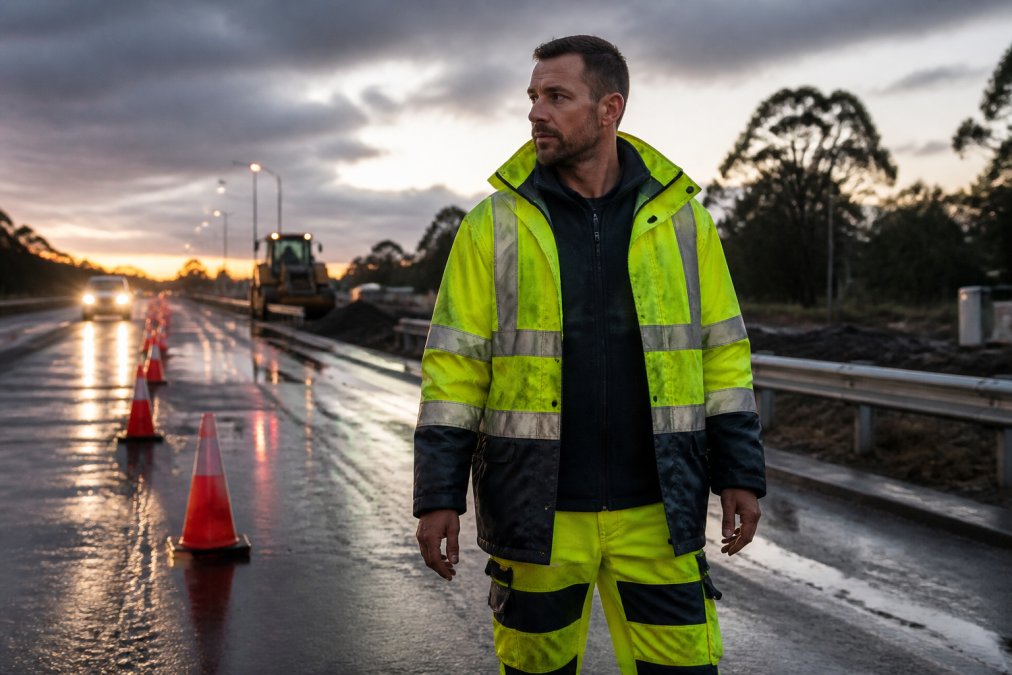
The outer shell is the piece that takes the salt and grit load directly, so it is the one worth spending on first. Look for a fully seam-sealed waterproof construction in a durable oxford polyester, a quilted lining that stays effective when damp, an internal pocket for gloves or a phone, and reflective tape rated for both day and night use. A zip-off hood is a practical detail, it lets the shell be worn under a hard hat or with a separate hood without the fabric bunching at the neck.
The mid-layer is where crews regulate temperature, so a half-zip design beats a pullover. Being able to vent heat without removing the garment entirely is the difference between a comfortable crew and one that is constantly stopping to adjust clothing. A two-tone hi-vis jumper with reflective tape keeps visibility intact when the outer shell comes off during physical work.

The leg protection is the layer most crews neglect until their pants are soaked through. Road spray hits legs first and lowest, and standard work pants soak through fast. Look for a double-tape design with 5 cm reflective tape on both legs, tool pockets, and a fit range that covers a spread-out crew, men's and women's cuts with short, regular, and long inseam options.
A note on sizing across a crew
Sizing is a durability issue, not just a comfort one. A jacket that is too tight at the shoulders restricts movement and stresses the seams; one that is too loose lets cold air circulate and catches on equipment. When outfitting a whole crew, collect chest, waist, and inseam measurements rather than relying on stated sizes, and check that the reflective tape placement still meets the standard across the full size range, tape position can shift on smaller and larger garments.
Temperature-Specific Layering Guide for Road Crews
Layering decisions should change with the temperature, not stay fixed all winter. A crew wearing the same three layers in every condition will overheat on mild days and still feel cold on the worst ones. The table below is a starting point that safety officers can adjust for local conditions.
| Conditions | Base Layer | Mid-Layer | Outer Shell |
|---|---|---|---|
| 10-15°C, dry | Light moisture-wicking top | None | Hi-vis shirt only |
| 5-10°C, dry | Moisture-wicking top | Half zip jumper | Optional |
| 0-5°C, wet or windy | Moisture-wicking top | Half zip jumper | Waterproof jacket |
| Below 0°C, wet | Thermal base layer | Jumper plus fleece | Waterproof jacket |
The principle is simple: add or remove the mid-layer first, and treat the outer shell as the fixed weather barrier. Workers who understand this stop guessing and start dressing for the actual conditions on site.
Ergonomics, Repairability and the True Cost of Heavy Gear
Heavy, stiff workwear has a cost that never shows up on the invoice. The ergonomic problem is not just weight, it is where that weight sits and how it resists movement. A jacket that hangs its mass from the shoulders pulls the wearer forward slightly, and over a ten or twelve hour shift that constant postural correction shows up as lower back and neck fatigue. Bulk around the elbows and knees is worse again, because road crews spend the day doing short, repeated movements: bending to place cones, climbing in and out of a truck cab, swinging a shovel, reaching across a barrier.
The practical test is range of motion, not warmth rating. A garment that lets a worker raise both arms overhead, squat, and twist at the waist without the hem riding up or the sleeves binding is doing more for crew endurance than an extra 50 gsm of fill. Most practitioners find that a lighter, well-cut jacket with a proper quilted lining outperforms a heavier boxy one across a full shift, even though the heavier jacket feels warmer in the shop.
Weight distribution matters in the layers underneath too. A mid-layer that bunches at the waist creates pressure points under a tool belt or harness, and a base layer that rides up leaves a cold strip at the lower back exactly where road spray hits. Fit is an ergonomic specification, not a fashion one.
Repairability: the specification nobody checks at purchase
Repairability is where the true cost of winter gear is decided. The two failure points on road crew garments are the reflective tape and the seam seals, and both behave very differently depending on construction quality.
- Reflective tape. Tape that is heat-applied to a low-quality backing peels at the corners after a season of washing and abrasion. Tape that is stitched as well as heat-applied can be re-stitched when a section lifts, and a garment with a taped seam allowance can be re-taped by a repairer rather than retired.
- Seam seals. A fully seam-sealed jacket can be re-sealed along a failed seam with repair tape, which is a ten-minute job. A jacket that relies on a coating rather than sealed seams has nothing to repair once the coating delaminates, it is landfill.
- Zips and hoods. A zip-off hood and a quality main zip are the difference between a jacket that gets a second winter and one that gets replaced because the zip failed while the shell was still sound.
A common pattern is that crews buy on sticker price and then replace the whole garment when one component fails. Buying gear that survives two or three winters, and budgeting a small amount per crew per year for tape and seam repairs, costs less in total than replacing cheap jackets every season.
The cheapest jacket is rarely the cheapest option. Factor in how many seasons a garment lasts, whether the reflective tape can be replaced, and whether the seams can be re-sealed before comparing prices.
Conclusion
Getting winter gear right for road crews is harder than it looks, because warmth, visibility, and weather protection have to work together rather than one at a time. The crews that stay comfortable and compliant are the ones that treat workwear as a layering system and verify AS/NZS 4602.1:2011 compliance on every garment.
Hi Vis Work Clothes supplies durable, compliant high-visibility apparel for construction, infrastructure, and maintenance teams, including the waterproof jacket, half-zip jumper, and double-tape work pants covered here. Every item can be printed or embroidered with your logo, and reflective tape options are available across the range, so a whole crew can be outfitted consistently. Get a quote from Hi Vis Work Clothes and kit your team out in gear built to last more than one season.
Frequently Asked Questions
What features should road crews look for in winter workwear?
Prioritise thermal insulation that traps heat without adding bulk, a waterproof and windproof outer shell with fully seam-sealed construction, and reflective tape that meets AS/NZS 4602.1:2011. Breathability matters too, because road crews move constantly and moisture-wicking fabrics stop sweat from chilling the body. A layering system of base, mid and outer shell gives you more flexibility than one heavy jacket.
How does AS/NZS 4602.1:2011 impact winter workwear selection?
AS/NZS 4602.1:2011 sets the minimum reflective tape width, placement and retroreflective performance for high-visibility garments. For winter workwear, the standard matters because bulky layers can obscure tape or create gaps. Check that reflective tape remains visible when a jacket is worn over a jumper, and verify the garment's class rating (day, night or day/night). Tape must be at least 5cm wide and positioned on the torso and limbs so it stays visible in low light and wet conditions, which are common on road crews.
How do you choose between insulated jackets and layering systems for road work?
Insulated jackets offer quick warmth for static or low-activity roles, but they limit flexibility when temperatures shift or when workers move between tasks. Layering systems let you add or remove a mid-layer jumper or fleece as conditions change, which suits road crews who alternate between physical work and standing near traffic. A waterproof outer shell over a half-zip jumper and a moisture-wicking base layer covers most winter scenarios. Choose insulation only if your crew works in consistently cold, low-movement conditions.
Are there high-visibility alternatives to traditional heavy jackets?
Yes. Instead of one heavy insulated jacket, consider a waterproof shell with a quilted lining worn over a half-zip jumper. The shell blocks wind and rain while the jumper provides warmth, and you can remove the jumper when conditions ease. This combination weighs less, improves range of motion and lets you adapt through the day. Look for garments with 5cm reflective tape, sealed seams and breathable mesh panels under the arms and at the collar to manage heat build-up.
What are the most durable materials for outdoor winter workwear?
For outer shells, 300D oxford polyester offers strong abrasion resistance and holds up to repeated wear on rough surfaces. For pants, a 60% cotton and 40% polyester blend balances durability with comfort and breathability. Reflective tape should be stitched securely rather than heat-pressed, so it does not peel after washing. Merino wool and synthetic fibres work well for base layers because they wick moisture and regulate temperature. Avoid lightweight fabrics on high-wear areas like knees, elbows and shoulders.
Recent Blogs
September 14, 2026
Durable Winter Workwear Alternatives for Road Crews
Explore durable winter workwear alternatives for road crews, covering thermal...
September 14, 2026
Durable Winter Workwear Alternatives for Road Crews
Explore durable winter workwear alternatives for road crews, covering thermal...
September 14, 2026
Durable Winter Workwear Alternatives for Road Crews
Explore durable winter workwear alternatives for road crews, covering thermal...