
Best Hi Vis Workwear for Winter: A Buying Guide


Table of Contents
- Why Winter Hi Vis Workwear Matters
- Types of Hi Vis Jackets and Jumpers for Cold Weather
- Winter Workwear Layering Tips for Extreme Cold
- Reflective Tape Standards and Hi Vis Workwear Compliance
- AS/NZS 4602.1:2011 Standards: What You Need to Know
- Top Winter Hi Vis Workwear Recommendations
- Choosing the Right Hi Vis for Your Industry and Climate
- Durability, Breathability and Maintenance
Why Winter Hi Vis Workwear Matters
Winter conditions transform ordinary workplace hazards into serious safety risks. Cold, darkness, and poor visibility combine to create dangerous conditions on construction sites, logistics hubs, and maintenance operations. High-visibility workwear is critical, it's the difference between a near-miss and a tragedy.
Workers in fluorescent jackets with reflective tape are visible to machinery operators, traffic, and colleagues in ways that regular clothing cannot match. During winter months, when natural light fades by mid-afternoon and weather conditions worsen, that visibility becomes essential.
The best hi vis workwear for winter combines multiple protection layers: waterproof outer shells to handle rain and sleet, insulated lining to maintain body heat, and reflective systems that work in both daylight and low-light conditions. At Hi Vis Work Clothes, we've designed our winter range specifically around these requirements, balancing visibility, thermal protection, and durability for teams working in demanding conditions.
Winter workwear compliance also protects your organisation. Australian workplace standards require specific reflective tape specifications and high-visibility colour standards. Non-compliant gear creates liability and undermines safety culture. Properly certified, professionally branded workwear signals that safety isn't negotiable.
Types of Hi Vis Jackets and Jumpers for Cold Weather
Winter hi-visibility workwear comes in distinct categories, each designed for different temperature ranges and work conditions.
Waterproof and Fully Seam-Sealed Options
Waterproof jackets form the outer shell of any winter workwear system. The critical difference between water-resistant and waterproof lies in seam construction. Water-resistant fabric sheds light rain; fully seam-sealed jackets keep workers dry in sustained wet conditions.
The Jacket Waterproof Hood Reflective Tape - All Weather from Hi Vis Work Clothes uses 100% 300D oxford polyester with complete seam-sealing. This construction stops water penetration at every joint, hood attachment, pocket seams, and sleeve cuffs. The quilted internal lining provides thermal insulation without adding bulk, allowing workers to move freely on site. A removable hood allows workers to adjust visibility when needed without removing the entire jacket.

Fully seam-sealed jackets cost more than basic water-resistant options, but they deliver measurable benefits. Workers stay dry during sustained rain, reducing heat loss through moisture. For teams working in winter weather across multiple shifts, seam-sealing is a safety baseline.
Insulated Jumpers for Layering
Insulated jumpers form the thermal core of winter workwear systems. Unlike jackets worn as outer shells, jumpers are designed to layer under waterproof protection, trapping warm air and maintaining body heat in extreme cold.
The Jumper Half Zip Reflective Tape - Yellow provides this mid-layer function. The half-zip design allows workers to adjust ventilation during physical activity, crucial when moving between heated vehicles and cold outdoor work. Reflective tape on jumpers maintains visibility standards even when workers temporarily remove their outer jacket. For extreme cold operations, insulated jumpers work best when paired with waterproof jackets, allowing workers to adjust layering without removing the entire protective system.

Winter Workwear Layering Tips for Extreme Cold
Effective layering is the foundation of winter workwear safety. A single heavy jacket often fails because it overheats during physical work, then leaves workers dangerously cold during rest periods. Strategic layering allows continuous temperature adjustment without removing protective gear.
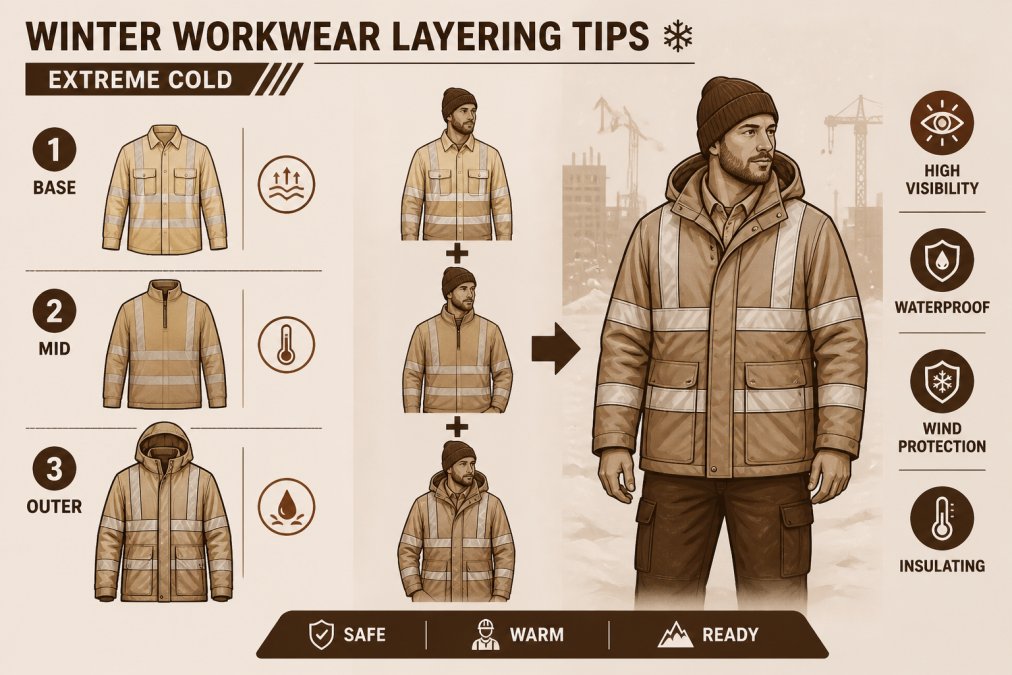
The three-layer system:
Base layer (moisture management): Start with a long-sleeve work shirt in breathable fabric. The Work Shirt HiVis Long Sleeve Reflective Tape Yellow uses 45% cotton and 55% polyester blend with breathable mesh at the collar and underarms. This combination wicks sweat away from skin while maintaining visibility.
Mid layer (insulation): Add an insulated jumper over the base shirt. The half-zip design lets workers open ventilation when moving between locations, preventing sweat accumulation. This layer should fit loosely enough to allow air circulation but snugly enough to maintain the thermal barrier.
Outer layer (weather protection): The waterproof jacket seals the system. It blocks wind and rain while allowing moisture from inner layers to escape. Fully seam-sealed construction prevents water penetration at stress points.
This three-layer approach works because each layer serves a specific function. For extreme cold (below 5°C), add thermal base leggings under work pants. The Work Pants Long Mens Double Tape Navy and Work Pants Long Womans Double Tape Navy both accommodate thermal underlayers without restricting movement. Layering also extends workwear lifespan, the outer jacket absorbs most weather exposure while inner layers stay protected.
Reflective Tape Standards and Hi Vis Workwear Compliance
Reflective tape performance determines visibility in low-light conditions. Not all reflective tape meets Australian workplace standards, and non-compliant gear creates liability while offering false security.
Reflective tape works through retroreflection, bouncing light directly back to its source. This allows workers to remain visible to vehicle operators, machinery controllers, and colleagues even in darkness or poor weather. Width matters significantly. A 5cm width reflective tape provides substantially better visibility than narrower alternatives. The Work Shirt HiVis Long Sleeve Reflective Tape Orange uses 5cm width tape positioned on shoulders and torso, high-visibility areas where vehicle operators look first.

Effective positioning uses multiple tape locations: shoulders, torso front and back, and sleeves. This ensures visibility from multiple angles and distances. Material degradation is a common compliance failure. Cheap reflective tape fades after 10-15 washes and peels at seams. Professional-grade tape maintains performance through 50+ wash cycles.
AS/NZS 4602.1:2011 Standards: What You Need to Know
The Australian/New Zealand Standard AS/NZS 4602.1:2011 defines high-visibility clothing requirements for workplace safety. This standard specifies minimum requirements for fluorescent colour, reflective tape placement, and overall visibility performance.
The standard categorises high-visibility clothing into performance levels. Class 1 provides basic visibility for low-speed environments; Class 2 suits moderate-speed traffic; Class 3 addresses high-speed environments like motorway work. Most construction and industrial workwear falls into Class 2 or Class 3 categories. Reflective tape specifications require minimum coverage areas and retroreflective properties. Garment construction also falls under compliance requirements, with seams that must withstand normal use without separation and fastenings that remain secure through repeated laundering.
For organisations ordering bulk workwear, compliance verification requires checking product documentation. Reputable suppliers provide test certificates confirming AS/NZS 4602.1:2011 compliance. According to Safe Work Australia guidance on high-visibility clothing, organisations are responsible for ensuring that supplied workwear meets applicable standards.
Top Winter Hi Vis Workwear Recommendations
Winter workwear selection depends on your team's specific work environment, climate conditions, and compliance requirements.
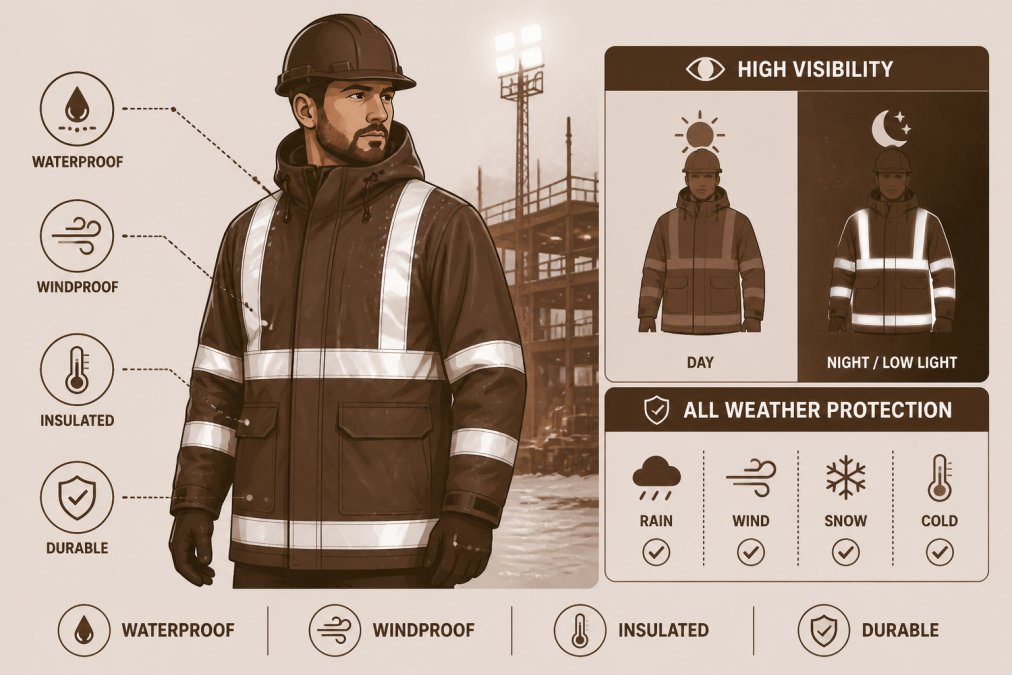
Jacket Waterproof Hood Reflective Tape - All Weather
The Jacket Waterproof Hood Reflective Tape - All Weather uses 100% 300D oxford polyester with complete seam-sealing, ensuring water stays out during sustained rain or sleet. The quilted internal lining provides thermal insulation without excessive bulk, allowing workers to move freely during physical tasks. The removable hood adapts to different visibility requirements. Two waist pockets provide practical storage for tools or communication devices.
Best for: Teams working in sustained winter rain, snow, or mixed conditions. Construction crews, maintenance teams, and outdoor logistics operations where weather protection is non-negotiable.
Jumper Half Zip Reflective Tape - Yellow
The Jumper Half Zip Reflective Tape - Yellow serves as the thermal mid-layer in winter systems. The half-zip design allows workers to adjust ventilation during physical exertion, preventing overheating and sweat accumulation. Reflective tape on the jumper maintains visibility compliance even when workers temporarily remove their outer jacket.
Best for: Teams layering for cold conditions. This works as the core thermal layer in three-layer systems, particularly for crews moving between heated vehicles and cold outdoor work.
Work Shirt HiVis Long Sleeve with Reflective Tape
The Work Shirt HiVis Long Sleeve Reflective Tape Yellow and Work Shirt HiVis Long Sleeve Reflective Tape Orange form the base layer in winter systems. The 45% cotton and 55% polyester blend balances moisture-wicking performance with comfort. Breathable mesh at the collar and underarms prevents heat trapping during physical activity. The 5cm reflective tape provides strong visibility in low-light conditions.
Best for: Base-layer visibility in winter systems. Construction teams, maintenance crews, and logistics operations where long-sleeve coverage is required for safety or compliance.
Combo Workwear Sets for Complete Protection
The Combo Mens Work Pants and Shirt Reflective Tape - Orange, Combo Womens Work Pants & Shirt Reflective Tape - Yellow, and Combo Womens Work Pants & Shirt Reflective Tape - Orange provide coordinated base-layer systems. These combos simplify procurement for bulk orders. The shirt uses 98% cotton and 2% polyester for comfort during extended wear. The pants use 40% polyester and 60% cotton for durability and movement flexibility. Both include 5cm reflective tape for strong visibility.
Best for: Teams requiring coordinated base-layer visibility. Small to medium-sized operations where uniform appearance and consistent compliance matter.
Choosing the Right Hi Vis for Your Industry and Climate
Different industries face distinct winter workwear requirements. Construction operations work outdoors in all conditions and need complete waterproof protection combined with thermal insulation. Seam-sealed jackets are essential; water penetration during winter construction creates dangerous heat loss and compliance failures.
Logistics and warehousing operations involve vehicle interaction and indoor-outdoor transitions. Teams move between heated warehouses and cold loading areas throughout the day. Layering systems with adjustable mid-layers prevent overheating during warehouse work while maintaining protection during outdoor loading.
Maintenance and utility operations often involve extended outdoor exposure in varied conditions. Teams need durable workwear that withstands repeated laundering while maintaining reflective performance. Seam-sealed jackets with quality reflective tape resist degradation through multiple wash cycles.
Ground crews at airports and transport hubs work in high-speed vehicle environments and need Class 3 high-visibility compliance with reflective tape on all garments. Climate variation across regions affects workwear selection. Teams in southern regions working through winter require full thermal insulation and waterproof protection. Assess your team's specific temperature range and precipitation patterns.
Bulk ordering creates opportunities for customisation. Hi Vis Work Clothes offers custom printing and embroidery services on workwear, allowing you to add your organisation's logo or branding.
Durability, Breathability and Maintenance
Winter workwear durability determines long-term compliance and cost-effectiveness. Durability starts with fabric construction. Oxford polyester (300D weight) resists abrasion and tearing better than lighter fabrics. Seam construction matters equally; reinforced seams withstand repeated movement and stress without separation.
Breathability prevents moisture accumulation inside protective gear. When workwear traps sweat, workers become cold as moisture evaporates against their skin. Breathable fabrics allow moisture to escape while blocking external water. Quality reflective tape resists peeling, fading, and curling through 50+ wash cycles. Cheap tape fails within 10-15 washes, creating compliance gaps exactly when you need protection most.
Maintenance practices extend workwear lifespan. Cold-water washing preserves reflective tape and fabric properties better than hot water. Machine drying on low heat reduces shrinkage and tape degradation. Avoid bleach and harsh detergents that degrade fabric and tape. Regular visual checks identify peeling tape, seam separation, or colour fading. Replace compromised items immediately rather than waiting for complete failure. Climate-controlled storage extends garment life, and UV exposure fades fluorescent colours, so covered storage is essential for maintaining visibility performance.
| Winter Workwear Layer | Primary Function | Temperature Range | Best Paired With |
|---|---|---|---|
| Work Shirt (Long Sleeve) | Base visibility and moisture management | All winter conditions | Jumper and jacket |
| Insulated Jumper (Half Zip) | Thermal insulation with ventilation | 0-10°C | Work shirt and jacket |
| Waterproof Jacket (Seam-Sealed) | Weather protection and visibility | Below 5°C or wet conditions | Work shirt and jumper |
| Work Pants (Double Tape) | Leg visibility and durability | All winter conditions | Thermal underlayers in extreme cold |
Winter workwear protects your team while maintaining professional visibility standards. The best systems layer protection, visibility, thermal insulation, and weather resistance, allowing workers to adjust to changing conditions without compromising safety. Quality workwear with professional branding reinforces safety culture and demonstrates organisational commitment to team protection.
Get a quote from Hi Vis Work Clothes for bulk winter workwear orders with custom branding. We specialise in durable, compliant high-visibility apparel designed for construction, logistics, and maintenance operations. Contact us to discuss your team's specific requirements and receive a tailored recommendation for winter workwear protection.
Frequently Asked Questions
What are the AS/NZS 4602.1:2011 standards for hi vis workwear?
AS/NZS 4602.1:2011 sets the Australian and New Zealand standard for high-visibility clothing. It specifies requirements for reflective tape width (typically 5 cm), colour (fluorescent yellow, orange, or red), and retroreflective material performance. The standard defines Class D/N ratings for day and night visibility. Compliance ensures your team's workwear meets legal workplace safety requirements and provides reliable visibility in low-light and busy environments. Always check product labels for certification marks.
How do I choose the right hi vis jacket for cold weather?
Look for waterproof, fully seam-sealed jackets with quilted thermal lining and internal pockets for layering. Check that reflective tape meets AS/NZS 4602.1:2011 standards. Consider your industry: construction and roadside work need Class D/N jackets, while warehouse work may use lower-visibility options. Ensure the jacket fits over base layers without restricting movement. Poly-cotton or 300D oxford polyester fabrics offer durability and weather resistance. Test ventilation options (storm flaps, pit zips) if your crew works in variable conditions.
What is the difference between day and night use hi vis workwear?
Day-use hi vis relies on fluorescent colour (bright yellow or orange) to be visible in daylight and busy environments. Night-use workwear adds retroreflective tape that bounces light back to its source, making workers visible in darkness or low-light conditions. Class D/N ratings indicate dual-purpose gear suitable for both day and night. For winter work spanning early mornings and late afternoons, choose Class D/N workwear with reflective tape to maintain visibility across all lighting conditions.
Are waterproof hi vis jackets necessary for winter work?
Yes, waterproof jackets are essential for winter workwear. Wet conditions accelerate heat loss and increase injury risk on slippery sites. Fully seam-sealed, 300D oxford polyester jackets with quilted lining provide both weather protection and thermal insulation. They prevent moisture from penetrating to base layers, maintaining core body temperature. For construction, utilities, and outdoor maintenance crews, waterproof hi vis jackets reduce weather-related downtime and keep teams safer in wet, cold conditions.
How should I care for reflective taped workwear to maintain visibility?
Wash hi vis workwear in cool water with mild detergent; avoid bleach and fabric softeners that degrade reflective tape. Dry on low heat or air dry to prevent adhesive damage. Inspect tape regularly for peeling, fading, or dirt buildup. Replace garments if reflective tape shows significant wear, as visibility is compromised. Store away from direct sunlight to slow UV degradation. Proper care extends the life of your workwear and ensures compliance with safety standards throughout the working season.
This article was written using GrandRanker
Recent Blogs
August 18, 2026
Best Hi Vis Workwear for Winter: A Buying Guide
Find the best hi vis workwear for winter. Compare jackets,...
August 18, 2026
Best Hi Vis Workwear for Winter: A Buying Guide
Find the best hi vis workwear for winter. Compare jackets,...
August 18, 2026
Best Hi Vis Workwear for Winter: A Buying Guide
Find the best hi vis workwear for winter. Compare jackets,...