
Hi-Vis Compliance Standards: AS/NZS 4602.1 Guide


Table of Contents
- What Makes Hi-Vis Clothing Compliant
- AS/NZS 4602.1:2011: The Standard That Governs Hi-Vis Apparel
- Class D vs Class N Hi-Vis: Understanding the Difference
- High Visibility Garment Testing Requirements
- Coverage, Design and Garment Labelling
- Maintenance, Wash-Life and Durability
- Industry-Specific Compliance: Who Needs What
- Visual Inspection Checklist for Compliance
Last Updated: August 13, 2026
What Makes Hi-Vis Clothing Compliant
High-visibility clothing prevents serious injuries and deaths on worksites by making workers visible to machinery operators, vehicle drivers, and supervisors in conditions where ordinary workwear would render them invisible. Compliant hi-vis apparel is measurable, testable, and regulated by law, the difference isn't cosmetic.
Hi-vis compliance standards define exactly what "visible" means: the colour of fluorescent fabric, the width and reflectivity of retroreflective tape, the coverage area of the garment, and how these elements perform in both daylight and low-light conditions. A worker struck by machinery or a reversing vehicle because they weren't seen clearly enough doesn't get a second chance.
The standard that governs all hi-vis clothing in this country is AS/NZS 4602.1:2011. This standard sets technical requirements for high-visibility safety apparel, defining acceptable fluorescent colours, specifying retroreflective tape performance, and establishing garment coverage requirements. Compliance testing is rigorous: materials are tested for colour stability, reflectivity is measured in candelas per lux per square metre, and garments are assessed for durability across multiple wash cycles.
AS/NZS 4602.1:2011: The Standard That Governs Hi-Vis Apparel
The AS/NZS 4602.1:2011 standard is the regulatory foundation for all high-visibility safety apparel used in Australia and New Zealand. It specifies performance requirements for both the fluorescent fabric and the retroreflective components that make hi-vis clothing work.
The standard defines three classes of hi-vis garments: Class D for daytime visibility, Class N for night-time visibility, and Class D/N for dual-purpose protection. Each class has different requirements for fabric area, tape width, tape placement, and reflectivity performance. The standard also covers garment labelling, certification marks, and durability testing to ensure that hi-vis clothing maintains its protective properties through normal use and washing.
Fluorescent Fabric Requirements
Fluorescent fabric is the foundation of daytime visibility. The fabric must be one of three approved colours: orange-red, yellow, or yellow-green. These colours are chosen because the human eye is most sensitive to them in daylight conditions, particularly in the yellow-green range.
The standard specifies exact chromaticity limits for each approved colour. Fabric that's too dark, too dull, or the wrong shade will fail compliance testing, even if it appears bright to the naked eye. Fluorescent fabric must also maintain its colour stability through repeated washing and UV exposure.
Retroreflective Tape Specifications
Retroreflective tape makes hi-vis clothing visible at night by reflecting light back toward its source. The tape must meet specific photometric performance requirements measured in candelas per lux per square metre (cd/lux/m²).
The standard defines two types of retroreflective tape: Type 1 with lower reflectivity for lower-risk environments, and Type 2 with higher reflectivity for greater night-time visibility. Tape width also matters: Class D garments may use narrower tape, while Class N and D/N garments require wider tape. Tape placement is specified precisely, with minimum distances between runs and specific positioning around the torso and limbs.
Class D vs Class N Hi-Vis: Understanding the Difference
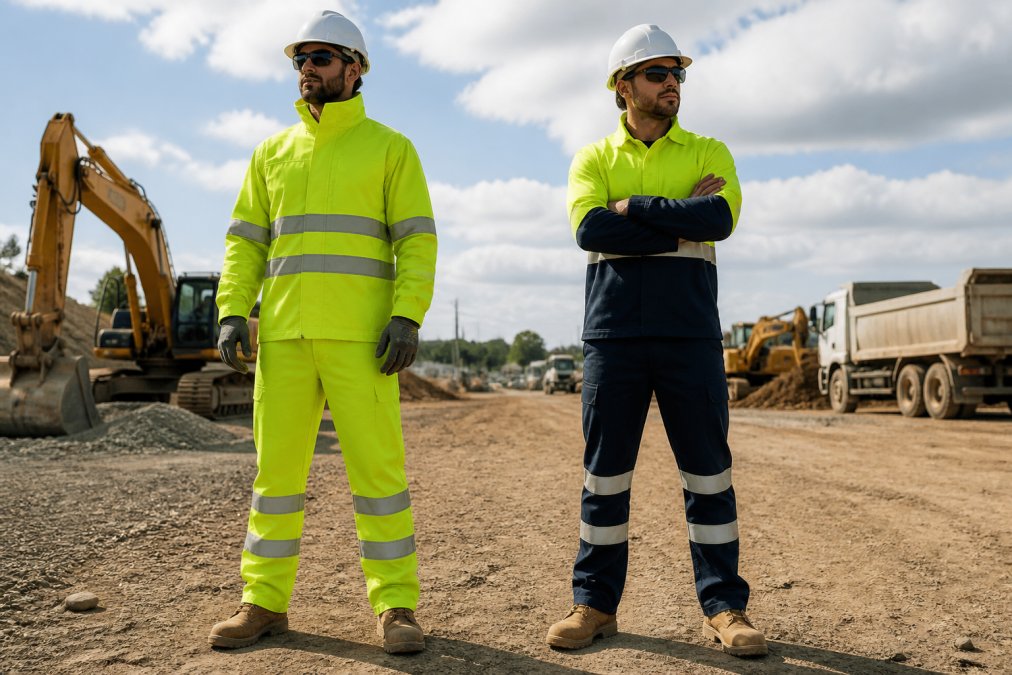
The choice between Class D and Class N hi-vis clothing depends entirely on when and where your team works. Class D is designed for daytime visibility in high-speed environments; Class N is designed for night-time visibility in lower-speed environments; Class D/N combines both.
Class D: Daytime and High-Speed Visibility
Class D garments are designed for workers in high-speed environments where visibility during daylight is critical. This includes road workers, airport ground crew, and construction sites with heavy vehicle traffic. Class D garments require a minimum fluorescent fabric area of 0.4 square metres. The garment must include retroreflective tape, but the tape is narrower and less extensive than in Class N garments, serving as a backup for lower-light conditions rather than as the primary visibility mechanism.
Class D is the most common hi-vis standard for Australian worksites because most work happens during daylight hours and is also the most cost-effective option for teams that don't regularly work in darkness.
Class N: Night-Time and Low-Speed Visibility
Class N garments are designed for night-time work or low-speed environments where workers need visibility in darkness. This includes warehouse workers, night-shift maintenance crews, and personnel working in low-light industrial settings. Class N garments require a minimum fluorescent fabric area of 0.8 square metres, twice that of Class D. The retroreflective tape is wider and more extensive, and must use Type 2 retroreflective material, which has higher reflectivity than Type 1.
Class N garments are more expensive than Class D because they require more fabric and more reflective tape. However, if your team works at night or in consistently low-light conditions, Class N is legally required.
Class D/N: Dual-Purpose Protection
Class D/N garments combine the requirements of both Class D and Class N, providing excellent visibility in both daylight and darkness. They require the larger fluorescent fabric area of Class N (0.8 square metres) and the extensive retroreflective tape coverage of Class N. For many organisations, Class D/N is the practical choice, eliminating the need to maintain separate garments for day and night use.
High Visibility Garment Testing Requirements
Compliance testing is not a one-time event. The standard requires testing at multiple stages: before a garment is released to market, and periodically throughout its lifespan to ensure it maintains its protective properties.
Initial testing verifies that the fluorescent fabric meets chromaticity requirements and that the retroreflective tape meets photometric performance standards. Durability testing is critical because hi-vis clothing degrades with use. A Class D garment must maintain its reflectivity performance for at least 25 wash cycles at 40 degrees Celsius; Class N garments have more stringent wash-life requirements because night-time visibility depends entirely on retroreflective tape performance.
Coverage, Design and Garment Labelling
The standard specifies exactly how much of the garment must be covered with fluorescent fabric and retroreflective tape. These coverage requirements exist because visibility is proportional to the amount of reflective surface area exposed to a driver's or operator's line of sight.
Upper Torso Coverage and Minimum Areas
Class D garments require a minimum of 0.4 square metres of fluorescent fabric concentrated on the upper torso where it's most visible to drivers and machinery operators. Class N garments require 0.8 square metres of fluorescent fabric, roughly double that of Class D, ensuring visibility from multiple angles and in low-light conditions.
Retroreflective tape must be positioned on the upper torso, lower torso, and sleeves or legs, depending on the garment type. Tape placement matters as much as its width: tape positioned too close to seams or edges may peel during washing or wear, and tape positioned on areas that flex excessively degrades faster than tape on flat surfaces.
Garment Labelling and Certification Marks
Every compliant hi-vis garment must carry a label that identifies its class (D, N, or D/N) and references the AS/NZS 4602.1:2011 standard. The label must also specify the type of retroreflective tape used and the washing instructions. Certification marks from accredited testing bodies appear on labels to confirm that the garment has been tested and meets the standard. If a garment doesn't carry the appropriate certification mark, it hasn't been tested and shouldn't be trusted.
Maintenance, Wash-Life and Durability
Hi-vis clothing is only protective if it remains compliant. A garment that fades or loses reflectivity becomes a liability rather than a safety asset. The standard specifies that hi-vis garments must maintain compliance through a minimum number of wash cycles: Class D garments typically maintain compliance for 25 wash cycles; Class N garments for up to 50 cycles, assuming washing at 40 degrees Celsius with standard detergent.
Washing at higher temperatures, using bleach, or using abrasive cleaning methods accelerates degradation. Retroreflective tape is the component most vulnerable to degradation. Dirt accumulation on the tape surface reduces reflectivity; UV exposure weakens the adhesive; physical wear causes the tape to peel or crack. Regular inspection of the tape is essential. If tape is peeling, cracked, or visibly dirty, the garment should be replaced.
Hi Vis Work Clothes garments are designed for durability across demanding work environments. Our Work Shirt HiVis Long Sleeve with Reflective Tape features 5-centimetre tape width and breathable mesh construction, delivering both compliance and comfort. For teams requiring maximum durability, our Jacket Waterproof Hood with Reflective Tape combines all-weather protection with strong retroreflective tape that withstands repeated washing and outdoor exposure.

Industry-Specific Compliance: Who Needs What
Different industries face different visibility hazards, and the standard recognises this by defining classes based on risk. Road workers and airport ground crew typically require Class D or Class D/N because they work in high-speed environments during daylight hours. Warehouse and logistics workers often work in low-light conditions or night shifts, making Class N the appropriate standard. Construction workers often work across multiple shifts and light conditions, making Class D/N the practical choice.
The safest approach is to assess your specific hazards. If your team works in high-speed environments in daylight, Class D is sufficient. If they work at night or in low-light conditions, Class N is required. If they work across varying conditions, Class D/N eliminates the need to maintain separate inventories.
Visual Inspection Checklist for Compliance
Regular visual inspection of hi-vis clothing catches degradation before it becomes a safety issue. A simple checklist performed by supervisors or safety officers ensures that garments remain compliant throughout their lifespan.
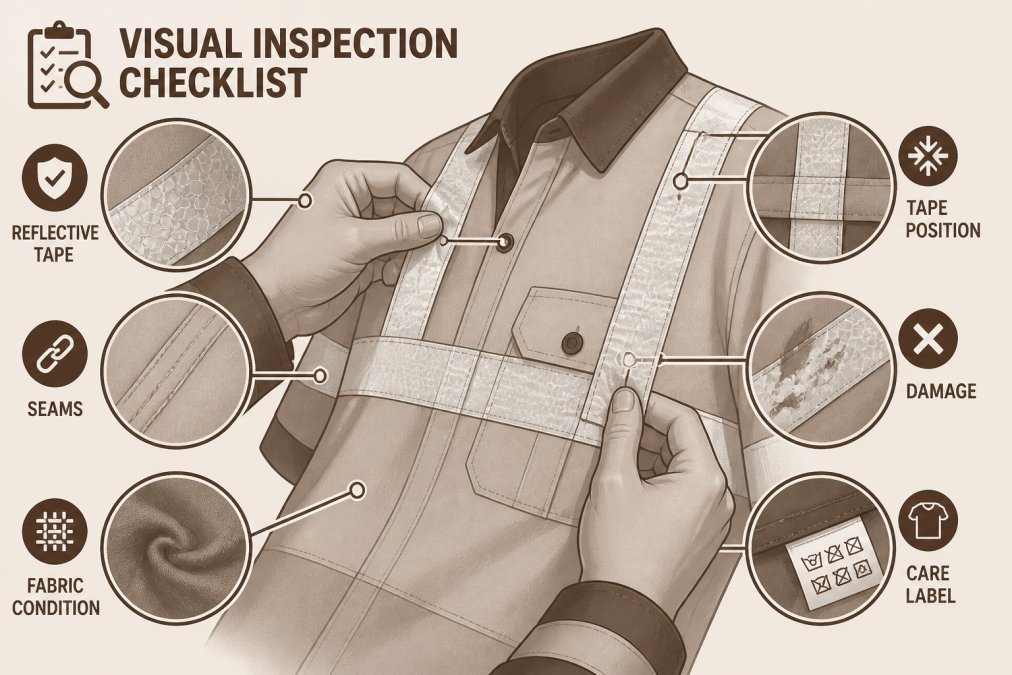
Fluorescent Fabric:
- Check for fading or discolouration. Fabric that's noticeably paler than new garments may be approaching the end of its compliance lifespan.
- Look for stains that won't wash out and feel the fabric for brittleness or loss of elasticity.
Retroreflective Tape:
- Run your finger along the tape edges. Peeling, cracking, or lifting tape must be replaced.
- Check for dirt accumulation on the tape surface. Clean tape with a damp cloth; if reflectivity doesn't improve, the tape has degraded and the garment should be replaced.
- Look for tape separation at seams or edges.
Seams and Edges:
- Inspect seams where tape is applied. Stitching should be intact and tape should be firmly adhered.
- Check for loose threads or unravelling fabric.
Overall Condition:
- Compare the garment to a new one. If the difference is obvious, the garment is likely approaching the end of its compliance lifespan.
- Check the label to confirm the class and washing instructions are still legible.
A garment that fails any of these checks should be removed from service and replaced.
Compliance with AS/NZS 4602.1:2011 is not negotiable, it's the legal baseline for workplace safety. Understanding what makes clothing compliant, maintaining it properly, and replacing it when it degrades ensures your team stays visible and protected. Hi Vis Work Clothes delivers garments tested and certified to these standards, with custom printing and embroidery to keep your team branded and professional. Get a quote today and ensure your team has the compliant, durable hi-vis apparel they need.
| Component | Class D Requirement | Class N Requirement | Class D/N Requirement |
|---|---|---|---|
| Fluorescent Fabric Area | 0.4 m² minimum | 0.8 m² minimum | 0.8 m² minimum |
| Retroreflective Tape Type | Type 1 or Type 2 | Type 2 | Type 2 |
| Retroreflective Tape Width | 5 cm minimum | 5 cm minimum | 5 cm minimum |
| Primary Use | Daytime, high-speed | Night-time, low-speed | Day and night, all speeds |
| Wash-Life (cycles) | 25 at 40°C | 50 at 40°C | 50 at 40°C |
According to Safe Work Australia's workplace safety guidance, high-visibility apparel is a critical component of hazard control in industries where visibility failures can cause serious injury. The standard AS/NZS 4602.1:2011 is referenced in workplace health and safety legislation across both states and territories, making compliance a legal requirement for organisations managing visibility hazards.
The Standards Australia and Standards New Zealand joint documentation on AS/NZS 4602.1:2011 provides the definitive technical specifications for fluorescent colours, retroreflective tape performance, and garment design.
Research from WorkSafe Victoria's guidance on personal protective equipment selection emphasises that PPE selection must be based on hazard assessment, not on generic industry practice. High-visibility apparel selection should follow a documented assessment of visibility hazards specific to your workplace and work patterns.
Frequently Asked Questions
What are the main regulations for hi-vis clothing in Australia?
Hi-vis compliance standards in Australia are governed by AS/NZS 4602.1:2011, which sets requirements for fluorescent fabric colour, retroreflective tape specifications, upper torso coverage, and classification levels (Class D, N, or D/N). Employers must provide compliant hi-vis apparel to workers in high-risk environments. The standard specifies minimum luminance, chromaticity, and photometric performance to ensure visibility in both daytime and night-time conditions.
What is the difference between Class D and Class N hi-vis garments?
Class D hi-vis is designed for daytime and high-speed traffic environments, with less retroreflective tape coverage. Class N is for night-time and low-speed visibility, requiring greater retroreflective tape area. Class D/N combines both standards, offering dual-purpose protection suitable for workers exposed to varied lighting conditions and traffic speeds. Your choice depends on when and where your team works.
How often should hi-vis workwear be replaced to maintain compliance?
Wash-life and durability are critical. AS/NZS 4602.1:2011 specifies that fluorescent fabric and retroreflective tape must maintain photometric performance after repeated industrial washing. Most compliant hi-vis garments are tested for 20-50 wash cycles. Inspect your workwear regularly for fading, peeling tape, or worn seams. Replace items when reflective properties visibly degrade or tape begins to lift, even if garments appear structurally sound.
What are the requirements for retroreflective tape on hi-vis workwear?
Retroreflective tape must meet AS/NZS 1906.4 specifications for performance and durability. Tape width, placement, and total coverage area vary by garment classification. Class D requires minimum tape coverage; Class N requires significantly more. Tape must be securely bonded to withstand industrial washing, sweat, and movement. Poor adhesion or peeling tape renders a garment non-compliant. Quality tape application is essential for meeting regulatory requirements and workplace safety.
Are employers legally required to provide compliant hi-vis clothing?
Yes. Under occupational health and safety legislation, employers must provide workers with appropriate personal protective equipment (PPE), including compliant hi-vis apparel when working in high-risk environments. Failure to supply certified hi-vis gear exposes your organisation to regulatory penalties and liability. Compliance is not optional; it is a legal obligation that protects both your team and your business.
What colours of hi-vis fabric are compliant under Australian standards?
AS/NZS 4602.1:2011 specifies fluorescent yellow-green and fluorescent orange-red as compliant fabric colours. Each colour has defined chromaticity and luminance requirements. Fluorescent yellow-green is the most common choice for general workwear. Fluorescent orange-red is used in certain high-visibility applications. Non-fluorescent colours or pink hi-vis are not compliant under the standard, regardless of reflective tape added.
How do I verify that hi-vis gear meets AS/NZS 4602.1:2011 compliance?
Check the garment label for certification marks and the relevant Class designation (D, N, or D/N). Reputable suppliers provide compliance documentation and test certificates. Inspect the fluorescent fabric for colour consistency and brightness. Verify retroreflective tape is securely bonded, properly placed, and meets width specifications. Request a compliance declaration from your supplier. Visual inspection combined with supplier certification gives you confidence your team is wearing genuinely compliant hi-vis apparel.
This article was written using GrandRanker
Recent Blogs
August 13, 2026
Hi-Vis Compliance Standards: AS/NZS 4602.1 Guide
Understand hi-vis compliance standards in Australia. Learn AS/NZS 4602.1:2011 requirements,...
August 13, 2026
Hi-Vis Compliance Standards: AS/NZS 4602.1 Guide
Understand hi-vis compliance standards in Australia. Learn AS/NZS 4602.1:2011 requirements,...
August 13, 2026
Hi-Vis Compliance Standards: AS/NZS 4602.1 Guide
Understand hi-vis compliance standards in Australia. Learn AS/NZS 4602.1:2011 requirements,...