
Buy Custom Branded Hi Vis Jackets: 2026 Guide


Table of Contents
- What to Check Before You Buy Custom Branded Hi Vis Jackets
- AS/NZS 4602.1:2011 Compliance for Workwear: What Buyers Must Verify
- Embroidery vs Screen Printing for Hi Vis: Which Branding Holds Up
- Durable All-Weather Hi Vis Jacket Features Worth Paying For
- Bulk Order Pricing, Minimums and Sizing Distribution
- Turnaround Times, Care and Getting a Quote
- Frequently Asked Questions
Last Updated: September 30, 2026
What to Check Before You Buy Custom Branded Hi Vis Jackets
Buying custom branded hi vis jackets is a procurement decision, not a fashion one. Get it right and your crew stays visible, compliant and recognisable on every site. Get it wrong and you're reordering in six months.
Matching the Jacket to the Job
Start with the working environment, not the catalogue.
- Roadside and traffic work: day/night rated garments with reflective tape on the torso and sleeves
- Warehousing and logistics: lighter day-use vests and shirts where heat is the bigger risk
- Construction and infrastructure: all-weather jackets with sealed seams for wet, cold sites
- Utility and field maintenance: two-tone garments so the high-visibility panels stay distinct from the navy
A jacket rated for day use only won't cut it for night shifts. Match the class to the shift pattern before anything else.

AS/NZS 4602.1:2011 Compliance for Workwear: What Buyers Must Verify
AS/NZS 4602.1:2011 compliance for workwear means the garment's fluorescent fabric and retroreflective tape meet the Australian and New Zealand standard for high-visibility safety garments. AS/NZS 4602.1 is the standard covering garment design and the performance of the retroreflective materials used on them.
- The specific standard the garment is tested against, stated in writing
- Confirmation of the day, night or day/night classification
- Details of the reflective tape used, not just "reflective tape" as a generic term
Embroidery vs Screen Printing for Hi Vis: Which Branding Holds Up
Embroidery vs screen printing for hi vis comes down to garment type and wear pattern. Embroidery stitches the logo directly into the fabric and survives industrial washing far better. Screen printing lays ink on the surface.

| Method | Best For | Durability | Detail Limit |
|---|---|---|---|
| Embroidery | Polos, jackets, work shirts | High, survives repeated washing | Simple logos, limited fine text |
| Screen printing | Vests, flat panels, large graphics | Moderate, can crack over time | Fine detail and gradients |
Logo Placement That Keeps Reflective Tape Visible
Never place a logo over reflective tape. The tape is the safety feature; covering it compromises the garment's rating and its performance. Standard placements that work:
- Left chest, clear of the shoulder tape
- Right chest for a secondary mark
- Back panel, positioned below the shoulder reflective bands
- Sleeve, only where no tape runs along that seam
Durable All-Weather Hi Vis Jacket Features Worth Paying For
The features that justify a higher unit price are the ones that stop you reordering next season. Sealed seams and thermal insulation extend the jacket's working life and its usable season.
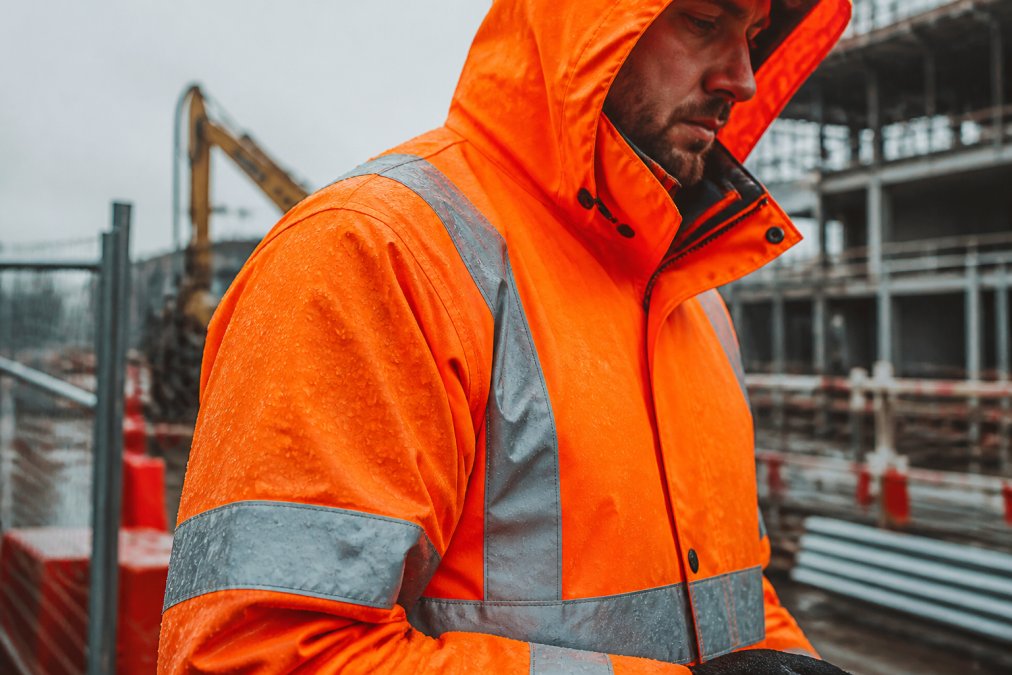
Look for:
- Waterproof and seam-sealed construction for wet-weather sites
- Quilted lining for cold-weather shifts
- Breathable fabric with mesh ventilation at the collar and underarms to reduce heat build-up
- Zip-off hoods for flexibility across conditions
Bulk Order Pricing, Minimums and Sizing Distribution
Bulk pricing on custom branded hi vis jackets is driven by four variables, and understanding how they interact is what separates a well-costed order from one that blows out after the PO is raised:
- Quantity breaks. Most suppliers tier pricing at set thresholds (commonly 10, 25, 50, 100 and 250 units). Crossing a threshold by even one unit can drop the per-unit rate across the whole run, so it often pays to round up rather than order exactly to headcount.
- Branding method. Embroidery carries a one-off digitising setup cost that is amortised across the run, the larger the order, the smaller that cost per garment. Screen printing carries a per-colour setup cost, so a three-colour logo on a small run can cost more to set up than to print.
- Garment type and fabric weight. A lightweight day-use vest and a seam-sealed all-weather jacket sit in different price bands. Mixing garment types in one order rarely unlocks the same quantity break as a single-style run.
- Decoration placement count. Each additional logo position (left chest, right chest, back, sleeve) adds a setup and a per-unit charge. Two positions is standard; four positions on a 20-unit run can add more to the invoice than the garments themselves.
Minimum Order Quantities
Minimums vary by supplier and by method. As a general pattern:
- Screen printing usually has the lowest minimum because setup is fast, but per-colour minimums apply.
- Embroidery typically has a modest minimum (often around 10-20 units) because of digitising.
- Heat transfer and vinyl sit between the two and suit small runs of complex, multi-colour logos.
Building a Sizing Distribution That Actually Fits
- Pull the garment's size chart and send it to each crew lead with a deadline.
- Collect by location, not by name, so you can see the spread across sites.
- Add a buffer for new starters and replacements, commonly 5-10% of total units, weighted toward the most common sizes.
- Check the extremes. If your matrix shows no smalls and no 5XL, confirm that against the actual crew before you commit, it usually means the form wasn't filled in properly.
For multi-site crews, build the matrix by location before you confirm quantities. It takes an hour and prevents the "three mediums, no larges" problem that leaves new hires in plain gear while the branded stock sits in the store.
What to Put in the Quote Request
To get an accurate bulk quote rather than a ballpark, send:
- Total quantity and the size breakdown
- Garment style and colour (or a link to the product)
- Logo file in vector format (EPS, AI or PDF) where possible
- Number and location of decoration positions
- Required delivery date and delivery address(es)
Turnaround Times, Care and Getting a Quote
Turnaround Times
Turnaround depends on order size, branding method and stock availability. As a working guide:
Safety Vest Adult Size Printed Logo →
- Stock garments with no branding: typically dispatched within a few business days.
- Screen printing: add roughly a week for setup and production on top of stock lead time.
- Embroidery: add digitising (one to two business days for a new logo) plus production time, which scales with stitch count and unit volume.
- Large runs (100+ units) or multi-position decoration: allow additional production time and confirm the schedule in writing.
Care and Maintenance: Protecting the Garment and Its Rating
The reflective tape is a performance material, not a trim, and how you wash the garment determines how long it keeps its rating.
Washing
- Follow the care label. Where it specifies a maximum wash temperature, treat that as a ceiling, not a target.
- Wash hi vis separately from oily or abrasive workwear. Grease and grit degrade both the fluorescent fabric and the tape.
- Use a mild detergent. Avoid bleach, and avoid fabric softener entirely, softener leaves a residue that coats the retroreflective surface and reduces how much light it returns.
- Turn the garment inside out and close zips and hook-and-loop fastenings before washing to stop them snagging the tape.
Drying
- Line dry in shade where possible. Prolonged direct sun fades fluorescent fabric, which is what gives the garment its daytime visibility.
- If tumble drying, use a low heat setting only. High heat is the single most common cause of tape lifting, cracking and delamination.
- Never dry-clean a hi vis garment unless the care label explicitly permits it.
Inspection and replacement
- Inspect the tape before each issue and at regular intervals during use. Look for peeling edges, cracking, fading, staining and stitching that has come away.
- Check the fluorescent fabric for fading. A garment that has gone from bright orange or yellow to a dull shade has lost daytime visibility even if the tape still looks intact.
- Replace the garment once the tape no longer reflects or the fluorescent colour has faded. A branded jacket that no longer performs is a compliance liability, not a saving.
Getting a Quote
To get a quote, send your quantities, sizes, logo file and required delivery date. Our Safety Vest Adult Size Printed Logo(https://hivisworkclothes.com.au/products/safety-vest-adult-size-printed-logo) shows how a printed logo sits alongside reflective shoulder and body tape.

Frequently Asked Questions
What are the AS/NZS 4602.1:2011 standards for high-visibility safety garments?
AS/NZS 4602.1:2011 sets the design and performance requirements for high-visibility garments, including how much fluorescent background fabric and retroreflective tape a garment needs. It also defines day, night and day/night use classes, so a jacket rated D/N works both in daylight and under vehicle headlights. When you buy custom branded hi vis jackets, ask the supplier to confirm the class and keep the compliance details on file for your safety records.
Is embroidery or screen printing better for hi vis jackets?
It depends on the garment and the logo. Screen printing suits flat, simple logos on lighter fabrics. Embroidery suits jackets, softshells and heavier outerwear. For reflective tape areas, both methods need care so the tape stays fully visible and reflective.
Can I add custom logos to reflective safety jackets without compromising visibility?
Yes, provided the logo is placed away from the reflective tape and the fluorescent background panels. Keep branding on the chest, back yoke or sleeve panels, and use colours that contrast with the garment rather than blending into it. A digital mock-up before production lets you check placement against the tape layout. Ask for the mock-up in writing so both sides agree on the final position and size.
What is the minimum order quantity for custom branded workwear?
Minimums vary by garment and decoration method. Small trade teams can often order from around a dozen pieces, while embroidery setups may carry a slightly higher minimum because of the digitising step. Unit price drops as volume rises, so it pays to group orders across crews. If you are unsure, request a quote with your team size and the supplier can confirm what is workable.
How do I choose the right fabric for all-weather hi vis workwear?
Match the fabric to the worst conditions your crew works in. For wet, cold sites, look for waterproof and seam-sealed outer shells with quilted lining, like a 300D oxford polyester jacket. For hot conditions, choose breathable mesh panels and lighter cotton-polyester blends so workers do not overheat. If crews work across seasons, a layered approach with a waterproof outer and breathable base layer covers more of the year.
How long does a bulk custom branded hi vis order take to arrive?
Turnaround depends on stock availability, decoration method and order size. A 200-piece order with embroidery or printing typically needs a production window plus delivery time, so confirm the schedule in writing before you commit. If you have new hires starting, place the order early and ask for a firm dispatch date. Ordering ahead of onboarding avoids the plain-gear gap that catches many teams out.
Procurement teams juggling compliance, branding and multi-site sizing need a supplier who can handle all three. Hi Vis Work Clothes provides high-visibility apparel with printed or embroidered branding, reflective tape options and all-weather jacket styles built for demanding sites. Send through your quantities, sizes and logo file, and get a quote with a confirmed turnaround.
Recent Blogs
October 01, 2026
Buy Custom Branded Hi Vis Jackets: 2026 Guide
Buy custom branded hi vis jackets with AS/NZS 4602.1 compliance,...
October 01, 2026
Buy Custom Branded Hi Vis Jackets: 2026 Guide
Buy custom branded hi vis jackets with AS/NZS 4602.1 compliance,...
October 01, 2026
Buy Custom Branded Hi Vis Jackets: 2026 Guide
Buy custom branded hi vis jackets with AS/NZS 4602.1 compliance,...