
Why Cheap Hi Vis Gear Fails Compliance: AS/NZS 4602.1


Table of Contents
- Why Cheap Hi Vis Gear Fails Compliance: An Overview
- What AS/NZS 4602.1 Compliance Actually Requires
- How to Identify Certified Hi Vis Clothing Before You Buy
- Reflective Tape Performance Standards and Why Cheap Tape Fails
- Common Failure Points in Low-Cost Hi Vis Workwear
- The Real Cost of Non-Compliant Hi Vis: Liability and Penalties
- UV Protection vs Visibility: What Cheap Gear Gets Wrong
- Conclusion
- Frequently Asked Questions
Last Updated: September 23, 2026
Why Cheap Hi Vis Gear Fails Compliance: An Overview
Cheap hi vis gear fails compliance because the fluorescent fabric and retroreflective tape that make it work are the first things manufacturers cut when they cut costs. A garment can look bright on the shelf and still fall short of AS/NZS 4602.1, the standard that sets out what high-visibility clothing must actually do. At Hi Vis Work Clothes, we see this every week: procurement teams buy on unit price, then discover the tape peels, the colour fades, and the certification label doesn't hold up to a site safety audit.
This guide from Hi Vis Work Clothes breaks down what the standard requires, how to read a certification label, and where low-cost garments typically fail. Below, we'll show you exactly how to spot non-compliant gear before it reaches your crew.
What AS/NZS 4602.1 Compliance Actually Requires
AS/NZS 4602.1 compliance requires a garment to meet defined thresholds for fluorescent background colour, retroreflective tape performance, and minimum surface areas of each. The standard is published by Standards Australia, and it separates garments into day, night, and day/night classifications. A day garment relies on fluorescent fabric alone. A night garment relies on retroreflective tape that bounces light back to its source. A day/night garment needs both, and that is where most cheap gear quietly fails.
Day, Night and Day/Night Garment Classifications
Day-use garments depend on fluorescent material to stand out in daylight. The colour must sit within a narrow band of chromaticity and hold a minimum luminance factor, so it stays vivid rather than washing out. Night-use garments depend on retroreflective tape, which returns light from headlights or work lamps to the wearer. Day/night garments combine both, and the tape placement, width, and total area are all specified. A garment marketed as "hi vis" without a classification is not compliant with anything in particular.
How to Identify Certified Hi Vis Clothing Before You Buy
How to identify certified hi vis clothing comes down to one habit: check the label and the licence number before you check the price. Compliant garments carry a certification label naming the standard, the garment classification, and the licensee. If a supplier can't show you that label, you're buying fabric, not certified PPE.
Reading Certification Labels and Licence Numbers
A legitimate label names AS/NZS 4602.1 and states whether the garment is day, night, or day/night. It also carries a licence number traceable to the certifying body, which lets a safety officer verify the claim rather than take it on faith. A common mistake is accepting a generic "complies with safety standards" tag with no standard number and no licence. That wording means nothing under a site safety audit.
Reflective Tape Performance Standards and Why Cheap Tape Fails
Reflective tape performance standards measure how much light the tape returns, and cheap tape fails because it uses a thinner retroreflective layer with weaker adhesion. That tape may pass a visual check on day one and still delaminate after a handful of industrial washes. Wash-fastness is the test most budget garments never survive.

The tape on our Safety Vest Adult Size Printed Logo uses reflective shoulder tapes plus two bands of reflective body tape, and it's printed with your logo and text. For crews working in rain and cold, the Jacket Waterproof Hood Reflective Tape - All Weather pairs a waterproof, fully seam-sealed shell with reflective tape and a zip-off hood. Both hold their visibility performance because the tape is built to survive repeated laundering, not just the showroom.

Common Failure Points in Low-Cost Hi Vis Workwear
Low-cost hi vis workwear fails at predictable points: the tape, the dye, the stitching, and the fabric weight. The tape cracks and peels. The fluorescent dye fades under UV exposure until the garment no longer meets the luminance requirement. Stitching pulls away at stress points. Thin fabric goes transparent when stretched, which reduces the effective fluorescent area below the standard's minimum.
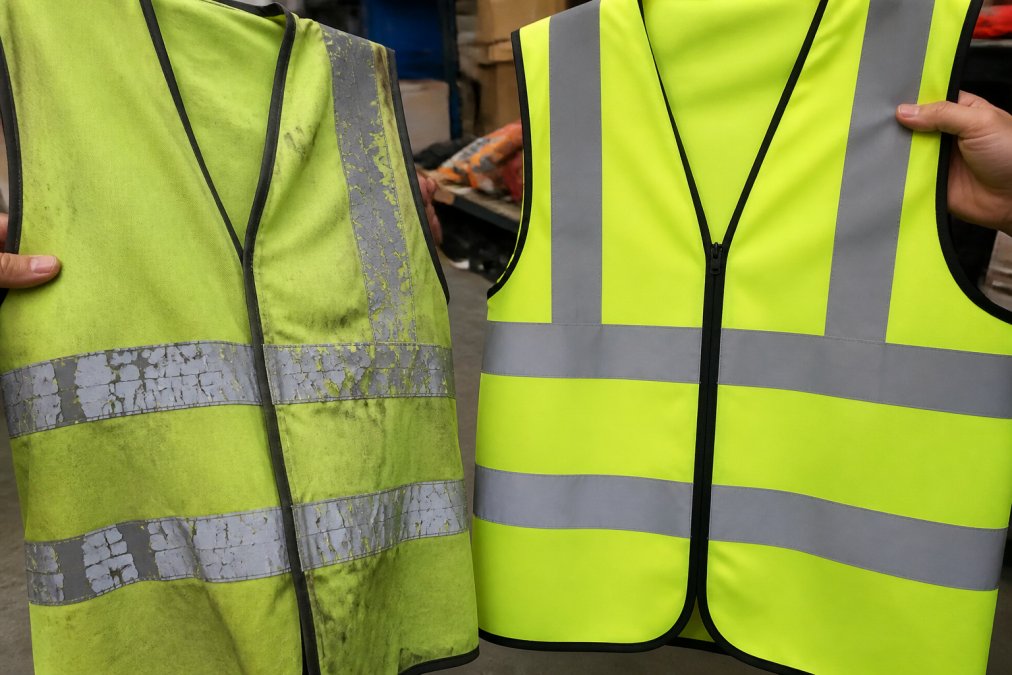
Here's how the common failure points map to fixes:
| Failure Point | What Goes Wrong | What to Check Before Buying |
|---|---|---|
| Reflective tape | Cracks, peels, loses retroreflectivity | Tape adhesion and wash-fastness claims |
| Fluorescent dye | Fades under UV, fails luminance | Colour retention after laundering |
| Stitching | Pulls apart at seams and stress points | Reinforced seams, fabric weight |
| Fabric transparency | Goes see-through when stretched | Material thickness and weave |
The Real Cost of Non-Compliant Hi Vis: Liability and Penalties
Non-compliant hi vis exposes employers to regulatory penalties and, more seriously, to liability if a worker is injured. Workplace safety regulators across the country treat PPE as an employer obligation, and Safe Work Australia publishes the model framework that underpins those duties. A site safety audit that flags non-compliant gear can halt work and trigger penalties. The unit price you saved rarely covers the cost of one incident.
Safety Vest Adult Size Printed Logo →
UV Protection vs Visibility: What Cheap Gear Gets Wrong
UV protection and visibility are two different jobs, and cheap gear usually sacrifices both. Fluorescent fabric is engineered to reflect visible light, not to block ultraviolet radiation, so a bright vest tells you nothing about sun protection factor. This is the gap most buying guides miss: a garment can pass every visibility check and still leave outdoor crews exposed to the sun for a full shift.
Why Fluorescent Fabric Is Not Sun-Protective Fabric
The fluorescent dyes that make hi vis fabric vivid work by absorbing UV and re-emitting it as visible light. That is the opposite of what a sun-protective fabric does. A UPF rating measures how much UV radiation passes through the fabric to the skin, and it depends on fibre type, weave density, colour, and stretch. Thin, loosely woven budget garments can have a UPF as low as 5 to 10, which offers minimal protection.
The Stretch Problem: Where UV Protection Quietly Fails
UV protection degrades where fabric stretches. When a garment is pulled across the shoulders or back, the weave opens and more UV passes through. Cheap gear with thin fabric and minimal stretch recovery loses protection exactly where the body is most exposed. This is why a UPF rating on a label is only meaningful if it is tested on the garment as worn, not on a flat swatch.
How to Check UV Protection Without a Lab
You cannot verify a UPF rating by eye, but you can apply a few practical checks before bulk purchasing:
- Look for a UPF rating on the label or in the supplier's documentation, and ask whether it was tested to the Australian/New Zealand standard for sun protective clothing.
- Hold the fabric up to a bright light. If you can see the light through it, UV is passing through too.
- Stretch the fabric gently across your hand and repeat the light test. If it becomes noticeably more transparent, the protection drops when worn.
- Check coverage. Long sleeves, a collar, and a higher neckline protect more skin than a sleeveless vest, regardless of the fabric rating.
- Ask how the rating holds up after washing. UV protection in some fabrics degrades with repeated laundering, especially where finishes are used rather than the fibre itself.
The Trade-Off: Breathability, Coverage, and Heat
For outdoor crews, our Jacket Waterproof Hood Reflective Tape - All Weather pairs a waterproof, fully seam-sealed shell with reflective tape and a zip-off hood, and the Work Shirt HiVis Long Sleeve Reflective Tape Orange offers long-sleeve coverage with breathable mesh for heat.

Conclusion
The gap between compliant and non-compliant hi vis comes down to tape, dye, and fabric that were built to last rather than to hit a price point. Buy on certification and wash-fastness, not unit cost, and you avoid the penalties, liability, and reordering cycle that cheap gear creates. Hi Vis Work Clothes supplies durable high-visibility apparel with reflective tape options, all-weather jackets, and custom printing or embroidery with your logo for teams and groups.
Frequently Asked Questions
How do I check if my hi vis clothing meets AS/NZS 4602.1 standards?
Look for a permanent label showing the standard number, the garment classification (Day, Night, or Day/Night), and the manufacturer's licence number. Check that the label is sewn in, not printed on a flimsy tag. You can verify the licence number with the issuing certification body. If the label is missing, faded, or the garment feels thin and stiff, treat it as non-compliant until proven otherwise.
What are the common reasons hi vis garments fail safety inspections?
The most frequent failures are faded fluorescent fabric, cracked or peeling reflective tape, missing certification labels, and incorrect garment class for the task. Cheap garments often use low-grade dyes that fade after a few washes, and reflective tape that loses retroreflectivity when flexed or laundered. Inspectors also reject garments with visible damage or contamination that reduces visibility performance.
Does cheap hi vis gear provide the same level of protection as certified workwear?
No. Cheap hi vis gear often skips independent testing, uses thinner fluorescent material, and applies lower-grade reflective tape. It may look similar but fails on chromaticity, luminance, and retroreflectivity. Certified workwear like the Safety Vest Adult Size meets AS/NZS 4602.1 requirements and uses reflective shoulder tapes plus two bands of reflective body tape, so you get verified visibility performance, not just a yellow shirt.
What are the consequences of wearing non-compliant hi vis on a worksite?
Non-compliant hi vis puts workers at risk of not being seen, which can lead to serious injury or death. Employers face regulatory penalties under work health and safety laws, plus potential liability if an incident occurs. Site safety audits can shut down work until compliant gear is provided. The cost of fines and downtime far exceeds the savings from buying cheap gear.
Recent Blogs
September 24, 2026
Why Cheap Hi Vis Gear Fails Compliance: AS/NZS 4602.1
Discover why cheap hi vis fails AS/NZS 4602.1 compliance. Learn...
September 24, 2026
Why Cheap Hi Vis Gear Fails Compliance: AS/NZS 4602.1
Discover why cheap hi vis fails AS/NZS 4602.1 compliance. Learn...
September 24, 2026
Why Cheap Hi Vis Gear Fails Compliance: AS/NZS 4602.1
Discover why cheap hi vis fails AS/NZS 4602.1 compliance. Learn...