
Quality Workwear vs Cheap Gear: ROI Analysis 2026


Table of Contents
- The Real Cost of Cheap Workwear: What the Price Tag Hides
- Quality Workwear vs Cheap Gear: Side-by-Side Comparison
- How to Test Fabric Durability for Work Trousers
- Cost-Benefit Analysis of Work Uniforms: Building the Business Case
- Workwear Replacement Cycle Frequency: When to Retire a Garment
- Safety Compliance, Brand Image and Team Morale
- Frequently Asked Questions
Last Updated: September 16, 2026
The Real Cost of Cheap Workwear: What the Price Tag Hides
A quality workwear vs cheap gear ROI analysis comes down to one uncomfortable truth: the cheapest garment on the invoice is rarely the cheapest garment on the job, and that gap is exactly what a quality workwear vs cheap gear ROI analysis exposes. This guide breaks down the numbers properly, covering total cost of ownership, fabric durability testing, replacement cycles and the business case you can take to an owner who only sees the upfront line item.
Upfront Expenditure vs Total Cost of Ownership
The upfront expenditure is the number on the quote. Total cost of ownership is what you actually pay across a garment's working life, and it includes far more than the purchase price.
A cheap hi-vis shirt might look like a saving at the register. Then you factor in shorter garment lifespan, more frequent reordering, higher laundry turnover, and the labour cost of coordinating replacements for crews spread across multiple sites. Total cost of ownership is the only figure that belongs in a procurement decision.
Most teams evaluate workwear on price per unit. The better metric is cost-per-wear: purchase price divided by the number of safe, presentable shifts the garment delivers before it fails. A garment that lasts twice as long at a modestly higher price usually wins that calculation comfortably.
Quality Workwear vs Cheap Gear: Side-by-Side Comparison
Quality workwear is apparel built to survive industrial laundering, repeated abrasion and daily UV exposure without losing its protective properties. Cheap gear is apparel built to hit a price point, and the compromises show up in the fabric, the stitching and the reflective tape.
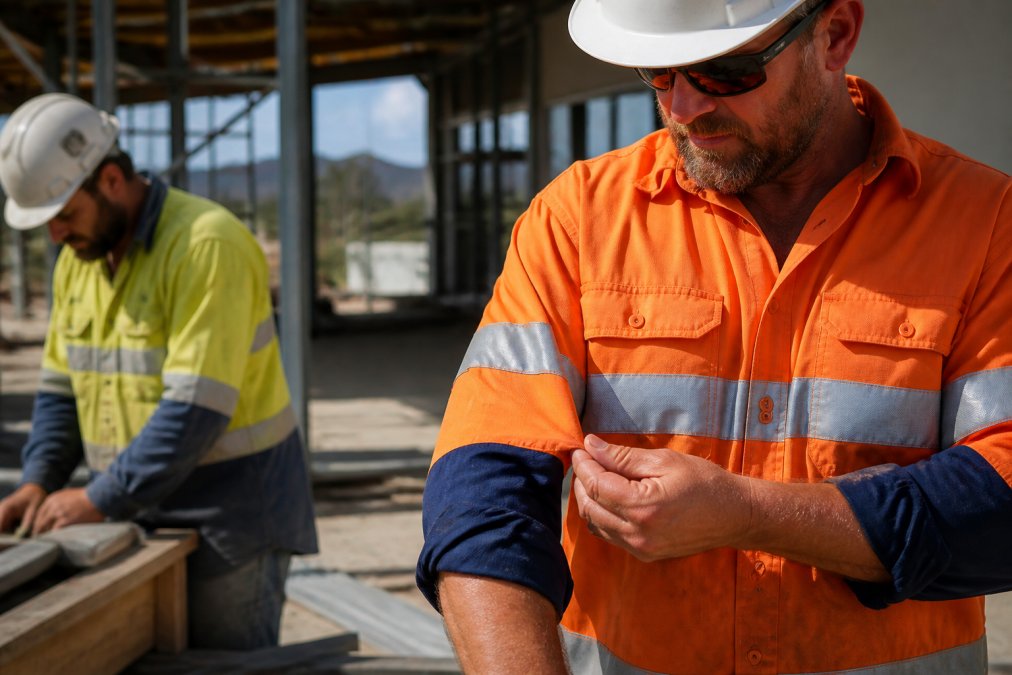
Here's how the two options compare on the factors that actually drive cost:
| Factor | Quality Workwear | Cheap Gear |
|---|---|---|
| Fabric durability | Heavier, tighter weave resists abrasion | Thinner fabric, pills and tears early |
| Stitching | Reinforced at stress points | Single-stitch, fails at seams |
| Reflective tape | Bonded, survives washing | Peels or fades after weeks |
| Replacement cycle | Longer intervals | Frequent reordering |
| Cost-per-wear | Lower over time | Higher than it looks |
Fabric Durability, Stitching and Construction
Fabric durability is a measure of how well a textile resists abrasion, tearing and colour loss under repeated wear and washing. It's the single biggest predictor of how long a garment will stay in service.
Reinforced stitching at shoulders, pockets and crotch seams is what stops a garment failing at its weakest point. Abrasion resistance and tear strength matter more on a construction site than the fabric's feel in the shop. Look for fade-resistant dyes and heavy-duty materials where the work is rough. Synthetic blends such as a cotton-polyester mix often balance comfort with tensile strength better than pure cotton.
How to Test Fabric Durability for Work Trousers
Learning how to test fabric durability for work trousers takes five minutes and saves months of reordering. Do it before you commit to a bulk order.
- Hold the fabric to a light source and check the weave density
- Stretch the seam at the crotch and check for stitch gaps
- Rub a coin firmly across the knee panel and inspect for pilling
- Bend the reflective tape and check it stays bonded
- Check the care label for industrial laundering guidance
Cost-Benefit Analysis of Work Uniforms: Building the Business Case
A cost-benefit analysis of work uniforms should compare total annual spend against the costs of failure: replacement orders, complaints, and safety incidents. That's the argument that lands with an owner focused on margins. But to move beyond the generic, you need a structured framework that captures both the obvious and the hidden returns.
The Four-Line ROI Framework
Build your business case on four lines, not three. First, replacement frequency: fewer reorders means less admin and less cash churn. Second, operational efficiency: crews spending less time chasing replacement gear spend more time on the job. Third, risk: workplace safety compliance and safety standards are non-negotiable, and a garment that fails its reflective requirement is a liability, not a saving.
Industry-Specific ROI Inputs
An ROI calculation for workwear follows the same logic across industries, but the inputs change. Here's how to weight them:
- Construction and infrastructure: weight the cost of downtime and the higher abrasion rate on site. A garment that fails mid-shift can halt work.
- Logistics and warehousing: weight laundering frequency and how often garments are worn. High-turnover laundry cycles degrade cheap tape quickly.
- Utilities and field maintenance: weight all-weather exposure and how quickly gear degrades outdoors. UV and moisture accelerate fabric breakdown.
The Formula and a Worked Example
The core formula: (annual replacement cost of cheap gear + coordination labour + safety incident costs) minus (annual replacement cost of quality gear + coordination labour + safety incident costs). The difference is your saving, and it usually grows with crew size.
Claiming the Sustainability Angle
Most competitors focus only on money. But modern ESG-conscious procurement managers also weigh environmental impact. Cheap workwear often follows a 'fast fashion' model: short lifespan, high replacement rate, more textile waste. Quality gear that lasts longer reduces landfill and carbon footprint. You can quantify this by estimating the number of garments replaced annually and multiplying by the embodied carbon of a typical work shirt (roughly 10-15 kg CO2e for a cotton-poly blend).
Downloadable ROI Calculator Template
To make this actionable, we've created a downloadable spreadsheet template that lets you input your own crew size, garment costs, replacement intervals, and labour rates. It automatically calculates cost-per-wear and total cost of ownership for both options. Download the free ROI calculator template
Workwear Replacement Cycle Frequency: When to Retire a Garment
Workwear replacement cycle frequency is the interval between a garment entering service and being retired. Set it by inspection, not by calendar, because a shirt worn daily fails faster than one worn twice a week.
Maintenance and Care Protocols That Extend Lifespan
Simple protocols stretch every garment's working life. Wash at the recommended temperature, turn garments inside out to protect the tape, avoid fabric softener which coats reflective surfaces, and air-dry where possible. Rotate garments between wears so no single item takes the full load. These habits reduce wear and tear and push out your replacement cycle.
Safety Compliance, Brand Image and Team Morale
Compliance, brand identity and employee comfort are the three returns that don't show up on a spreadsheet but absolutely affect the bottom line. A compliant, durable uniform protects the crew, presents a professional appearance to clients, and signals that the business takes the team's safety seriously.
Frequently Asked Questions
How do you calculate the ROI of workwear?
Divide the purchase price by the number of wears a garment delivers before it fails. A $79 high-vis combo worn twice a week for two years works out to roughly 76 cents per wear; a $45 set that frays after six months costs about 87 cents per wear. Add replacement labour, ordering admin and downtime, and the gap widens further. Track cost-per-wear across a full replacement cycle, not a single invoice.
Does high-quality workwear actually last longer in harsh conditions?
Construction, mining and logistics sites punish garments through abrasion, UV exposure and industrial laundering. Quality gear resists this through heavier fabric weights, reinforced stitching at stress points and fade-resistant dyes. Cheap gear often uses lighter synthetic blends that thin quickly at the knees, elbows and pockets. The practical test is tear strength and abrasion resistance after repeated washes, not how the garment looks on day one.
What are the hidden costs of buying cheap work gear?
The invoice is only the first cost. Cheap gear drives more frequent reordering, higher procurement admin time, sizing inconsistencies across crews, and replacement of garments mid-cycle. There is also a safety dimension: reflective tape that peels or fades reduces visibility, which creates compliance exposure. Add employee complaints about chafing, overheating and poor fit, and the true cost of a bargain purchase climbs well past the sticker price.
How does branded workwear impact employee productivity and retention?
Uniforms signal that a business treats its team as professionals. When garments fit well, breathe properly and hold their shape, workers wear them correctly instead of rolling up sleeves or removing layers. That compliance protects them on site. Companies that invest in proper branded gear often report fewer complaints about discomfort and a stronger sense of team identity, both of which support retention in tight labour markets.
What standards should Australian workwear meet for durability?
High-visibility garments sold in Australia must meet AS/NZS 4602.1 for day/night visibility, with reflective tape rated under AS/NZS 1906.4. Durability is separate: check that tape is stitched, not heat-sealed only, and that fabric holds colour and tensile strength after repeated industrial laundering. A compliant garment that fails after ten washes is not a bargain. Ask suppliers for construction detail and wash-test evidence before committing to a bulk order.
Procurement budgets are tight, and the pressure to take the cheapest quote is real. But cheap gear carries a cost that shows up later in reorders, complaints and compliance risk. Hi Vis Work Clothes supplies durable, high-visibility workwear with reflective tape, breathable construction and all-weather options, all printed or embroidered with your logo and branding. Get a quote and build a workwear order that lowers your total cost of ownership instead of just your first invoice.
Recent Blogs
September 17, 2026
Quality Workwear vs Cheap Gear: ROI Analysis 2026
Quality workwear vs cheap gear roi analysis: Quality workwear vs...
September 17, 2026
Quality Workwear vs Cheap Gear: ROI Analysis 2026
Quality workwear vs cheap gear roi analysis: Quality workwear vs...
September 17, 2026
Quality Workwear vs Cheap Gear: ROI Analysis 2026
Quality workwear vs cheap gear roi analysis: Quality workwear vs...