
High Vis Clothing: AS/NZS 4602.1 Buying Guide 2026


Table of Contents
- Why High Vis Clothing Fails the Compliance Check
- AS/NZS 4602.1 Standards: What Your Gear Must Actually Meet
- Class D vs Class N Workwear: Getting Day and Night Right
- Fabric Technology: What Holds Up on Site
- The High Vis Clothing Range: Jackets, Shirts, Vests and Pants
- Custom Hi Vis Workwear: Branding That Survives the Wash
- Care and Maintenance: Making High Vis Clothing Last
- Frequently Asked Questions
Last Updated: September 15, 2026
Why High Vis Clothing Fails the Compliance Check
Most high vis clothing fails a compliance check for a boring reason: it was never compliant in the first place. A garment can look fluorescent under site lights and still fall outside the standard the moment a safety officer reads the label. At Hi Vis Work Clothes, we see this constantly with bulk orders where buyers picked on colour and price, not certification.

High vis clothing is protective apparel made from fluorescent fabric and retro-reflective tape, manufactured and tested to meet the AS/NZS 4602.1 standard for visibility in daylight and low light conditions. The fluorescent base colour handles daytime visibility. The retro-reflective tape bounces light back to its source, which is what makes a worker visible to a reversing truck at night.
Three failure points account for most non-compliant gear we inspect:
- No standard reference on the garment label. If it doesn't state AS/NZS 4602.1 with a class, it isn't certified for workplace use.
- Reflective tape that has yellowed, cracked or peeled. Tape degrades with washing and UV exposure, and degraded tape fails its retro-reflective performance requirements.
- Wrong class for the task. Day-only garments on a night shift is the single most common mistake we see in workplace compliance audits.
The Safe Work Australia guidance on personal protective equipment is clear that PPE must be selected for the specific hazard, and visibility hazards change between day and night shifts. That's the gap this guide closes.
AS/NZS 4602.1 Standards: What Your Gear Must Actually Meet
AS/NZS 4602.1 is the joint Australian and New Zealand standard that sets the design, colour, and retro-reflective performance requirements for high visibility safety garments. It sits alongside AS/NZS 1906.4, which governs the reflective materials themselves.
What the standard actually tests:
- Fluorescent colour performance. The base fabric must hold its luminance under specified light conditions. Faded or washed-out colour fails.
- Retro-reflective tape minimums. Tape must meet a minimum coefficient of retroreflection, measured after washing cycles, not just when new (Catalogue Item - Standards Catalogue).
- Placement configuration. Tape positioning follows prescribed patterns, typically two horizontal bands around the torso plus braces or bands over the shoulders.
- Durability after laundering. Certification applies to the garment after a set number of wash cycles, which is why cheap tape peels and compliant tape doesn't.
Class D vs Class N Workwear: Getting Day and Night Right
Class D and Class N describe when a garment is certified for use, and mixing them up is where most workplace compliance problems start.
Class D garments are certified for daytime use only, relying on fluorescent fabric for visibility. Class N garments are certified for night use, built around retro-reflective tape that performs under vehicle headlights and artificial light. Class D/N garments meet both, and they're the safest default for any operation running shifts that cross from daylight into darkness.
| Class | Certified For | Visibility Mechanism | Typical Use |
|---|---|---|---|
| Class D | Daytime only | Fluorescent fabric | Day shifts, indoor loading docks |
| Class N | Night only | Retro-reflective tape | Night road works, rail corridors |
| Class D/N | Day and night | Fluorescent fabric plus tape | Shift work, dual-shift sites, all-weather crews |
For teams working split shifts, standardising on Class D/N removes the guesswork. One garment, one standard, no swapping at the depot gate.
Fabric Technology: What Holds Up on Site
Fabric choice decides whether a garment survives a summer on site or falls apart by month three. This is the part most buying guides skip, and it's the part that drives your real cost per wear.
Cotton and polyester blends are the workhorse for hi vis shirts. The blend balances breathability against durability, and it holds print and embroidery well. Our long sleeve work shirts use a 45% cotton, 55% polyester blend with 5cm reflective tape and breathable mesh at the collar and underarm, which is where heat stress complaints usually start.

Polyester and oxford weaves handle outerwear. A 300D oxford polyester shell with a quilted lining is what keeps a jacket waterproof and warm without turning it into a sauna. Look for fully seam-sealed construction if the jacket is going to see actual rain, not just morning dew.
Moisture-wicking and breathability matter more than most buyers expect. Crews working in heat lose productivity to discomfort long before they lose it to anything else, and a garment that traps sweat gets left in the ute.
The High Vis Clothing Range: Jackets, Shirts, Vests and Pants
The right high vis clothing range covers four categories, and most teams need at least three of them. What most buying guides skip is that the correct garment depends heavily on your industry, because the visibility hazard changes with traffic speed, machinery, and shift patterns.
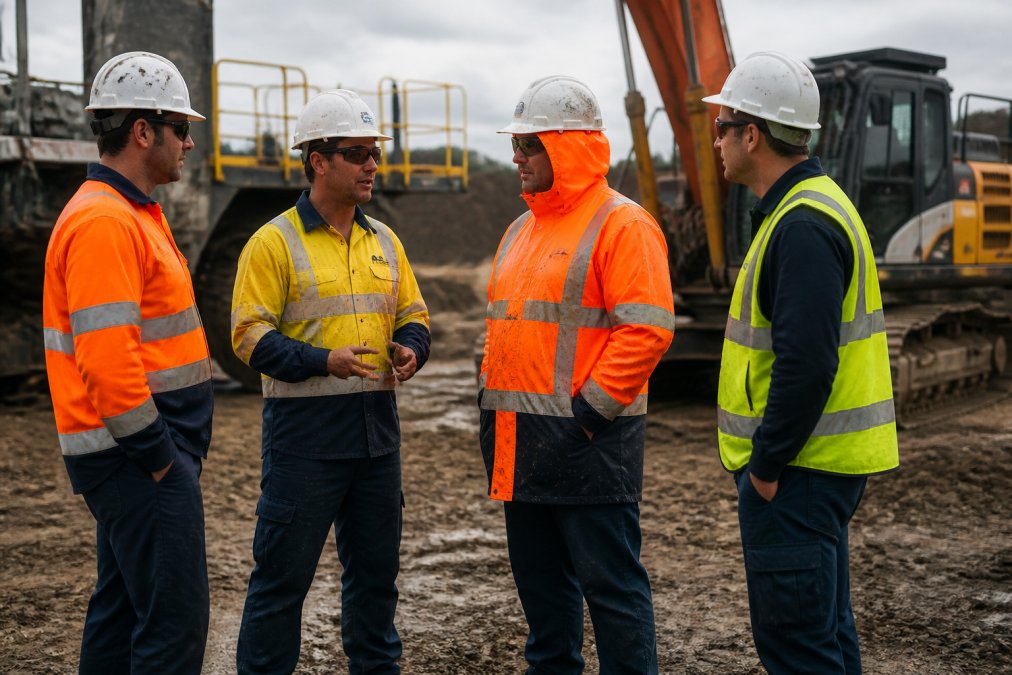
1. Hi vis jackets and outerwear. The Safe Work Australia guidance on working in heat and cold makes the point that environmental conditions change PPE requirements, and outerwear is where that bites. Our waterproof hood reflective tape all-weather jacket is a Class D/N two-tone jacket in 100% 300D oxford polyester with a quilted lining, fully seam-sealed, with a zip-off hood and two waist pockets. It's built for crews who don't get to stop when it rains.
2. Hi vis work shirts. Long sleeve shirts cover the arms, which matters for both sun protection and visibility. Our long sleeve reflective tape work shirt in orange and matching yellow version both run 5cm reflective tape with breathable mesh at the collar and underarm.
3. Safety vests. Vests are the fastest way to bring a visitor or a short-term contractor into compliance. Our adult safety vest with printed logo uses hi vis material with reflective shoulder tapes and two bands of body tape.

4. Cargo pants and overalls. Work pants with cargo pockets and reinforced knees handle the day-to-day abuse, and overalls suit trades where a shirt riding up is a genuine hazard.
Matching the Garment to the Industry
A common pattern across Australian worksites is that the same garment is worn across very different risk profiles. Here is how to match the range to the job:
- Mining and resources. High vehicle traffic, dust, and long shifts. Class D/N is the default, and two-tone garments with contrast panels help workers stand out against machinery and stockpiles. Look for reinforced stitching and heavier fabrics that survive abrasive environments.
- Construction. Mixed day and night work, often near moving plant. Class D/N jackets and long sleeve shirts with 5cm tape are common. Breathability matters because crews are often in direct sun for long periods.
- Traffic management. The highest visibility risk because workers are adjacent to live traffic.
Custom Hi Vis Workwear: Branding That Survives the Wash
Why Branding Fails After Washing
Most branding failures trace back to three mechanisms:
Placement Rules That Protect Compliance
Sizing Distribution Across Crews
Care and Maintenance: Making High Vis Clothing Last
Frequently Asked Questions
What are the Australian standards for high visibility clothing?
High vis clothing in Australia is governed by AS/NZS 4602.1, which sets out the design, reflective tape placement and minimum areas of fluorescent and retro-reflective material required. Garments are classified as Class D (day), Class N (night) or Class D/N (day and night). A garment marked D/N has been tested to remain visible under headlights and in low light, which is what most construction, logistics and utility sites require.
What is the difference between Class D and Class N high vis clothing?
Class D workwear relies on fluorescent fabric to stand out in daylight, so it is suited to indoor or well-lit daytime tasks. Class N uses retro-reflective tape that bounces light back to the source, making the wearer visible in low light and at night. Class D/N combines both. If your crew works across shifts or outdoors, Class D/N is the safer default because it covers daytime visibility and nighttime safety in one garment.
How do I ensure my team's high vis workwear is compliant?
Check the garment label for an AS/NZS 4602.1 reference and the day/night classification, then match it to your site's risk assessment. Confirm the reflective tape is intact and correctly positioned, and replace any item where the tape is peeling, faded or contaminated. Keep a simple register of what each crew member has been issued so you can show compliance during an audit or incident investigation.
Why is custom branding important for high visibility workwear?
Custom hi vis workwear does two jobs: it keeps your team visible and it makes them identifiable to clients, site managers and the public. Printed logos or embroidery on safety vests, shirts and jackets help supervisors spot their own crew in a crowded site, and they present a professional image when your team is on a customer's premises. Ordering branded gear in bulk also simplifies sizing and reordering across multiple crews.
Visibility hazards don't announce themselves, and neither do non-compliant garments until an incident or an audit surfaces them. Hi Vis Work Clothes supplies durable high-visibility apparel built to AS/NZS 4602.1, with reflective tape options, all-weather jacket choices, and custom printing or embroidery so your team looks professional while staying protected. Get a quote from Hi Vis Work Clothes and put your crews in gear that holds its class.
Recent Blogs
September 15, 2026
High Vis Clothing: AS/NZS 4602.1 Buying Guide 2026
High vis clothing guide for Australian teams: AS/NZS 4602.1 compliance,...
September 15, 2026
High Vis Clothing: AS/NZS 4602.1 Buying Guide 2026
High vis clothing guide for Australian teams: AS/NZS 4602.1 compliance,...
September 15, 2026
High Vis Clothing: AS/NZS 4602.1 Buying Guide 2026
High vis clothing guide for Australian teams: AS/NZS 4602.1 compliance,...