
Enhanced Safety on the Job for Warehouse Logistics


Table of Contents
- Why Enhanced Safety on the Job for Warehouse Logistics Pays Off
- Common Warehouse Hazards That Cause the Most Injuries
- WHS Requirements for Warehousing: What You Must Legally Do
- Your Warehouse Risk Assessment Checklist for Every Shift
- High Visibility Workwear Standards and PPE That Actually Protect
- Traffic, Manual Handling and Ergonomics: Daily Controls That Work
- Building a Safety Culture: Mental Health, Near-Miss Reporting and Leadership
- Frequently Asked Questions
Last Updated: September 17, 2026
Why Enhanced Safety on the Job for Warehouse Logistics Pays Off
Enhanced safety on the job for warehouse logistics is not a compliance box to tick. It is the operational foundation that keeps your team intact, your stock moving, and your costs predictable. This guide from Hi Vis Work Clothes breaks down the hazards that cause the most injuries, the legal duties you carry, and the daily controls that actually hold up on a busy floor.
The business case is straightforward once you look past the obvious. A serious injury removes an experienced operator from the roster, triggers an investigation, disrupts pick rates, and invites a regulator onto your site. WorkSafe Australia and the state regulators that enforce the model WHS laws treat warehouses as high-risk environments for good reason: the combination of moving vehicles, repetitive manual order picking, and heavy loads creates conditions where a single lapse has consequences. Safe Work Australia's guidance on the model WHS laws
The payoff comes in three places: fewer musculoskeletal injuries, lower operational costs from downtime and claims, and a workforce that reports problems before they become incidents. Below, we walk through the hazards, the legal requirements, and the practical controls that deliver that outcome.
Common Warehouse Hazards That Cause the Most Injuries
The hazards that cause the most warehouse injuries are well documented and largely preventable: musculoskeletal injuries from manual handling, slip trip and fall incidents, forklift and pedestrian interactions, and struck-by events involving falling loads.
Musculoskeletal injuries dominate the injury statistics in warehousing. They build up over time through repetitive strain, awkward lifting techniques, and poorly designed pick paths. A worker who lifts 200 cartons a shift with poor form will eventually break down, and the injury often appears long after the cause.
The other major categories break down like this:
- Slip, trip and fall: Spilled liquids, loose packaging, uneven flooring, and cluttered walkways
- Vehicle and pedestrian contact: Forklifts, reach trucks, and pallet jacks operating near foot traffic
- Falling objects: Unstable loads, poor stacking, and racking without load stability checks
- Chemical exposure: Cleaning agents, battery acid, and fuels stored or handled without proper controls
- Repetitive strain: Order picking, packing, and scanning performed at pace for full shifts
What most guides miss is that these hazards interact. A wet floor near a blind corner where a forklift turns is far more dangerous than either hazard alone. Your risk assessment needs to map where hazards overlap, not just list them in isolation.
WHS Requirements for Warehousing: What You Must Legally Do
WHS requirements for warehousing centre on one duty: provide and maintain a workplace that is safe and without risks to health, so far as is reasonably practicable. That duty sits with the person conducting the business or undertaking (PCBU), and it cannot be delegated away to a supervisor, a contractor, or a safety officer.
The phrase "so far as is reasonably practicable" is where most of the work sits. It means weighing the likelihood of harm against the cost, time, and difficulty of eliminating it. A control that is cheap and easy to apply is almost always reasonably practicable; one that would shut down operations for a month may not be. Regulators assess that balance after an incident, with the benefit of hindsight, so the reasoning needs to be documented before, not after.
Under the model Work Health and Safety Act, you must:
- Identify hazards and assess the risks arising from them
- Eliminate risks so far as is reasonably practicable, and if not, minimise them
- Provide information, training, instruction, and supervision
- Consult with workers on matters that affect their health and safety
- Monitor the health of workers and the conditions of the workplace
- Record and notify certain incidents to the regulator
The model WHS Regulations add specific duties that apply directly to warehouse operations. Hazardous manual tasks must be managed through a risk assessment that considers the postures, forces, and repetition involved. Hazardous chemicals require a register, current safety data sheets, and controls for storage and handling. Plant and structures, including racking and forklifts, must be inspected, maintained, and operated by competent people.
The hierarchy of controls is the framework regulators expect you to apply. From most to least effective: eliminate the hazard, substitute it, isolate people from it, engineer a control, then rely on administrative controls and finally PPE. A warehouse that jumps straight to PPE, a hi-vis vest and a pair of gloves, without first separating pedestrians from forklifts has not met the duty. PPE is the last line, not the first.
Consultation is a legal duty, not a courtesy. Workers must be given a reasonable opportunity to express views and contribute to decisions about health and safety. In practice, that means a functioning health and safety committee or elected health and safety representatives, and evidence that worker input shaped your risk controls. Regulators look for consultation records when they investigate.
Jacket Waterproof Hood Reflective Tape →
Record-keeping is where many warehouses come unstuck. You should be able to produce, on request: current risk assessments, training records with dates and content, plant maintenance logs, chemical registers and safety data sheets, incident and near-miss reports, and evidence of consultation. A generic safety manual downloaded from the internet will not satisfy a regulator who is standing on your floor looking at your actual layout.
Finally, incident notification duties are strict. A death, a serious injury, or a dangerous incident must be reported to the regulator immediately. Failing to notify is itself an offence, separate from whatever caused the incident. Build the notification step into your post-incident workflow so it is not forgotten in the confusion.
Your Warehouse Risk Assessment Checklist for Every Shift
A warehouse risk assessment checklist is a short, repeatable inspection that verifies your controls are in place before work starts. It is not a substitute for a full risk assessment, but it catches the daily drift that turns a controlled site into a dangerous one.
Run this before each shift, or at each shift handover:
- Walkways and pedestrian routes clear, marked, and free of obstructions
- Flooring dry, with spill kits stocked and accessible
- Forklift pre-start checks completed and logged
- Racking inspected for damage, with load stability confirmed
- Emergency exits unobstructed and evacuation routes visible
- PPE available, in good condition, and being worn correctly
- Chemicals stored correctly, with safety data sheets accessible
- Near-miss reports from the previous shift reviewed
The checklist should take under ten minutes and be signed off by a supervisor. The value is not the paperwork, it is the habit of looking. Teams that run a consistent pre-shift check catch small problems, a damaged rack beam, a faded walkway line, before they become incident reports.
High Visibility Workwear Standards and PPE That Actually Protect
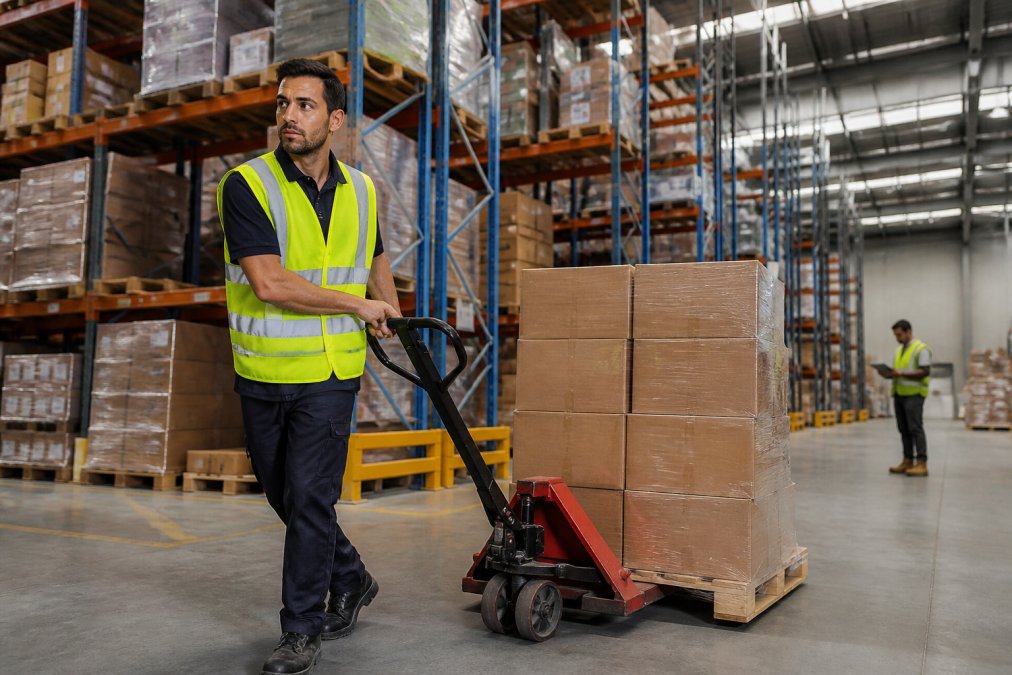
High visibility workwear standards exist because being seen is a control, not a preference. In a warehouse where forklifts and pedestrians share space, a worker in dark clothing in a blind spot is a hazard the operator cannot react to in time.
Traffic, Manual Handling and Ergonomics: Daily Controls That Work
Traffic management is where the most serious warehouse incidents are prevented. The principle is separation: keep pedestrians and vehicles apart, and where they must share space, control the interaction with barriers, marked crossings, and clear right-of-way rules.
For lifting technique, the essentials hold up:
- Keep the load close to your body and avoid twisting
- Bend the knees, not the back, and lift smoothly
- Split heavy loads or use a mechanical aid rather than pushing through
- Rotate tasks across the shift to break up repetitive strain
Building a Safety Culture: Mental Health, Near-Miss Reporting and Leadership
Safety culture is the difference between a site that complies and a site that is genuinely safe. It shows up in whether workers report a near miss or stay quiet because they fear blame.
Frequently Asked Questions
How can high-visibility apparel reduce workplace accidents?
High-visibility apparel with reflective tape makes workers easier to see around forklifts, pallet jacks and reversing vehicles, which is where many warehouse incidents occur. Under Australian Standards, hi-vis garments must meet AS/NZS 4602.1 for day/night use, and reflective tape must stay intact after washing. Choosing durable workwear, such as a safety vest with printed logo and reflective shoulder tapes, keeps visibility consistent shift after shift. Pairing hi-vis with traffic management plans gives the strongest protection.
What are the primary WHS obligations for warehouse operators?
Under the model Work Health and Safety Act, a person conducting a business or undertaking must ensure worker health and safety so far as is reasonably practicable. For warehousing, that means identifying hazards, providing safe systems of work, maintaining plant and equipment, offering training and supervision, and consulting workers on safety matters. You must also record and report notifiable incidents to the relevant regulator. Keeping a current risk assessment and toolbox talk schedule helps demonstrate compliance during an inspection.
How do you conduct a risk assessment for warehouse operations?
Start by walking the floor and listing every hazard: forklift movements, manual order picking, slips and trips, chemical storage and load stability. For each hazard, assess the likelihood and severity of harm, then decide on controls using the hierarchy of control, from elimination down to PPE. Document who is responsible and by when. Review the assessment after any incident, near-miss or layout change. A simple warehouse risk assessment checklist, completed monthly, keeps the process consistent.
What role does personal protective equipment play in warehouse safety?
PPE is the last line of defence, not the first. It protects against specific hazards when higher controls cannot remove them entirely. In warehousing, that typically means high-visibility clothing for pedestrian and vehicle separation, safety footwear for dropped loads, and gloves for manual handling. PPE must be provided free of charge, fit correctly and be maintained. A durable all-weather jacket with reflective tape, for example, keeps workers visible and dry during outdoor loading tasks.
Recent Blogs
September 18, 2026
Enhanced Safety on the Job for Warehouse Logistics
Discover practical steps for enhanced safety on the job for...
September 18, 2026
Enhanced Safety on the Job for Warehouse Logistics
Discover practical steps for enhanced safety on the job for...
September 18, 2026
Enhanced Safety on the Job for Warehouse Logistics
Discover practical steps for enhanced safety on the job for...