
Long Lasting Hi Vis Reflective Tape: 2026 Guide


Table of Contents
- What Makes Long Lasting Hi Vis Reflective Tape Essential for Workplace Safety
- AS/NZS 1906.4 Compliance: Meeting Legal Safety Standards
- Class 1 Reflective Tape Standards vs Class 2: Which You Need
- Adhesive vs Sew-on Reflective Tape: Durability and Application
- Product Specifications and Dimensions for Hi Vis Reflective Tape
- Installation, Maintenance, and Long-Term Care
- Removal and Surface Preparation for Tape Replacement
- Conclusion: Selecting the Right Hi Vis Reflective Tape for Your Team
Last Updated: August 27, 2026
What Makes Long Lasting Hi Vis Reflective Tape Essential for Workplace Safety
High-visibility workwear equipped with reflective tape is non-negotiable in hazardous environments. Worker visibility directly influences incident prevention, particularly in construction, logistics, and field maintenance. The challenge isn't finding reflective tape; it's finding tape that maintains its reflectivity coefficient, adhesive strength, and colour vibrancy through months of UV exposure, weather, abrasion, and repeated washing cycles.
| Tape Type | Application Method | Best For | Durability Range |
|---|---|---|---|
| Class 1 Adhesive-backed | Direct application to garment | Budget-conscious teams, frequent replacement cycles | 6-12 months |
| Class 2 Adhesive-backed | Direct application to garment | High-visibility requirements, extended durability | 12-24 months |
| Sew-on reflective tape | Stitched into seams | Permanent workwear, unlimited wash cycles | 3+ years |
| Iron-on heat transfer | Heat-applied to fabric | Custom branding, semi-permanent | 12-18 months |
AS/NZS 1906.4 Compliance: Meeting Legal Safety Standards
Reflective tape used in Australian workwear must meet requirements outlined in [AS/NZS 1906.4(/blogs/news/high-visibility-clothing-standards-australia) High-visibility safety apparel | standards.org.au]. This standard defines performance criteria for reflective materials, visibility ranges, colour specifications, and durability under real-world conditions.
Compliance is a legal obligation under workplace health and safety legislation. If your team works in roadside operations, airport ground operations, construction, or any role where visibility in low-light conditions is critical, your hi vis reflective tape must meet minimum performance thresholds set by this standard.
The standard classifies reflective tape into performance levels based on reflective coefficient (how much light bounces back to the source). A higher reflective coefficient means the tape remains visible at greater distances and in lower-light conditions. Compliance also covers colour specifications: fluorescent yellow, fluorescent yellow-green, and fluorescent orange are the only approved colours. Generic "yellow" or "orange" tape won't meet requirements; fluorescent pigments must meet specific lightness and saturation thresholds.
Verify that your supplier can provide certification showing the product meets AS/NZS 1906.4. This protects your business from liability and ensures your team is genuinely protected.
Class 1 Reflective Tape Standards vs Class 2: Which You Need
The choice between Class 1 and Class 2 reflective tape determines both your visibility range and compliance standing for specific work environments.
Class 1 reflective tape delivers a reflective coefficient of 100-150 cd/lux/m², providing visibility at approximately 100-150 metres under night-time conditions. Class 1 suits lower-speed environments, stationary work, or situations where workers are not in direct contact with moving traffic.
Class 2 reflective tape achieves a reflective coefficient of 200-300 cd/lux/m², providing visibility at 200-300 metres or more. Class 2 is required for high-speed environments, roadside work, airport ground operations, and any role where workers are near moving vehicles or equipment. In a 100 km/h zone, a driver has roughly 2.5 seconds to react once they see an object 100 metres ahead. At 150 metres, reaction time increases to approximately 3.75 seconds, enough additional time to reduce collision severity or avoid impact entirely.
If your team works near roadways, in airport operations, or in any high-speed setting, Class 2 is non-negotiable. For indoor warehousing, general construction, or lower-speed environments, Class 1 usually meets compliance requirements. Consult your safety officer or check specific requirements for your industry under Safe Work Australia guidance on high-visibility apparel.
Adhesive vs Sew-on Reflective Tape: Durability and Application
The method you choose to attach reflective tape fundamentally changes durability, maintenance, and long-term cost.
Adhesive-backed reflective tape uses permanent adhesive applied during manufacturing. The tape is pressed directly onto the garment fabric, creating an immediate bond. This method is fast, requires no specialised equipment, and is ideal for quick deployment. Hi Vis Work Clothes offers adhesive-backed options like the Work Pants Long Mens Double Tape Navy and Work Shirt HiVis Long Sleeve Reflective Tape Orange, which feature 5cm-width reflective strips positioned for optimal visibility.


The limitation: adhesive-backed tape degrades with repeated washing, UV exposure, and flexing at seams. After 12-24 months of regular use and laundering, the adhesive begins to fail, with edges curling and tape peeling away from corners and stress points.
Sew-on reflective tape is stitched into the fabric using needle and thread, creating a mechanical bond that doesn't rely on adhesive. This method is labour-intensive and requires trained personnel, but durability is exceptional. Sew-on tape remains attached through unlimited wash cycles, maintains reflectivity for 3+ years, and only fails when the underlying fabric wears out.
Heat transfer film (iron-on) sits between these approaches. It's applied using heat and pressure, creating a semi-permanent bond lasting 12-18 months. It's practical for custom branding or logo application.
For operations managers deciding between methods: How long will this garment be in service? How often is it washed? Adhesive-backed works for short-term projects or frequent replacement cycles. Sew-on works for permanent team uniforms and high-durability requirements.
Product Specifications and Dimensions for Hi Vis Reflective Tape
Reflective tape width, placement, and coverage directly determine visibility performance and compliance with AS/NZS 1906.4 standards.
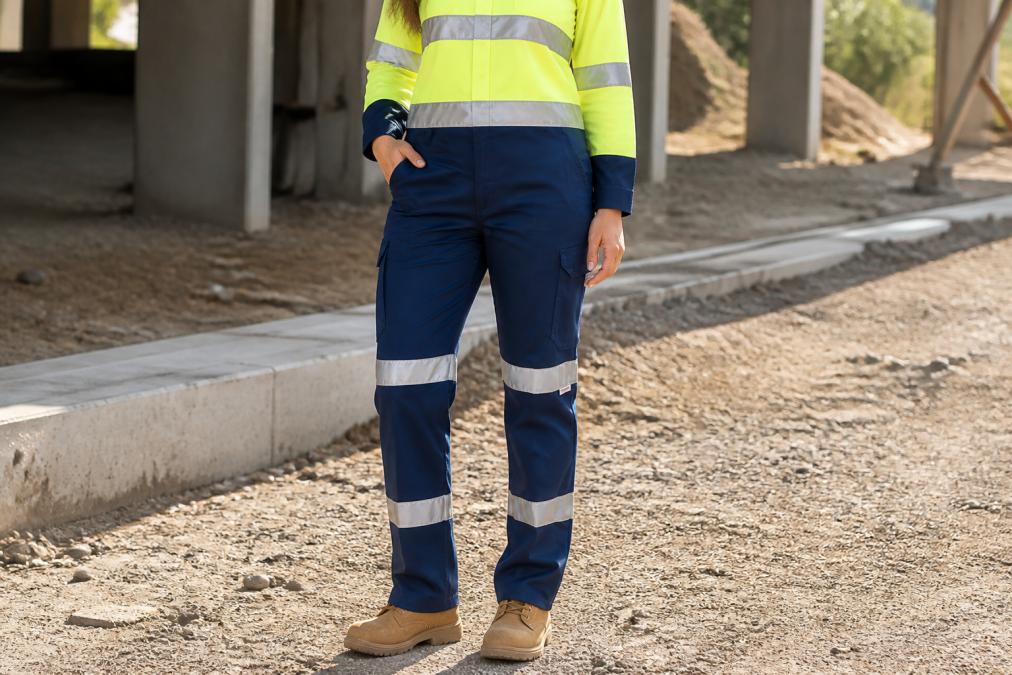
Tape width is the primary specification. Most workplace applications use 5cm-width tape, which balances visibility, fabric coverage, and manufacturing efficiency. The Work Pants Long Womans Double Tape Navy and Work Pants Long Mens Double Tape Navy both feature 5cm reflective strips positioned horizontally across the legs. The Work Shirt HiVis Long Sleeve Reflective Tape Yellow and Work Shirt HiVis Long Sleeve Reflective Tape Orange models also use 5cm-width tape for arm and torso coverage.

Tape placement matters for both visibility and durability. Horizontal bands across the torso and legs are standard because they're visible from multiple angles and less prone to peeling at stress points.
Number of tape bands affects visibility and cost. Single-tape designs meet minimum compliance for lower-risk environments. Double-tape designs improve visibility and are standard for construction and roadside work. Hi Vis Work Clothes's double-tape design reflects this standard; two reflective bands per garment provide adequate visibility for most workplace scenarios whilst keeping the garment comfortable.
Reflectivity grade is specified as either high-intensity or diamond grade. High-intensity tape (Class 1) uses standard retroreflective materials. Diamond grade (Class 2) uses advanced prismatic materials that reflect light more efficiently, appearing brighter and maintaining visibility at greater distances in low-light conditions.
Colour specifications must meet fluorescent standards. Fluorescent yellow provides contrast against most backgrounds. Fluorescent orange is used in some industries for additional visibility. Fluorescent yellow-green is increasingly common in high-speed environments because it provides superior contrast in night-time conditions.
Installation, Maintenance, and Long-Term Care
Proper installation and maintenance determine whether your hi vis reflective tape delivers protection for months or fails within weeks.

Installation of adhesive-backed tape requires surface preparation. The garment fabric must be clean, dry, and free of dust, lint, or moisture. Wipe the area with a lint-free cloth. Apply the tape firmly, pressing from the centre outward to eliminate air bubbles. Use a roller or hard edge to ensure complete contact.
For sew-on tape, professional installation is recommended. The stitching must be tight and consistent, with thread colour matching the tape or garment.
Washing and drying are critical for adhesive-backed tape longevity. Use warm water (below 60°C) and mild detergent. Avoid harsh chemicals, bleach, or high-temperature settings, which degrade the adhesive. Wash inside-out when possible to reduce direct friction on the tape. Air dry rather than machine drying.
For sew-on tape, standard washing is fine. The mechanical bond is unaffected by temperature or detergent.
Inspection and maintenance should be monthly for adhesive-backed tape, quarterly for sew-on. Check for edge peeling, colour fading, or reflectivity loss. If tape edges are lifting, re-press them firmly or apply fabric-safe adhesive. If reflectivity has faded noticeably, replacement is needed.
Storage affects tape longevity. Keep garments in a cool, dry place away from direct sunlight. UV exposure degrades reflective materials over time, even when not in use.
Removal and Surface Preparation for Tape Replacement
When adhesive-backed tape fails or needs replacement, improper removal can damage the underlying garment fabric.
Gentle removal is the first step. Peel the tape slowly and at a shallow angle (close to parallel with the fabric surface). If the tape resists, apply gentle heat using a hair dryer on low setting to soften the adhesive.
Adhesive residue removal comes next. Use rubbing alcohol or a commercial adhesive remover on a cloth, and gently rub the area until residue is gone. Test the remover on an inconspicuous area first to ensure it doesn't damage the fabric.
Surface preparation for new tape application requires a clean, dry surface. Wash the area with mild soap and water, then air dry completely. Wait at least 24 hours after cleaning before applying new tape.
Fabric inspection is important before reapplication. If the fabric is torn, thin, or heavily worn at the tape location, consider replacing the garment rather than re-taping.
For sew-on tape removal, a seam ripper or small scissors carefully cuts the stitching. Remove all thread remnants before applying new tape.
Conclusion: Selecting the Right Hi Vis Reflective Tape for Your Team
Choosing long lasting hi vis reflective tape means understanding your compliance requirements, work environment, and durability expectations. Class 1 tape meets most indoor and lower-speed scenarios. Class 2 is essential for roadside, airport, and high-speed work. Adhesive-backed tape offers quick deployment but requires replacement every 12-24 months. Sew-on tape delivers 3+ years of durability at higher upfront cost.
At Hi Vis Work Clothes, our range of reflective workwear is designed to meet AS/NZS 1906.4 compliance whilst delivering the durability your team needs. Our Work Pants Long Mens Double Tape Navy and Work Pants Long Womans Double Tape Navy feature 5cm reflective tape positioned for maximum visibility and durability. For upper-body protection, the Work Shirt HiVis Long Sleeve Reflective Tape Orange and Work Shirt HiVis Long Sleeve Reflective Tape Yellow provide breathable comfort with strong reflective coverage. For all-weather protection, the Jacket Waterproof Hood Reflective Tape - All Weather combines weather resistance with Class D/N reflective standards, ideal for extended outdoor work.
Get a quote from Hi Vis Work Clothes today and ensure your team is protected with compliant, long-lasting hi vis reflective tape engineered for demanding work environments.
Frequently Asked Questions
How often should hi vis reflective tape be replaced? Adhesive-backed tape typically requires replacement every 12-24 months depending on washing frequency and UV exposure. Sew-on tape lasts 3+ years. Inspect monthly for edge peeling or reflectivity loss and replace when visibility noticeably declines.
Does hi vis reflective tape meet Australian workplace standards? Yes, when sourced from compliant manufacturers. Verify that your supplier provides certification showing the product meets AS/NZS 1906.4 High-visibility safety apparel standards. This confirms the reflective coefficient, colour specifications, and durability requirements are met.
Can adhesive-backed reflective tape be washed? Yes, but with care. Use warm water (below 60°C) and mild detergent. Avoid bleach, harsh chemicals, and high-temperature drying. Air dry when possible. Aggressive washing accelerates adhesive degradation.
What's the difference between Class 1 and Class 2 reflective tape? Class 1 provides visibility at approximately 100-150 metres in night-time conditions. Class 2 provides visibility at 200-300 metres or more. Class 2 is required for high-speed environments and roadside work. Class 1 is suitable for lower-risk, stationary, or indoor work.
Is sew-on reflective tape worth the higher cost? For permanent team uniforms or high-durability requirements, yes. Sew-on tape lasts 3+ years versus 12-24 months for adhesive-backed. Over a 3-year period, sew-on typically costs less per year and requires no replacement cycles.
Frequently Asked Questions
How long does hi vis reflective tape last in outdoor conditions?
Quality hi vis reflective tape's durability depends on material grade, adhesive type, and exposure to UV light and weather. Regular cleaning extends lifespan; inspect tape quarterly for peeling, fading, or damage. Sew-on tape generally outlasts adhesive-backed options in high-wear environments. Harsh UV exposure and temperature fluctuations reduce longevity faster than protected storage.
What is the difference between Class 1 and Class 2 reflective tape standards?
Class 1 reflective tape offers lower visibility and is suitable for low-speed environments; Class 2 provides higher reflectivity for high-speed traffic and poor visibility conditions. Class 2 meets AS/NZS 1906.4 requirements for most workplace safety applications. Class 2 tape has a larger retroreflective coefficient, making it visible from greater distances at night. For construction sites and vehicle markings, Class 2 is a common requirement.
Should I choose adhesive or sew-on reflective tape for durability?
Sew-on reflective tape offers superior durability in high-wear situations, withstanding repeated washing and abrasion without peeling. Adhesive-backed tape is easier to apply but requires quality surface preparation and may fail after 1-2 years in harsh conditions. For workwear that undergoes regular laundering, sew-on is more reliable. Adhesive works best on rigid surfaces like vehicles or equipment where washing is infrequent.
How do I ensure my reflective tape meets safety compliance standards?
Verify that tape meets AS/NZS 1906.4 standards before purchase. Check product documentation for reflective coefficient measurements and retroreflectivity test results. Apply tape according to manufacturer instructions, ensuring proper surface preparation and adhesive contact. Inspect regularly for damage or fading. Most suppliers provide compliance certificates; request these before ordering bulk quantities for your team.
This article was written using GrandRanker
Recent Blogs
August 27, 2026
Long Lasting Hi Vis Reflective Tape: 2026 Guide
Choose durable hi vis reflective tape for construction and workplace...
August 27, 2026
Long Lasting Hi Vis Reflective Tape: 2026 Guide
Choose durable hi vis reflective tape for construction and workplace...
August 27, 2026
Long Lasting Hi Vis Reflective Tape: 2026 Guide
Choose durable hi vis reflective tape for construction and workplace...