
Badger Australia vs RSEA Safety Workwear


Table of Contents
- Badger Australia vs RSEA Safety Workwear: What Buyers Need to Know
- Product Range: High-Visibility Clothing, Safety Footwear and Protective Gear
- Compliance and Australian Safety Standards: What to Verify
- Workwear Supplier Comparison Checklist for Trade Teams
- Workwear Sizing and Fit Guide for Bulk Orders
- Workwear Uniform Order Template: Simplifying Your Procurement
- High Visibility Workwear for Teams: Custom Branding and Durability
- Conclusion: Choosing the Right Workwear Supplier
- Frequently Asked Questions
Last Updated: October 8, 2026
Badger Australia vs RSEA Safety Workwear: What Buyers Need to Know
Choosing between Badger Australia and RSEA Safety workwear comes down to what your team actually needs: a broad retail network versus a supplier that builds uniforms around your branding and your compliance paperwork. This guide from Hi Vis Work Clothes breaks down product range, footwear, Australian safety standards, sizing, and procurement so you can compare both properly.
Most buying decisions stall on the same three questions. Does the gear meet the standards we have to prove? Will it survive a full season on site? And can we get 200 units branded and delivered before the new crew starts? Below, we compare Badger Australia vs RSEA Safety workwear across those exact criteria, then show you where a specialist supplier fits.
Product Range: High-Visibility Clothing, Safety Footwear and Protective Gear
Both retailers carry the basics: hi-vis shirts, polos, jackets, pants, and safety boots. RSEA Safety operates a large retail footprint with a wide catalogue spanning PPE, signage, and first aid. Badger Australia leans toward workwear and footwear with strong brand-name stock.
Where they differ is depth versus fit. A general catalogue gives you options; it does not give you a garment cut for your crew's climate and tasks. The practical test is whether the range covers the four categories most trade teams actually order in a single cycle:

- Hi-vis upper body, shirts, polos, and jackets rated for day, night, or day-night use
- Hi-vis lower body, pants and shorts with reflective tape positioned for the wearer's typical posture
- Safety footwear, steel-toe and composite options with midsole choices matched to the terrain
- Wet weather and thermal layers, jackets and fleece that sit over the hi-vis layer without hiding the tape
A catalogue that stocks all four lets you raise one purchase order instead of four. That matters more than raw SKU count when a crew starts on Monday.
Safety Footwear Options
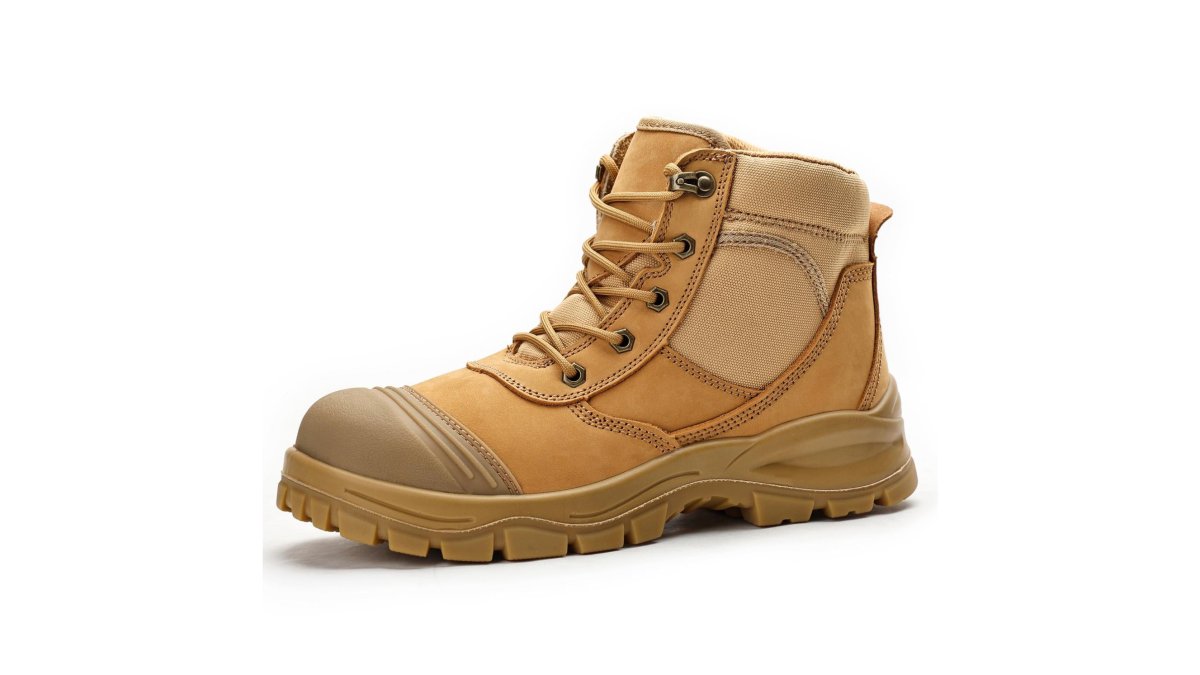
Footwear is where procurement teams feel the difference fastest. Both suppliers stock steel-toe and composite options, but the specification detail matters more than the logo on the box.
Our range covers the common site requirements:
- Crazy Horse Leather Boot at $169.00 with a European Standard Steel Toe and European Standard Steel midsole
- ES Nubuck Leather Boot at $179.00 with a Top-layer Nubuck Leather+TPU toe cap, European Standard Steel Toe, and European Standard Kevlar midsole
- Oxford Cloth Nubuck Leather Boot at $165.50 with a Top-layer Nubuck Leather+Oxford Cloth upper, European Standard Steel Toe, European Standard Kevlar midsole, and dual-density PU injection molding outsole
- TPU Nubuck Leather Boot at $196.00 with a Top-layer Nubuck Leather+TPU toe cap, European Standard Steel Toe, European Standard Kevlar midsole, and PU + Rubber outsole
- Top-layer Nubuck Leather Boot at $165.00 with a Top-layer Nubuck Leather upper, European Standard Steel Toe, European Standard Kevlar midsole, and dual-density PU injection molding outsole
Product-Level Compliance Evidence
A range is only useful if each item can be defended in an audit. Ask for the test report reference, the certification body, and the issue date for the specific garment or boot, not the fabric or the leather. A fabric certificate does not prove the sewn garment meets AS/NZS 4602.1, and an inspector will ask for garment-level evidence. Build a simple register: item, standard, certificate reference, expiry. That register is the difference between a range that looks compliant and one that is.


Compliance and Australian Safety Standards: What to Verify
Compliance is not a brochure claim. It is a document trail. High-visibility garments are generally assessed against AS/NZS 4602.1 for day, night, or day-night use, and AS/NZS 1906.4 for the retroreflective material itself. Footwear is typically assessed against AS/NZS 2210.3.
Ask both suppliers for the same three things: the test report reference, the certification body, and the date it was issued. Garments rated for day-night use carry reflective tape that must stay retroreflective after repeated washing, so the care instructions are part of the compliance story, not an afterthought.
For guidance on what your workplace must document, the Safe Work Australia national guidance material sets out the model work health and safety framework that most jurisdictions follow. Confirm the current requirements with your own state or territory regulator.
Workwear Supplier Comparison Checklist for Trade Teams
A workwear supplier comparison checklist turns a subjective conversation into a scored decision. Score each supplier from 1 to 5 against the criteria below, then weight the ones that matter most to your operation.
| Criteria | What to Check | Why It Matters |
|---|---|---|
| Product range | Hi-vis, footwear, wet weather, FR options | Fewer suppliers to manage |
| Compliance evidence | Garment-level test reports | Defensible in an audit |
| Branding | Printing or embroidery, wash durability | Consistent team presentation |
| Sizing | Full size run, inclusive fit | Fewer returns and swaps |
| Turnaround | Lead time on branded bulk orders | Crews start on day one |
| Account support | Dedicated contact, reorder history | Less admin per order |
Run the same checklist against Badger Australia vs RSEA Safety workwear and against us. The scores usually make the decision obvious.
Workwear Sizing and Fit Guide for Bulk Orders
Sizing is the hidden cost in bulk orders. Get it wrong and you pay twice: once for the garment, once for the replacement and the freight.
A practical approach is to size on measurements rather than labels, because a size 12 in one brand is not a size 12 in another. Collect chest, waist, and height for each worker, then map those numbers to the supplier's chart. The chart is the contract, if the supplier cannot provide one with body measurements rather than garment measurements, that is a warning sign.
Fit also varies by garment type, and this is where most bulk orders go wrong:
- Hi-vis shirts and polos, check shoulder width and sleeve length, because a shirt that is tight across the shoulders restricts overhead work
- Hi-vis pants, check the rise and the leg length separately; a pant that fits the waist but is short in the leg will not stay over a boot
- Jackets and wet weather layers, size to fit over the hi-vis layer, not against the body, or the reflective tape will be obscured
- Safety boots, check the width fitting as well as the length, since a boot that is correct in length but narrow will not be worn for a full shift
Inclusive sizing is part of this. A full size run should extend beyond the middle of the range, and the supplier should be able to confirm which sizes are stocked versus made to order. If the larger or smaller sizes are made to order, that changes your lead time and your buffer stock.
- Order one sample garment in the middle of your size range and have two or three people try it on
- Build a sizing sheet per crew, not per company, since trades vary in build
- Add a small buffer of the two most common sizes for new starters
- Record each worker's confirmed size so reorders do not restart the process
Workwear Uniform Order Template: Simplifying Your Procurement
A workwear uniform order template removes the back-and-forth that stalls bulk orders. Copy the structure below and fill it in before you request quotes.
Uniform Order Template
- Company and site details: [business name] / [site address]
- Order purpose: [new starters / replacement / seasonal]
- Garment list: [item, colour, size, quantity]
- Branding: [logo file, placement, print or embroidery]
- Compliance required: [standard, day or night rating]
- Sizing sheet: [attached per worker]
- Delivery: [address, required date, split deliveries]
- Approver: [name, purchase order number]
Send the same completed template to every supplier you are comparing. It forces an apples-to-apples quote and exposes lead times early.
High Visibility Workwear for Teams: Custom Branding and Durability
Custom branding is where a specialist supplier earns its place. We print or embroider your logo across hi-vis apparel, and offer reflective tape options and all-weather jacket builds for crews working outside year-round.
Conclusion: Choosing the Right Workwear Supplier
The real challenge is not picking a brand. It is proving compliance, fitting every worker, and getting branded gear on site before the first shift. For teams that need that handled in one order, Hi Vis Work Clothes provides high-visibility workwear, custom logo printing and embroidery, reflective tape options, and all-weather jacket options suited to construction, professional teams, and group requirements. Get a quote and we will work through your sizing sheet and compliance requirements with you.
Frequently Asked Questions
What is the difference between Badger Australia and RSEA Safety?
Badger Australia and RSEA Safety are both workwear retailers serving the Australian market, but they differ in scale, product focus and service model. Badger Australia operates as a specialised supplier with a curated range of industrial workwear and safety gear. RSEA Safety runs a larger network of retail stores and offers a broader catalogue across many categories. For buyers, the key difference lies in product depth, custom branding capability and how each handles bulk orders for teams. A workwear comparison should weigh these factors against your specific trade requirements.
How should businesses compare workwear suppliers?
Start with a workwear supplier comparison checklist covering product range, compliance evidence, sizing options, custom branding, delivery timeframes and returns policy. Request samples to assess fabric durability and fit. Confirm that high-visibility garments meet Australian safety standards, and ask for product-level certification rather than general claims. Also evaluate whether the supplier offers a dedicated account manager for business contracts, as this affects how smoothly reorders and sizing distribution are handled across multiple crews or states.
What should a workwear uniform order template include?
A workwear uniform order template should capture employee names, roles, sizes, quantity per item, branding placement, and delivery deadlines. Include columns for high-visibility class requirements and any flame-retardant or anti-static specifications. Add a section for sizing distribution across sites so you can track who receives what. This template reduces back-and-forth with your supplier and ensures every team member gets correctly fitted gear. It also simplifies reordering when new staff join or existing items wear out.
How do I ensure consistent high-visibility workwear for teams across multiple locations?
Standardise your order by selecting one supplier and one product range for all sites. Use a workwear sizing and fit guide to collect accurate measurements from every team member before placing the bulk order. Centralise branding so logos and reflective tape placement remain identical across garments. Set up a business account with your supplier to streamline reorders. If crews work in different climates, choose all-weather options that maintain high-visibility performance in both hot and cold conditions.
What should you check before ordering branded safety workwear?
Before ordering, verify that the garments meet the relevant Australian safety standards for your industry, including high-visibility class and any flame-retardant requirements. Confirm the supplier's embroidery or printing method and ask about wash durability. Check sizing availability across the full range, especially if you have team members needing inclusive sizing. Review the returns policy for branded items, as customised gear often has different terms. Finally, confirm lead times so new hires are not left waiting for uniforms.
This article is published by Hi Vis Work Clothes. Compliance requirements vary by jurisdiction; confirm current obligations with your state or territory work health and safety regulator.
Recent Blogs
October 09, 2026
Badger Australia vs RSEA Safety Workwear
Badger Australia vs RSEA Safety workwear: compare product range, compliance,...
October 09, 2026
Badger Australia vs RSEA Safety Workwear
Badger Australia vs RSEA Safety workwear: compare product range, compliance,...
October 09, 2026
Badger Australia vs RSEA Safety Workwear
Badger Australia vs RSEA Safety workwear: compare product range, compliance,...