
Safety Compliance for Airport Ground Crews: A 2026 Guide


Table of Contents
- Safety Compliance for Airport Ground Crews: Overview and Regulatory Framework
- CASA Ground Operations Regulations and Compliance Standards
- Aviation Safety Management Systems Australia: Building Your SMS
- Ground Support Equipment Safety Australia: GSE Management and Operation
- Airport Safety Induction Australia: Training and Certification for Ground Staff
- Airside Safety Protocols: Tarmac Operations and Emergency Response
- Personal Protective Equipment and High-Visibility Compliance
- Technological Integration and Data-Driven Safety Culture
Safety Compliance for Airport Ground Crews: A 2026 Guide
Last Updated: July 30, 2026
Safety compliance for airport ground crews prevents incidents, protects lives, and keeps operations running smoothly. At Hi Vis Work Clothes, we understand that ground crew safety extends beyond wearing the right gear to encompass comprehensive management systems, rigorous training, hazard identification, and a safety culture that permeates every shift. Below, we'll show you how to implement a strong safety compliance framework that meets CASA regulations, IATA standards, and real-world operational demands.
Safety Compliance for Airport Ground Crews: Overview and Regulatory Framework
Understanding the regulatory landscape is your first step toward building a compliant operation. In Australia, safety compliance for airport ground crews falls under the Civil Aviation Safety Authority (CASA), which sets baseline expectations through various instruments and advisory circulars.
Your responsibility is to stay current with these regulations and translate them into actionable Standard Operating Procedures (SOPs) that your team can follow daily.
Ground operations are high-risk environments where split-second decisions and equipment failures can have catastrophic consequences. Aircraft arrivals and departures involve complex coordination between tug drivers, marshalling staff, baggage handlers, fuelling crews, and catering teams. Each role carries distinct hazards, from tyre pressure management on tugs to obstruction clearance on the apron.
CASA Ground Operations Regulations and Compliance Standards
CASA's approach to ground operations safety is principles-based rather than prescriptive, meaning you have flexibility in how you achieve compliance, but you must demonstrate that your methods work. The Civil Aviation Regulations (CARs) Part 139 covers aerodrome operations, including ground service requirements.
Your organisation must hold an Aerodrome Operator Certificate (AOC) or equivalent authority to conduct ground handling activities, and that certificate comes with conditions around safety management, staff competency, and incident reporting.
According to CASA's Part 139 regulations, aerodromes must establish and maintain a Safety Management System (SMS) that identifies hazards, assesses risks, and implements controls. Your SMS should document how you select, train, and supervise ground handlers; how you maintain equipment; how you manage fatigue and human factors; and how you respond to incidents.
CAP437 and IATA Standards for Airside Safety
CAP437 is the UK Civil Aviation Authority's guidance document on aerodrome safety, widely referenced as best practice. It covers airside safety protocols, vehicle operation, pedestrian movement, and emergency procedures.
IATA (International Air Transport Association) standards complement regulatory requirements by setting industry benchmarks for ground handling, equipment maintenance, and safety performance indicators. Aligning your operations to CASA regulations, CAP437, and IATA standards means adopting practices tested across hundreds of airports globally.
Aviation Safety Management Systems Australia: Building Your SMS
A Safety Management System is the backbone of safety compliance. Your SMS must have four pillars: safety policy, safety risk management, safety assurance, and safety promotion. Your safety policy must state clearly that safety is non-negotiable, that every employee has a duty to report hazards, and that the organisation will support anyone who raises safety concerns.
Risk Assessment and Hazard Identification in Ground Operations
Risk assessment is where theory meets reality. You must systematically identify hazards in your operation, not just the obvious ones, but the subtle, context-specific risks that emerge from your particular mix of aircraft types, weather patterns, staff experience, and equipment.
Common hazards in airport ground operations include vehicle strikes on the apron, tyre failures on tugs and ground support equipment, fuel and chemical spills, noise-induced hearing damage, fatigue-related errors, struck-by incidents during cargo handling, pedestrian incidents, and weather-related hazards such as strong crosswinds or icy surfaces.
For each hazard, assign a risk rating (high, medium, or low) based on likelihood and consequence. Controls should follow the hierarchy: elimination, substitution, engineering controls, administrative controls, and finally PPE.
Safety Performance Indicators and Incident Reporting
Establish safety performance indicators (SPIs) such as lost-time injury frequency rate (LTIFR), total recordable incident rate (TRIR), near-miss reporting rate, hazard identification rate, training completion rate, and audit compliance rate. Track these metrics monthly and use data to drive improvement.
Incident reporting is not punishment, it's learning. When an incident occurs, investigate thoroughly. Ask not just "what happened?" but "why did it happen?" Look for systemic factors: unclear procedures, staff fatigue, poor maintenance, or pressure to work faster. A learning culture strengthens safety; a blame culture kills reporting.
Ground Support Equipment Safety Australia: GSE Management and Operation
Ground support equipment, tugs, loaders, baggage carts, catering vehicles, fuel trucks, is essential to airport operations. Each piece is a potential hazard if not properly maintained, inspected, and operated. Your GSE safety programme must cover selection, maintenance, inspection, operator training, and incident investigation.
When selecting GSE, consider total lifecycle cost, including maintenance, fuel efficiency, and safety features. Modern GSE includes collision avoidance systems, stability control, and enhanced braking. Older equipment may lack these features; if you operate older fleet, you need compensating controls such as more frequent inspections, stricter speed limits, or additional operator training.
Maintenance, Inspection, and Safe Operation Procedures
Every piece of GSE must have a documented maintenance schedule. Oil changes, filter replacements, brake inspections, and tyre pressure checks are not optional, they're the foundation of safe operation. Maintenance records should be kept for at least five years.
Pre-operation inspections are the operator's responsibility. Before starting equipment, the operator should walk around, check for damage, verify tyre pressure, check fluid levels, and test brakes. Safe operation procedures must be specific to your fleet and written in plain language with diagrams, tested during initial training, and refreshed annually.
Airport Safety Induction Australia: Training and Certification for Ground Staff
Your induction programme is where new staff learn your safety culture. An effective induction covers your organisation's safety policy, key hazards and controls, your SMS and reporting procedures, emergency procedures, location-specific hazards, role-specific hazards, PPE use, radio communication and hand signals, fatigue management, and mental health support.
The induction should take at least one full day, combining classroom, practical demonstration, and supervised on-the-job training. Staff should not work unsupervised until they've demonstrated competency.
Mandatory Induction Checklist and Competency Assessment
Create a checklist documenting what each new hire must learn and who verified their competency. A competency assessment might include a written test on hazards and controls (pass mark 80%), practical demonstration of key tasks, supervised operation under a mentor for 20-40 hours depending on role, and final sign-off by a supervisor. Annual refresher training should be mandatory, covering procedure changes, incident lessons, and new hazards.
Mental Health, Fatigue Management, and Human Factors
Ground crew work is physically and mentally demanding. Early starts, shift work, high-pressure environments, and responsibility around aircraft create stress. Fatigue is a hazard that's often invisible until it causes an incident.
A fatigue management policy should address maximum working hours per shift and per week, minimum rest periods between shifts, rotation patterns that minimise fatigue, how staff can report fatigue without fear of punishment, and support for staff with sleep disorders. Mental health support should be available through an Employee Assistance Programme, peer support networks, or counselling.
Airside Safety Protocols: Tarmac Operations and Emergency Response
The apron is the highest-risk zone in airport operations. Multiple teams, vehicles, and aircraft move simultaneously. Communication must be clear, visibility must be high, and procedures must be followed without exception.
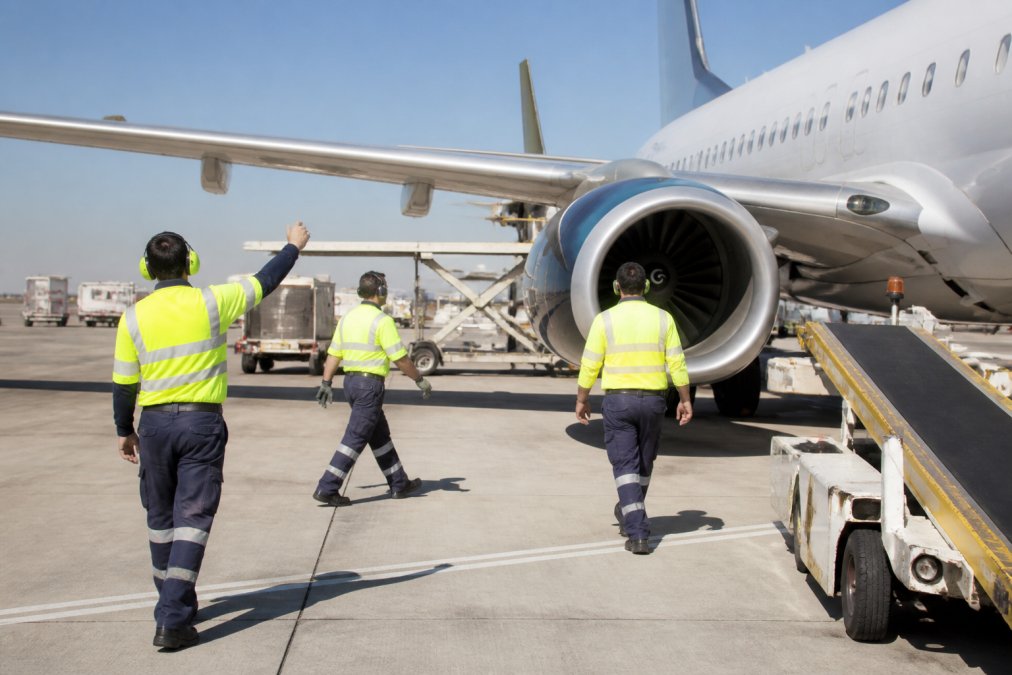
Airside safety protocols should cover vehicle movement (speed limits, designated routes, pedestrian crossing points), aircraft arrival and departure procedures, pedestrian movement, obstruction clearance, and night operations.
Departure and Arrival Procedures, Obstruction Clearance
Departure procedures begin with a pre-push-back briefing between the tug driver and flight crew. The flight crew confirms correct positioning and readiness; the tug driver confirms understanding and begins push-back only when clearance is given. Before any aircraft movement, the area must be cleared of obstruction. A dedicated observer should verify clearance before movement begins.
Emergency Chute Deployment and Passenger Safety
Emergency chutes are deployed only in genuine emergencies. Ground staff should know where chutes are located on different aircraft types, how to assist passengers exiting via chute, how to communicate with flight crew during emergencies, how to manage passenger movement, and how to coordinate with emergency services. Emergency procedures should be practised annually through full-scale or tabletop exercises involving multiple teams.
Personal Protective Equipment and High-Visibility Compliance
Personal protective equipment is your last line of defence when engineering and administrative controls aren't enough. On the apron, the most critical PPE is high-visibility clothing and hearing protection.
High-visibility clothing must meet Australian Standards AS/NZS 1906.4:2010, which specifies requirements for workers in daytime and low-light conditions. Clothing must have fluorescent material (day-glo yellow or orange) combined with reflective tape at least 50 mm wide, positioned on sleeves, torso, and legs to create a recognisable pattern.
Hearing protection is equally critical. Aircraft noise exceeds 100 decibels at close range; prolonged exposure causes permanent hearing damage. Hearing protection must be worn whenever noise levels exceed 85 decibels, typically anywhere on the apron when aircraft engines are running.
Selecting Compliant High-Visibility Workwear for Ground Crews
When selecting high-visibility workwear, start with the Australian Standard. Look for clothing that clearly displays compliance with AS/NZS 1906.4:2010. Reflective material must be positioned to ensure visibility from all angles, particularly from behind where approaching vehicles pose the greatest hazard.
Hi Vis Work Clothes specialises in high-visibility apparel designed for demanding work environments like airport ground operations. Their [Work Shirt HiVis Long Sleeve Reflective Tape Yellow](https://hivisworkclothes.com.au/products/work-shirt-hivis-long-sleeve-reflective-tape-yellow) features 5 cm reflective tape positioned on sleeves and torso, breathable mesh at the collar and underarms, and a durable 45% cotton, 55% polyester blend that withstands repeated washing and outdoor exposure.

For lower-body visibility, the Work Pants Long Mens Double Tape Navy includes double reflective tape positioned on the legs. For variable weather, the Jacket Waterproof Hood Reflective Tape - All Weather provides comprehensive protection with 100% 300D oxford polyester construction and quilted lining.

For teams requiring branded workwear, the Safety Vest Adult Size Printed Logo allows you to add your organisation's branding while maintaining compliance. When bulk-ordering workwear, ensure sizing is appropriate for your workforce.

Technological Integration and Data-Driven Safety Culture
Technology is transforming airport ground operations. Real-time vehicle tracking, automated hazard detection, predictive maintenance, and AI-powered incident analysis are operational reality at leading Australian airports. Vehicle tracking systems use GPS and IoT sensors to monitor GSE location, speed, and operational patterns. Predictive maintenance uses sensor data to predict equipment failures before they happen.
However, technology is not a substitute for culture. The most sophisticated tracking system won't prevent incidents if staff feel they can't report near-misses without punishment. Build your safety culture by leading from the front, listening to staff, celebrating near-miss reporting, learning from incidents, communicating transparently, and investing in training.
| Safety Culture Element | What It Looks Like | Impact |
|---|---|---|
| Leadership commitment | Senior management visible on apron, attending safety meetings, making safety-first decisions | Staff believe safety is genuine priority |
| Reporting culture | Staff report near-misses and hazards without fear; investigations are fair and learning-focused | Early identification of risks; prevention rather than reaction |
| Competency | Staff are well-trained, confident, and know their limits; training is refreshed regularly | Fewer errors; better decisions under pressure |
| Communication | Clear procedures, regular briefings, radio protocols respected, hand signals standardised | Fewer misunderstandings; faster hazard response |
| Equipment | Maintained properly, inspected regularly, replaced when unsafe; staff trained on operation | Fewer equipment failures; staff confidence in reliability |
| Psychological safety | Staff feel valued, respected, and supported; mental health resources available; fatigue is managed | Staff speak up; incidents prevented before they cause harm |
Ground crew safety is a commitment to bringing every team member home safely every day. The regulatory framework provides the baseline; your SMS provides the structure; your culture provides the motivation. Invest in training, listen to your staff, investigate incidents thoroughly, and create an environment where safety is genuinely valued.
At Hi Vis Work Clothes, we support this mission by providing durable, compliant high-visibility workwear that keeps your team visible and protected. When your crew is properly equipped, trained, and supported, incidents become rare, your operation runs smoothly, and your reputation for safety becomes your competitive advantage. Get a quote from Hi Vis Work Clothes today and ensure your team has the professional, compliant gear they need to work safely every shift.
Frequently Asked Questions
What are the key safety regulations for airport ground crews in Australia?
Airport ground crews in Australia must comply with CASA regulations, CAP437 standards, and IATA guidelines. These frameworks govern airside safety, ground support equipment operation, hazard identification, and emergency procedures.
All AOC holders and ground handlers must establish Safety Management Systems (SMS) that document risk profiles, standard operating procedures, and incident reporting mechanisms. Compliance is mandatory across all Australian aerodromes.
What training and induction are required for airport safety compliance in Australia?
All ground staff must complete a formal airport safety induction before working airside. This includes hazard awareness, emergency procedures, airside safety protocols, GSE operation, and communication standards. Inductions must be documented and competency assessed.
Refresher training is typically required annually or when procedures change. Mental health and fatigue management training is increasingly important for managing human factors in ground operations.
How does a Safety Management System (SMS) support ground operations compliance?
An SMS provides a framework for identifying hazards, assessing risks, implementing controls, and monitoring safety performance. It includes documented procedures, incident reporting systems, safety performance indicators, and regular audits.
An effective SMS helps ground handlers meet CASA requirements, reduce incidents, and build a strong safety culture. It must cover all ground operations: aircraft handling, GSE maintenance, tarmac procedures, and passenger safety.
What personal protective equipment must airport ground crews wear?
Ground crews must wear high-visibility apparel with reflective tape (typically 5cm width), safety footwear, and task-specific PPE such as hard hats, gloves, or eye protection. High-visibility clothing must meet Australian visibility standards and be maintained in good condition.
Quality workwear with durable reflective tape reduces visibility failures and heat stress. Consider breathable fabrics with mesh panels for comfort during long shifts, especially in Australian heat.
How do Australian airports manage Ground Support Equipment (GSE) safety?
GSE safety is governed by maintenance schedules, pre-operation inspections, and operator competency. Equipment must be regularly serviced, with defects logged and repaired before use. Operators require formal training and certification.
Common GSE hazards include tyre pressure failures, braking issues, and obstruction collisions. Documented inspection records and maintenance logs are essential for regulatory compliance and incident prevention.
What role does CASA play in airport ground crew safety compliance?
CASA (Civil Aviation Safety Authority) sets the regulatory framework for aviation safety in Australia, including ground operations. CASA requires all AOC holders to maintain an SMS, conduct hazard assessments, report incidents, and ensure competency of all personnel.
CASA audits compliance through inspections and reviews safety performance data. Ground handlers must understand CASA's expectations and maintain detailed records of training, incidents, and corrective actions.
How can ground crews reduce fatigue and mental health risks during compliance?
Fatigue management includes scheduling practices that prevent excessive shift lengths, rotation patterns that allow recovery, and fatigue risk assessment tools. Mental health support, peer support programs, and clear reporting mechanisms help address psychological hazards.
Ground crews face high-stress environments with safety-critical tasks; recognising fatigue and mental health as hazards, not personal failings, strengthens safety culture and reduces incidents caused by human factors.
This article was written using GrandRanker
Recent Blogs
July 30, 2026
Safety Compliance for Airport Ground Crews: A 2026 Guide
Master safety compliance for airport ground crews in Australia. Learn...
July 30, 2026
Safety Compliance for Airport Ground Crews: A 2026 Guide
Master safety compliance for airport ground crews in Australia. Learn...
July 30, 2026
Safety Compliance for Airport Ground Crews: A 2026 Guide
Master safety compliance for airport ground crews in Australia. Learn...