
Preventing Heat Stress in Work Uniforms: A 2026 Guide


Table of Contents
- Understanding Heat Stress and Core Body Temperature
- Breathable Workwear Fabrics Australia: Material Selection Matters
- Cooling Work Uniforms Australia: Fit, Cut, and Design
- Heat Stress Management Workplace Australia: Engineering Controls and Work Practices
- UV Protective Workwear Australia: Additional Thermal Protection
- Personal Protective Equipment and Cooling Systems for Heat Stress Prevention
- Educating Employees on Heat Stress and Workplace Safety Compliance
- Practical Implementation: Selecting and Maintaining Heat-Stress-Prevention Uniforms
Preventing Heat Stress in Work Uniforms: A 2026 Guide
Last Updated: July 29, 2026
Research from occupational health bodies across Australia shows that heat-related illness remains one of the most preventable workplace hazards, yet thousands of workers experience heat exhaustion each year because their uniforms work against their body's natural cooling systems. This guide covers preventing heat stress in work uniforms through fabric selection, fit, engineering controls, and practical workplace strategies.
The challenge is straightforward: most standard work uniforms trap body heat, restrict airflow, and accelerate core body temperature rise. The solution involves understanding how fabric technology, garment design, and hydration work together to maintain thermal regulation.
Understanding Heat Stress and Core Body Temperature
Heat stress occurs when your body cannot cool itself effectively, causing core body temperature to rise beyond safe levels. This happens when environmental heat, physical exertion, and clothing combine to overwhelm your body's natural evaporative cooling system. Workers in construction, utilities, agriculture, and outdoor services face the highest risk, particularly during Australian summer months when heat index values can exceed 50°C.
Your core body temperature sits around 37°C under normal conditions. When it rises to 38-39°C, you experience heat exhaustion. Beyond 40°C, heat stroke becomes a medical emergency. Work uniforms either help or hinder this thermal regulation. Heavy fabrics, tight fits, and poor ventilation trap sweat against the skin, preventing evaporative cooling. Breathable, moisture-wicking materials allow sweat to evaporate efficiently, keeping core temperature stable.
Warning Signs of Heat-Related Illness
Recognising early signs of heat stress prevents serious injury. Watch for these warning signs in yourself and your team:
- Heavy sweating followed by reduced or no sweating (a dangerous sign that the body's cooling system is failing)
- Dizziness, lightheadedness, or confusion
- Rapid or irregular heartbeat
- Muscle cramps, particularly in the legs or abdomen
- Nausea or headache
- Weakness or fatigue that develops quickly
- Red, hot skin that feels dry to the touch
Heat exhaustion can progress to heat stroke within minutes. Heat stroke is a medical emergency: call emergency services immediately if someone becomes unresponsive, loses consciousness, or stops sweating despite high body temperature.
How Work Uniforms Affect Thermal Regulation
Your uniform is the first line of defence between your body and the environment. Poor uniform choices sabotage thermal regulation by trapping heat, preventing sweat evaporation, and adding weight that increases metabolic heat production.
A standard cotton work shirt absorbs sweat and holds moisture against your skin, preventing evaporation. Heavy denim or thick canvas trousers add insulation when you need the opposite. The fit matters enormously: tight uniforms restrict blood circulation and airflow, trapping heat. Loose-fitting garments allow air to circulate, enabling sweat to evaporate and body heat to dissipate.
Breathable Workwear Fabrics Australia: Material Selection Matters
Fabric choice determines how effectively your uniform manages moisture and heat. Modern synthetic blends outperform traditional cotton for heat-stress prevention.
Moisture-Wicking and Evaporative Cooling
Moisture-wicking fabrics pull sweat away from your skin and move it to the fabric's outer surface, where it can evaporate. This evaporative cooling is your body's primary heat-regulation mechanism. When sweat sits on your skin instead of evaporating, you stay hot and wet.
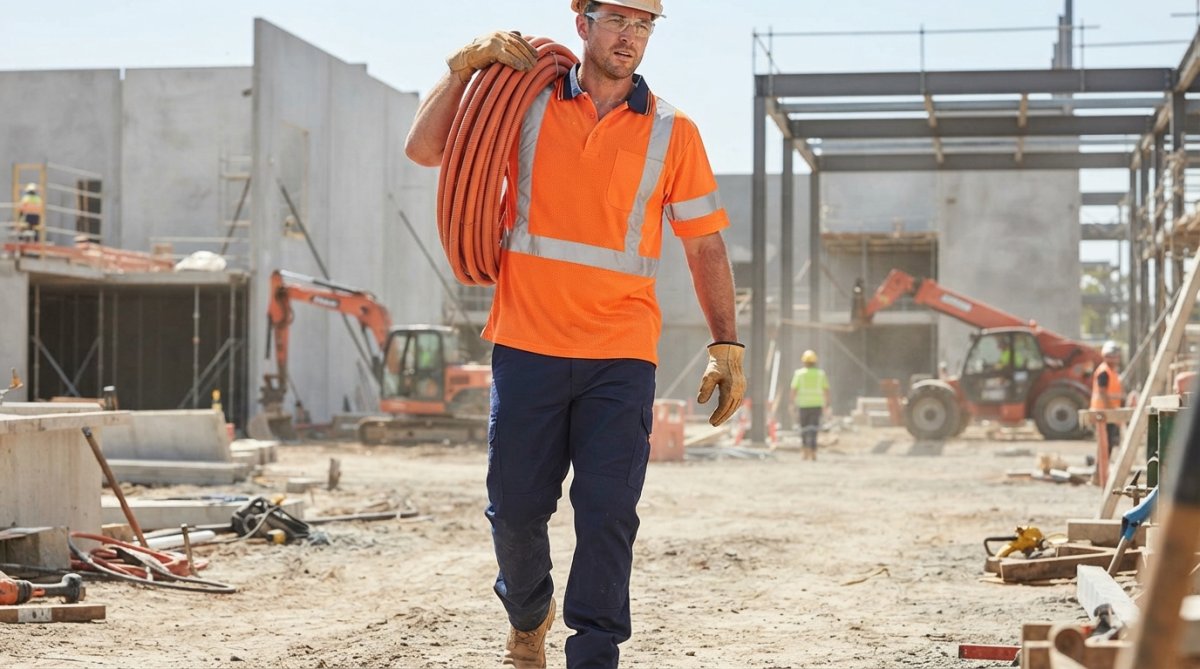
Polyester bird eye mesh, used in many modern work polos, is engineered for this purpose. The mesh structure creates air channels that allow moisture to travel away from skin and air to circulate freely. When you compare a standard cotton polo to a polyester mesh polo in identical conditions, the mesh version keeps workers cooler because sweat doesn't accumulate. This is why Hi Vis Work Clothes' [Polo Shirt Short Sleeve Hi Vis No Tape - Yellow](https://hivisworkclothes.com.au/products/polo-shirt-short-sleeve-hi-vis-yellow) and Polo Shirt Short Sleeve Hi Vis Reflective Tape - Orange use 100% polyester bird eye mesh fabric, which actively supports your body's cooling system.
Synthetic Blends vs Cotton: What Works Best
Cotton is breathable but absorbs moisture rather than wicking it. A cotton shirt soaked with sweat becomes heavy, uncomfortable, and thermally inefficient. Cotton also dries slowly, meaning you stay wet for hours after sweating.
Polyester and polyester blends wick moisture away from skin, dry quickly, and maintain their structure through repeated washing. For heat-stress prevention, pure synthetic blends perform best.
| Fabric Type | Moisture-Wicking | Drying Speed | Heat Regulation | Best Use |
|---|---|---|---|---|
| 100% Cotton | Poor | Slow | Poor | Indoor, cool weather |
| 50/50 Poly-Cotton | Moderate | Moderate | Moderate | General purpose |
| 100% Polyester | Excellent | Fast | Excellent | Heat stress prevention |
| Merino Wool | Good | Slow | Good | Cool weather only |
Cooling Work Uniforms Australia: Fit, Cut, and Design
The best fabric loses its advantage if your uniform is cut too tight. Fit directly affects how much air can circulate around your body and how freely sweat can evaporate.
Loose-Fitting vs Tight-Fitting Clothing
Loose-fitting clothing allows air to circulate freely, creating natural convection that carries heat away from your body. There's space between the fabric and your skin, so sweat can evaporate rather than pooling. Tight-fitting uniforms restrict this airflow, press fabric against your skin, trap sweat, and compress blood vessels, reducing circulation and the body's ability to dissipate heat.
The solution is strategic looseness: fit should be relaxed around the torso and limbs where airflow matters most, whilst maintaining enough structure for safety and professional appearance.
Layering Strategies for High-Risk Environments
In extreme heat environments, layering helps prevent heat stress when done correctly. A moisture-wicking base layer pulls sweat away from skin. A loose-fitting outer layer allows air circulation. Together, they create a two-layer system where sweat moves from skin to the base layer to the outer layer's surface, where it evaporate. For very high-heat environments, consider adding a lightweight, loose-fitting overshirt made from UV-protective fabric. The key is maintaining air gaps; tight layering defeats the purpose.
Heat Stress Management Workplace Australia: Engineering Controls and Work Practices
Uniform selection is only part of preventing heat stress. Engineering controls and work practices create the environment where those uniforms can actually protect workers.
Work-Rest Cycles and Acclimatisation
Workers new to hot environments need time to acclimatise. The body adapts to heat over 7-14 days, increasing sweat production and improving cardiovascular stability. During acclimatisation, reduce workload and increase rest breaks.
Work-rest cycles are critical. In temperatures above 32°C, most workers need scheduled breaks every 60-90 minutes. In temperatures above 38°C, reduce this to 30-45 minute work periods. Rest breaks should happen in a cooler environment, indoors, in shade, or in air-conditioned spaces.
Hydration and Electrolyte Replacement
Sweat cools your body but depletes water and electrolytes. Dehydration impairs sweat production, reducing your body's cooling capacity. Workers should drink water regularly throughout the day, not just when thirsty. A practical guideline is 200-300 mL of water every 15-20 minutes during active work in heat.
For work lasting more than 60-90 minutes in heat, water alone is insufficient. Sports drinks or electrolyte supplements that contain sodium, potassium, and carbohydrates are more effective than water alone for sustained heat work. Alcohol and caffeine increase dehydration risk and should be minimised before and during heat exposure.
UV Protective Workwear Australia: Additional Thermal Protection
Australian UV radiation is among the world's most intense, particularly between 10 a.m. and 4 p.m. UV radiation adds thermal load to the body whilst increasing skin cancer risk. UV-protective fabrics reduce this dual threat.
UPF (Ultraviolet Protection Factor) ratings indicate how much UV radiation a fabric blocks. A UPF 50+ fabric blocks 98% of UV rays. High-visibility fabrics in bright yellow or orange can be engineered with UV-protective coatings that reflect rather than absorb radiation, keeping the uniform cooler whilst protecting skin. For outdoor workers in Australia, UV protection should be a standard feature of work uniforms.
Personal Protective Equipment and Cooling Systems for Heat Stress Prevention
For workers in extreme heat environments, additional cooling systems can supplement uniform choices.
Phase-Change Materials and Advanced Cooling Vests
Phase-change materials (PCMs) are substances that absorb heat as they transition from solid to liquid, then release that heat as they cool back to solid. Cooling vests containing PCM packs can absorb 10-20 kJ of heat per kilogram of material, reducing core body temperature by 0.5-1.5°C compared to standard uniforms alone. These vests work best during rest breaks, allowing workers to return to work with a lower core temperature and extended safe working time.
Maintenance and Care of Cooling Gear
Moisture-wicking fabrics only work if they're clean. Detergent residue, body oils, and sweat salts build up on synthetic fibres, reducing their water-repelling properties. After 10-15 washes without proper care, a high-performance polyester shirt performs like cotton.
Wash moisture-wicking fabrics separately from cotton. Use minimal detergent, roughly half the normal amount. Avoid fabric softener, which coats fibres and destroys wicking. Rinse thoroughly to remove all detergent residue. Air dry when possible; high heat in dryers can damage synthetic fibres.
Educating Employees on Heat Stress and Workplace Safety Compliance
Workers must understand why uniform choices and work practices matter. Education creates buy-in and ensures compliance with heat stress prevention protocols.
Risk Assessment and Heat Index Awareness
Begin with a formal heat risk assessment. Identify work areas and tasks where heat stress is most likely: outdoor work, work near heat sources, enclosed spaces with poor ventilation, or work requiring heavy physical exertion. The heat index combines temperature and humidity to reflect how hot it actually feels. A temperature of 35°C with 60% humidity feels like 43°C. Workers should understand that humidity matters as much as temperature for heat stress risk.
Train workers to recognise heat index warnings. Many Australian regions issue heat alerts when conditions exceed safe thresholds. Align work schedules with these alerts, reducing hours or shifting to cooler times of day when alerts are active.
Practical Implementation: Selecting and Maintaining Heat-Stress-Prevention Uniforms
Start by auditing your current uniforms. Are they cotton or synthetic? Are they tight or loose? Do they allow sweat to evaporate or trap moisture? If your team is experiencing heat-related complaints or incidents, the uniform is likely part of the problem.
Transition to moisture-wicking synthetic fabrics with loose-fitting cuts. For high-visibility requirements, choose fabrics that combine reflective properties with UV protection and moisture-wicking. Test new uniforms in your actual work environment before rolling out to the full team.
Establish a replacement schedule. High-performance fabrics degrade with use and washing. Most work uniforms should be replaced annually or every 18 months to maintain their thermal protection.
Pair uniform upgrades with hydration protocols, work-rest schedules, and heat awareness training. The best uniform in the world cannot prevent heat stress if workers are dehydrated, overworked, or unaware of heat risk. Preventing heat stress in work uniforms is a system: fabric, fit, hydration, scheduling, and education work together.
Hi Vis Work Clothes provides durable high-visibility apparel specifically designed for Australian work environments. Our polyester mesh polos, including the [Polo Shirt Short Sleeve Hi Vis Reflective Tape - Yellow](https://hivisworkclothes.com.au/products/polo-shirt-short-sleeve-hi-vis-reflective-tape-yellow) and Polo Shirt Short Sleeve Hi Vis No Tape - Orange, are engineered for moisture-wicking and breathability. We also offer custom printing and embroidery so your team looks professional whilst staying protected. Our reflective tape options provide visibility without sacrificing thermal performance.
Heat stress remains preventable. The uniforms your team wears determine whether they work with or against your body's natural cooling system. By selecting breathable, moisture-wicking fabrics in loose-fitting cuts, implementing sensible work-rest cycles, ensuring proper hydration, and educating your team on heat risk, you eliminate the leading cause of heat-related illness in Australian workplaces. Hi Vis Work Clothes specialises in high-visibility workwear engineered for heat stress prevention, durable fabrics that wick moisture, custom branding to maintain professional appearance, and reflective options that protect without trapping heat. Start with a uniform audit, transition to synthetic mesh fabrics, and pair that upgrade with practical heat management protocols. Your team's safety depends on it.
Frequently Asked Questions
What types of fabrics are best for preventing heat stress in work uniforms in Australia?
Polyester bird eye mesh fabrics and synthetic blends are ideal for Australian workplaces because they offer superior moisture-wicking properties compared to cotton. These materials promote evaporative cooling and allow sweat to dry quickly, helping maintain a lower core body temperature. Look for breathable workwear fabrics with UV protection when working outdoors. High-visibility polo shirts made from 100% polyester mesh, such as those available from Hi Vis Work Clothes, combine breathability with essential safety visibility.
What are the warning signs of heat stress that workers should watch for?
Early warning signs of heat-related illness include excessive sweating, weakness, dizziness, nausea, headache, and muscle cramps. As heat stress progresses, workers may experience confusion, rapid pulse, or loss of consciousness, indicating heat exhaustion or heat stroke. Employers should educate employees to recognise these symptoms in themselves and colleagues. If a worker shows signs of heat stress, move them to a cooler area immediately, provide fluids with electrolyte replacement, and seek medical attention if symptoms persist. Regular risk assessments and work-rest cycles help prevent these dangerous situations.
How does hydration relate to preventing heat stress when wearing work uniforms?
Proper hydration is essential for maintaining core body temperature and preventing heat exhaustion. Workers should drink fluids consistently throughout the day, not just when thirsty, and consume electrolyte-replacement beverages during extended shifts in high heat. Heavy or tight-fitting uniforms can mask dehydration symptoms, making fluid intake even more critical. Educating employees on heat stress management includes teaching them to drink water regularly and recognise signs of dehydration. Combined with breathable, loose-fitting uniforms and work-rest cycles, adequate hydration significantly reduces heat-related illness risk in Australian workplaces.
This article was written using GrandRanker
Recent Blogs
July 29, 2026
Preventing Heat Stress in Work Uniforms: A 2026 Guide
Preventing heat stress in work uniforms: Prevent heat stress in...
July 29, 2026
Preventing Heat Stress in Work Uniforms: A 2026 Guide
Preventing heat stress in work uniforms: Prevent heat stress in...
July 29, 2026
Preventing Heat Stress in Work Uniforms: A 2026 Guide
Preventing heat stress in work uniforms: Prevent heat stress in...