
How to Choose Breathable Hi Vis Workwear: 2026 Guide


Table of Contents
- Start With Your Hazard Class and AS/NZS 4602.1:2011 Standards
- Pick the Right Fabric for Breathable Hi Vis Workwear
- Why GSM and Fabric Weight Decide Comfort on Site
- Moisture-Wicking Hi Vis Shirts: What Actually Keeps Sweat Moving
- Ventilation Panels, Airflow and Skin Protection Trade-Offs
- Choosing Between Shirts, Polos and Singlets for Your Crew
- How to Wash Lightweight Work Trousers for Longevity
- Layering for Variable Weather and Shift Length
- Conclusion
- Frequently Asked Questions
Last Updated: September 21, 2026
Start With Your Hazard Class and AS/NZS 4602.1:2011 Standards
Choosing breathable hi vis workwear starts with compliance, not comfort. Under AS/NZS 4602.1:2011 high-visibility safety garments, garments are rated for day use, night use, or both. Get this wrong and the shirt fails a site audit, no matter how well it breathes.

The standard uses simple codes:
- D = day use only
- N = night use only
- D/N = day and night use
Day, Night or Day/Night: Reading the D and D/N Codes
Day garments rely on fluorescent fabric alone. Night garments add retroreflective tape so drivers see workers in headlights. Day/night garments combine both.
Most construction, logistics and ground crew roles need D/N. Office or yard staff in daylight only can often wear D-rated gear. Check your site's risk assessment before ordering. Hi Vis Work Clothes stocks reflective tape options across its range, so you can match the rating your crew actually needs.
Pick the Right Fabric for Breathable Hi Vis Workwear
The fabric decides how breathable hi vis workwear feels after eight hours on site. Three options dominate, and each suits a different job.
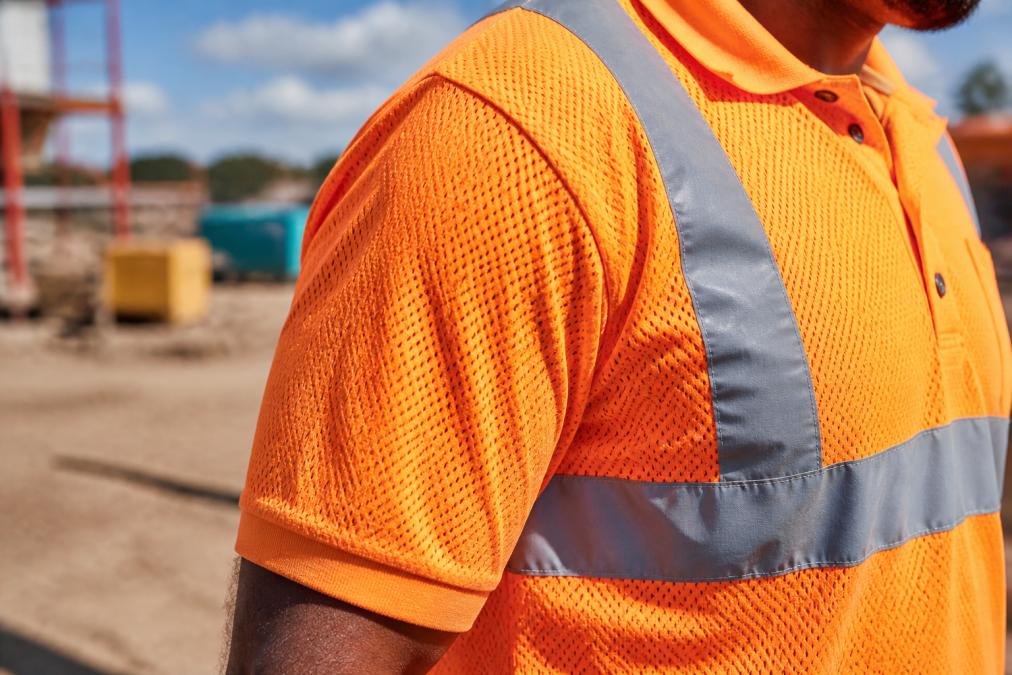
Polyester Bird Eye Mesh vs Cotton Drill vs Stretch Cotton
Polyester bird eye mesh is a woven synthetic fabric with small holes that let air pass through. It dries fast, wicks sweat, and stays light in heat. This is the go-to choice for summer and hot indoor environments.
Cotton drill is a tough natural fibre with good abrasion resistance. It breathes, but soaks up sweat and dries slowly. Better for cooler conditions and trades where spark or abrasion risk is high.
Stretch cotton adds elastane for movement. Great for workers who climb, kneel, or reach all day.
| Fabric | Breathability | Durability | Best For |
|---|---|---|---|
| Polyester bird eye mesh | High | Medium | Hot weather, logistics |
| Cotton drill | Medium | High | Trades, cooler months |
| Stretch cotton | Medium | High | Active roles, climbing |
Why GSM and Fabric Weight Decide Comfort on Site
GSM (grams per square metre) is the single most objective number on a hi vis garment label. It tells you how heavy the fabric is, and that number predicts how the garment will perform in heat, how long it will last, and whether it will feel like a second skin or a sauna suit after eight hours.
Most guides say "lightweight" without defining it. Here are the ranges that matter for breathable hi vis workwear:
| GSM Range | Classification | Breathability | Durability | Typical Use |
|---|---|---|---|---|
| 110-140 | Ultra-light | Excellent | Low | Singlets, hot indoor work, light duties |
| 140-170 | Lightweight | Very good | Medium | Summer polos, mesh shirts, outdoor crews |
| 170-200 | Mid-weight | Good | High | Year-round shirts, trades, abrasion risk |
| 200-240 | Heavyweight | Moderate | Very high | Cooler months, heavy trades, spark risk |
| 240+ | Extra-heavy | Low | Exceptional | Winter drill shirts, harsh environments |
For breathable hi vis in hot conditions, look for 140-170 GSM. This range balances airflow with enough substance to hold reflective tape securely and survive repeated industrial washing. Below 140 GSM, the fabric may feel cooler but tape adhesion and seam integrity can degrade faster.
Above 200 GSM, you are trading breathability for toughness.
When comparing quotes, put the GSM next to the price. A cheaper garment at 120 GSM may need replacing twice as often as a 160 GSM option, which changes the real cost per wear. Match the weight to the season and the job, not to a single preference.
Polo Shirt Short Sleeve Hi Vis →
Moisture-Wicking Hi Vis Shirts: What Actually Keeps Sweat Moving
Moisture-wicking hi vis shirts pull sweat away from skin and spread it across the fabric surface, where it evaporates faster. Synthetic fabrics like polyester do this well. Cotton holds moisture against the skin.
Look for these features:
- Synthetic blends or 100% polyester construction
- Mesh or bird eye weave for airflow
- Flat seams to reduce chafing
- A relaxed, ergonomic fit that doesn't cling
Ventilation Panels, Airflow and Skin Protection Trade-Offs
Ventilation panels are mesh inserts placed under the arms, across the back, or along the sides. They work by creating a chimney effect: hot air rises and escapes through the mesh, while cooler air enters from below. On a 35°C day, that circulation can be the difference between a worker who lasts the shift and one who overheats by lunch.
How Mesh Affects UV Protection
Standard hi vis fabric with a UPF rating blocks most UV radiation. Mesh panels, by design, have holes. Those holes let air through, and they also let UV through. A garment with large mesh panels may have a lower effective UPF across the covered area than the fabric rating suggests.
Balancing Airflow and Protection by Role
- Outdoor crews in full sun: prioritise UPF-rated fabric with targeted ventilation under the arms and across the back. Avoid large mesh panels on shoulders and chest where sun exposure is highest.
- Indoor or shaded roles: more mesh is fine. Airflow matters more than UV protection when the sun is not a factor.
- Spark or chemical risk: limit mesh entirely. Choose drill or tightly woven fabric that resists penetration. Mesh can catch sparks and does not block splashes.
- Mixed roles: consider a polo with mesh under the arms only, paired with a UPF-rated collar and sleeves. This gives airflow where it helps most without sacrificing coverage where it matters.
A common mistake is ordering the same garment for indoor and outdoor crews. Indoor crews can handle more mesh; outdoor crews need a smarter balance. Split your order by exposure level and you will cut both complaints and sun-related incidents.
Choosing Between Shirts, Polos and Singlets for Your Crew
The garment style affects both breathability and how your team actually wears it. There's no single best option, only the right fit for the job.
| Style | Airflow | Coverage | Best For |
|---|---|---|---|
| Shirt | Low-medium | Full | Cooler weather, client sites |
| Polo | Medium | Full with collar | Most roles, year-round |
| Singlet | High | Minimal | Hot indoor work |
How to Wash Lightweight Work Trousers for Longevity
Lightweight work trousers lose their breathability and reflective tape performance when washed wrong. Follow these steps to get more wears per garment.
- Check the care label before the first wash
- Turn garments inside out to protect reflective tape
- Wash in cold or warm water, never hot
- Use mild detergent, skip fabric softener
- Avoid bleach and harsh stain removers
- Tumble dry low or hang dry in shade
- Inspect tape for peeling or fading after each wash
Layering for Variable Weather and Shift Length
Weather shifts across a shift. A layering system keeps breathable hi vis working in heat and cold.
Conclusion
Getting breathable hi vis right comes down to matching fabric, weight and style to the actual job, not guessing. Most complaints about chafing and overheating trace back to a single fabric ordered for every role.
Frequently Asked Questions
What is the Australian standard for hi-vis clothing?
AS/NZS 4602.1:2011 sets the requirements for high-visibility safety garments in Australia and New Zealand. It defines three categories: Class D for day use, Class N for night use with retroreflective tape, and Class D/N for both day and night. The standard also references AS/NZS 1906.4 for the reflective tape itself, covering colour fastness and retroreflective performance. Always check the garment label confirms compliance with AS/NZS 4602.1:2011 and the correct class for your work environment.
Why is moisture-wicking important in high-visibility workwear?
Moisture-wicking fabrics pull sweat away from the skin to the outer surface where it evaporates, rather than letting it saturate the garment. When sweat soaks into a heavy cotton shirt, the fabric clings, chafes and blocks airflow, which raises the risk of heat stress on site. Breathable hi vis workwear with wicking properties keeps the wearer drier, reduces skin irritation and helps maintain thermal regulation through a full shift, especially in hot or humid conditions.
What is the difference between Class D and Class D/N hi-vis clothing?
Class D (day) garments use fluorescent fabric only, making the wearer visible in daylight. Class D/N (day/night) garments combine fluorescent fabric with retroreflective tape, so the wearer is visible both in daylight and when illuminated by vehicle headlights or work lights at night. If your crew works across both day and night shifts, or in low-light conditions such as dawn, dusk or indoor warehouses, Class D/N is the safer choice.
How do I keep breathable hi vis workwear compliant after repeated washing?
Wash hi vis garments according to the care label, usually in cold or warm water with a mild detergent, and avoid fabric softener, bleach and high-heat drying, which break down reflective tape and fluorescent dyes. Turn garments inside out, close zips and wash separately from abrasive items. Inspect the reflective tape regularly for cracking, peeling or reduced retroreflectivity. Replace any garment where the tape or fluorescent colour has faded, as it may no longer meet AS/NZS 4602.1:2011 performance requirements.
Recent Blogs
September 22, 2026
How to Choose Breathable Hi Vis Workwear: 2026 Guide
Learn how to choose breathable hi vis workwear that meets...
September 22, 2026
How to Choose Breathable Hi Vis Workwear: 2026 Guide
Learn how to choose breathable hi vis workwear that meets...
September 22, 2026
How to Choose Breathable Hi Vis Workwear: 2026 Guide
Learn how to choose breathable hi vis workwear that meets...