
Bulk Custom Safety Workwear Online: A How-To Guide


Table of Contents
- Understanding Your Bulk Custom Safety Workwear Needs
- AS/NZS 4602.1 Compliant Workwear: What You Need to Know
- Embroidery vs Screen Printing for Workwear: Which Method Lasts
- The Bulk Workwear Procurement Process: Step-by-Step
- Garment Selection for Different Industries and Conditions
- Bulk Order Benefits and Discount Structures
- Common Mistakes to Avoid When Ordering in Bulk
- Conclusion
Last Updated: August 14, 2026
Understanding Your Bulk Custom Safety Workwear Needs
Ordering bulk custom safety workwear online requires clarity on what your team actually needs before committing budget and timeline. Most teams underestimate how many variables affect their final order: team size, seasonal conditions, specific fit requirements, and branding choices all influence cost and turnaround time significantly.
Before requesting a quote, answer three foundational questions: What hazards does your team face? How many people are you outfitting? What's your realistic timeline? These answers determine everything downstream. A construction crew working in high-traffic road zones needs different reflective specifications than a warehouse team. A 50-person order has different pricing than a 12-person order. A three-week deadline eliminates some customisation options entirely.
AS/NZS 4602.1 Compliant Workwear: What You Need to Know
AS/NZS 4602.1 is the Australian and New Zealand standard that defines high-visibility safety clothing requirements. If your team works near traffic, on construction sites, or in any role where visibility prevents incidents, compliance with this standard is a legal requirement under workplace health and safety legislation.
The standard specifies minimum reflective tape width, placement, and material properties. It defines colour requirements (fluorescent yellow-green or orange) and sets rules for total reflective area based on hazard class. Most importantly, it requires that reflective tape and fluorescent material maintain their properties through multiple wash cycles, which is where cheaper workwear fails.
When ordering in bulk, compliance becomes a procurement issue. You need to verify that every garment meets the standard before it ships. Many online retailers cut corners by sourcing cheaper base garments and applying reflective tape that degrades after 10-15 washes instead of the 50+ cycles the standard requires.
Embroidery vs Screen Printing for Workwear: Which Method Lasts
The choice between embroidery and screen printing affects durability, appearance, and cost. On workwear that gets washed constantly, this difference matters significantly.
Screen printing applies ink directly to fabric, while embroidery stitches thread into the material. Screen printing is simpler and cheaper initially, but workwear gets exposed to sweat, detergent, UV light, and repeated washing. Printed logos fade and crack after 20-30 industrial washes. Embroidered logos hold up through 100+ wash cycles with minimal fading because the thread is mechanically locked into the fabric rather than sitting on top of it.
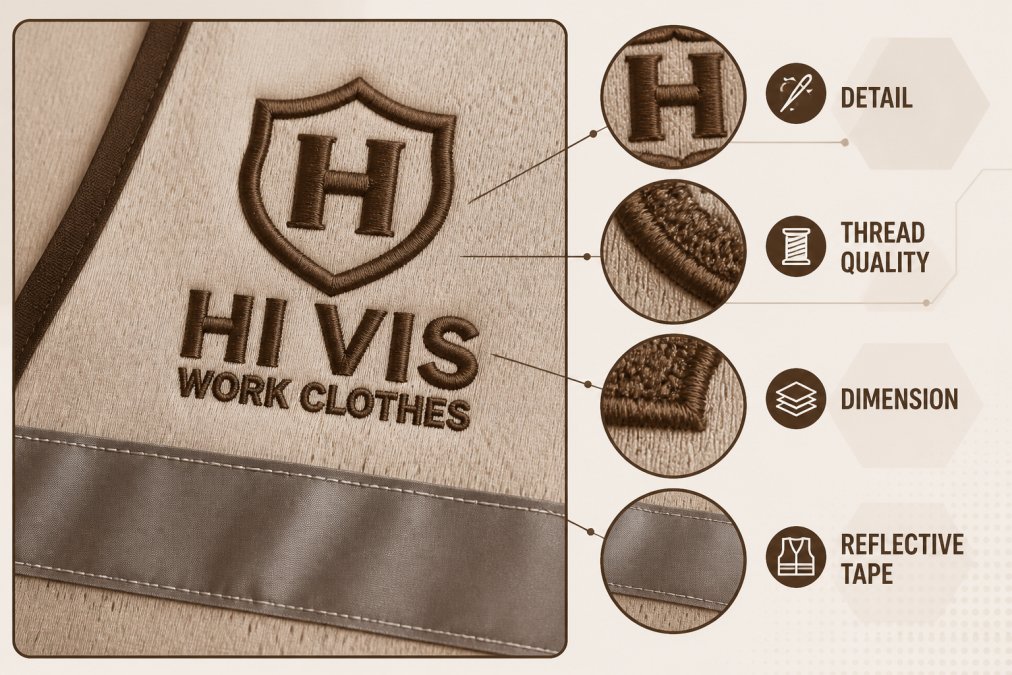
Embroidery requires setup per design and takes longer per garment, typically costing 40-60% more per unit than printing. However, for garments in rotation for 12+ months, the durability math favours embroidery. Use screen printing for temporary branding (seasonal crews, short-term contracts). Use embroidery for core daily uniforms.
The Bulk Workwear Procurement Process: Step-by-Step
Ordering bulk custom safety workwear follows a predictable sequence. Understanding each step helps you avoid delays and ensures you get what you actually need.
Step 1: Define Your Team's Requirements and Size Range
Count your team members and collect actual measurements or have people try on sample sizes. Workwear fit affects safety and comfort. A vest that's too loose moves around during movement and exposes skin. A shirt that's too tight restricts mobility.
Document any special requirements. Do you have women on the crew? Standard unisex workwear often fits poorly for women. Do you have people with mobility requirements? Are there seasonal variations? List your customisation requirements: company name, logo, specific colour, text placement. Be specific about placement, does the logo go on the chest, back, or both?
Create a simple spreadsheet: name, size, any special notes. This becomes your reference document throughout the process.
Step 2: Select Your Garments and Customisation Method
Choose the specific garments you need. Are you ordering vests only, or full sets? Do you need jackets for winter? Pants? Shirts?
Decide on embroidery versus screen printing based on your durability timeline and budget. For bulk orders, many teams choose printing for vests (lower cost, fast turnaround) and embroidery for shirts and jackets (higher durability, more professional appearance).
Confirm fabric specifications. Does your team work in wet conditions? Look for water-resistant or moisture-wicking fabrics. Do they work outdoors year-round? Breathable mesh at collar and underarms prevents heat stress. Check GSM (grams per square metre); heavier fabric (200+ GSM) lasts longer in high-wear environments.
Step 3: Upload Your Design and Confirm Placement
Submit your logo file in high resolution (minimum 300 DPI for printing, 600 DPI for embroidery). Specify exact placement: "Left chest, 10 centimetres from the top, 5 centimetres from the left edge" is precise. Use the supplier's mockup tool to visualise placement before confirming.
Confirm colour matching. If your logo uses specific brand colours (Pantone numbers, RGB values, or hex codes), provide those. Review artwork proofs carefully and check for distortion, colour accuracy, and placement. Most suppliers allow one round of revisions at no charge.
Step 4: Review Turnaround Times and Delivery Options
Standard production typically takes 10-15 business days for screen printing, 12-18 business days for embroidery. This doesn't include design approval time or shipping. If your team needs uniforms in three weeks, you're cutting it close. Rush fees typically add 30-50% to the cost.
Confirm delivery options and whether split shipments to multiple locations are available. Get everything in writing: production start date, proof approval deadline, production completion date, and delivery date.
Garment Selection for Different Industries and Conditions
Different work environments demand different specifications.
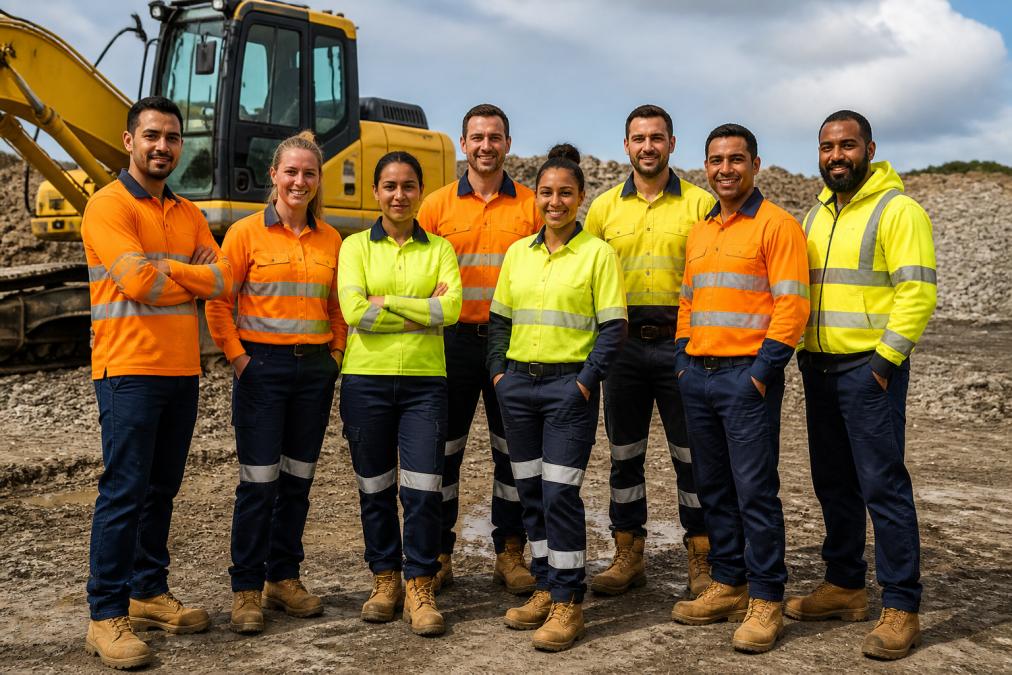
Construction and Infrastructure: High-visibility vests with reflective tape are non-negotiable. Full-body coverage (pants and shirts) offers better protection than vests alone. Look for durable fabrics (200+ GSM cotton-polyester blends) that withstand rough handling and frequent washing. Pockets are essential for carrying tools and equipment.
Logistics and Warehousing: Indoor environments with forklifts and moving vehicles. Vests with clear reflective bands are typically sufficient. Breathable fabrics matter because these teams move constantly. Moisture-wicking technology prevents sweat buildup during long shifts.
Utilities and Maintenance: All-weather jackets with reflective tape are essential. Look for water-resistant or waterproof materials with taped seams. Insulated options for winter crews. Breathable linings for summer. Multiple pockets for tools and safety equipment.
Airport Ground Crews: Full-body coverage with extensive reflective tape. Durable fabrics that survive frequent washing and harsh cleaning chemicals. Professional appearance matters; embroidery often works better than printing for this reason.
Trade Services: Small teams, varied work environments. Look for garments that work in both indoor and outdoor settings. Many trade teams prefer vests that layer over existing uniforms rather than full replacement sets.
Bulk Order Benefits and Discount Structures
Bulk ordering delivers financial and operational advantages that justify the upfront planning effort.
Cost per unit decreases significantly with volume. A single safety vest might cost more retail. A bulk order of 50 vests reduces the per-unit cost substantially. An order of 200 vests drops further. These savings compound across a full team.
Consistency across your team. When everyone wears identical branded workwear, your team looks professional and cohesive. Clients and customers perceive professionalism. Your team feels like a unified operation rather than individuals in random gear.
Simplified replacement cycles. Instead of replacing one worn vest every month, you replace the entire team's gear annually or every 18 months. This reduces administrative overhead and simplifies inventory management.
Customisation economies. Screen printing setup costs are fixed regardless of quantity. A 10-unit order and a 200-unit order both require the same setup. With larger quantities, that fixed cost spreads across more units, reducing per-unit customisation cost dramatically.
Negotiated pricing. Suppliers offer volume discounts at defined thresholds. Ask explicitly about discount structures and get pricing in writing before you commit.
Common Mistakes to Avoid When Ordering in Bulk
Most bulk order problems are preventable and come from rushing, incomplete planning, or unfounded assumptions.
Mistake 1: Underestimating sizing variation. Teams assume everyone wears medium or large. In practice, sizing spreads across a wider range. Collect actual measurements or sizes before ordering. Build in 10-15% extra for new hires and replacements.
Mistake 2: Choosing printing when durability matters. Screen-printed logos fade and crack after 6-12 months of weekly washing. If your team will wear these garments for 18+ months, embroidery costs more upfront but saves money long-term.
Mistake 3: Skipping compliance verification. Ask for compliance certificates for the specific batch. Verify reflective tape width and material properties. This takes 10 minutes and prevents regulatory problems.
Mistake 4: Ignoring turnaround time. Standard production is 12-15 days plus 3-5 days shipping. Add design approval delays, and you're asking for problems. Build in buffer time and work backwards from your deadline.
Mistake 5: Not getting approval in writing. Get all specifications, size, colour, placement, fabric, customisation method, in writing before production begins. Verbal approvals create disputes when placement or colours don't match expectations.
Mistake 6: Underestimating storage and distribution logistics. A large order arrives at your warehouse. You need to unpack it, verify quantities, sort by size, and distribute to team members across multiple locations. Plan for this before the order arrives.
Mistake 7: Choosing the cheapest option without checking durability. A supplier quotes significantly less per vest. But the reflective tape peels after 20 washes instead of 100. You're replacing the entire order after one year instead of three. The cheap option costs more over time.
Bulk custom safety workwear requires planning, but the process is straightforward once you understand the variables. Start by defining your team's actual needs. Verify compliance with AS/NZS 4602.1 standards. Choose customisation methods based on durability requirements. Build realistic timelines and get everything in writing.
Hi Vis Work Clothes simplifies this process with transparent pricing, compliance verification, and clear turnaround times. Get a quote for your bulk order today and see how professional branded workwear strengthens your team's safety and cohesion.
| Step | Focus Area | Timeline | Key Decision |
|---|---|---|---|
| 1 | Define requirements and sizing | 1-2 weeks | Collect actual team measurements |
| 2 | Select garments and customisation | 3-5 days | Embroidery or screen printing? |
| 3 | Upload design and confirm placement | 5-7 days | Get approval in writing |
| 4 | Review turnaround and delivery | 2-3 days | Standard or rush production? |
| 5 | Place order and track production | 10-18 days | Monitor progress and approve proofs |
| 6 | Receive and distribute | 3-5 days | Verify quantities and distribute to team |
Ordering bulk custom safety workwear online is fundamentally a compliance and logistics exercise. The safety standards are clear, AS/NZS 4602.1 defines what your team needs. The procurement process is predictable: define requirements, select garments, upload design, confirm timeline, place order. The financial benefits are substantial, with cost per unit dropping significantly with volume.
The real challenge is avoiding common pitfalls: underestimating sizing variation, skipping compliance verification, choosing durability shortcuts, or missing turnaround deadlines. Teams that plan upfront and get specifications in writing have smooth experiences.
Hi Vis Work Clothes handles the complexity by offering AS/NZS 4602.1 compliant workwear with transparent pricing, design verification, and reliable turnaround. For operations managers and safety officers managing bulk orders, this removes guesswork from the process. Get a quote for your team's bulk custom safety workwear and start building professional, compliant uniforms that protect your crew and strengthen your brand.
Frequently Asked Questions
What are the AS/NZS standards for hi-vis safety workwear?
AS/NZS 4602.1 is the standard for high-visibility safety garments in Australia and New Zealand. It specifies minimum reflective tape width (typically 5 cm), colour requirements (yellow, orange, or red), and placement on garments. Your bulk custom safety workwear must meet these standards to comply with workplace safety regulations. Always confirm that your supplier's garments carry the AS/NZS certification mark before ordering large quantities for your team.
How do I choose between embroidery and screen printing for workwear?
Embroidery offers superior durability for bulk workwear orders, especially in harsh conditions. Thread-based logos withstand repeated washing and wear without peeling. Screen printing is faster and cheaper for large quantities but may fade after 20-30 washes. For teams working in high-moisture or high-heat environments, embroidery justifies the slightly longer turnaround time. Consider your team's washing frequency and the garment's expected lifespan when deciding which method suits your bulk order.
How long does it typically take to process bulk custom workwear orders?
Standard turnaround for bulk custom safety workwear is 7-14 business days after artwork approval, depending on order size and customisation method. Embroidery orders may take slightly longer than screen printing. Rush options are available for additional cost if you need gear within 3-5 days. Always factor in delivery time when planning your procurement timeline, especially for crews starting on a fixed date.
What information do I need to provide for a bulk workwear quote?
Provide your team size and size breakdown (XS to 3XL quantities), desired garment type (vests, shirts, pants, or combo sets), colour preference, customisation method (embroidery or screen printing), logo file format, and any special requirements (reflective tape width, breathable fabric, all-weather options). Include your delivery location and preferred turnaround timeframe. This information allows suppliers to calculate costs accurately and confirm whether your order meets compliance standards like AS/NZS 4602.1.
This article was written using GrandRanker
Recent Blogs
August 14, 2026
Bulk Custom Safety Workwear Online: A How-To Guide
Order bulk custom safety workwear online with confidence. Learn compliance...
August 14, 2026
Bulk Custom Safety Workwear Online: A How-To Guide
Order bulk custom safety workwear online with confidence. Learn compliance...
August 14, 2026
Bulk Custom Safety Workwear Online: A How-To Guide
Order bulk custom safety workwear online with confidence. Learn compliance...