
Breathable Hi-Vis Jackets for Summer Work: 2026 Guide


Table of Contents
- Why Breathable Hi-Vis Jackets Matter for Summer Work
- Quick Comparison: Top Breathable Hi-Vis Jackets for Summer
- Lightweight Hi-Vis Workwear Australia: Materials That Cool You Down
- Moisture-Wicking Hi-Vis Jackets Australia: Sweat Management Technology
- AS/NZS 4602.1:2011 Compliant Hi-Vis: Safety Without Compromise
- UPF 50+ Hi-Vis Jackets: Sun Protection for Extended Outdoor Work
- Key Features to Look for in Breathable Hi-Vis Jackets for Summer
- Care and Maintenance: Extending Hi-Vis Longevity in Australian Heat
Last Updated: July 26, 2026
Why Breathable Hi-Vis Jackets Matter for Summer Work
Working outdoors in Australian heat presents a dual challenge that most standard workwear simply doesn't address: staying visible to machinery and vehicles while preventing heat exhaustion. At Hi Vis Work Clothes, we understand that breathable hi vis jackets for summer work aren't a luxury, they're essential safety equipment that directly impacts worker performance and health. The problem isn't new, but the solutions have evolved significantly.
When temperatures exceed 28°C, workers in standard hi-vis gear experience rapid heat buildup, reduced alertness, and dangerous fatigue. Meanwhile, removing the jacket to cool down eliminates the visibility protection that keeps them safe on site. This creates a false choice that many workers face daily, and it's where breathable hi vis jackets for summer work become genuinely critical.
The difference between summer-specific gear and standard workwear comes down to fabric engineering and design philosophy. Standard hi-vis jackets prioritise waterproofing and durability but trap moisture and body heat.
Summer variants use mesh panels, moisture-wicking fabrics, and strategic ventilation to maintain visibility while allowing sweat to evaporate. This isn't just comfort, it's about maintaining the cognitive function and physical coordination that prevent workplace accidents.
Quick Comparison: Top Breathable Hi-Vis Jackets for Summer
| Product | Key Advantage | Best For | Breathability Rating |
|---|---|---|---|
| Bisley Men's Long Sleeve Taped Hi Vis Industrial Cool Vented Shirt | Vertical cotton mesh back ventilation | Heavy industrial work | Excellent |
| Hard Yakka Koolgear Hi Vis 2 Tone Taped Vented Long Sleeve Polo | UPF 50+ sun protection with mesh venting | Extended outdoor exposure | Excellent |
| KingGee Workcool 2 Hi Vis Reflective Long Sleeve Shirt | Multiple cooling vents with lightweight fabric | Hot conditions, all-day wear | Excellent |
| Workcraft WW9024 Hi Vis Jacket With Tape | Waterproof and breathable balance | Variable weather conditions | Good |
| 5.11 Tactical Reversible Hi-Vis Jacket | GORE-TEX® breathability with tactical versatility | Professional versatility | Excellent |
Lightweight Hi-Vis Workwear Australia: Materials That Cool You Down
The foundation of any breathable hi-vis jacket lies in fabric selection and construction. Australian summers demand materials that actively dissipate heat rather than simply allow it to escape passively. Cotton mesh, polyester grid knit, and blended fabrics each offer different advantages depending on your work environment.
Cotton-based mesh fabrics like those used in the Bisley Industrial Cool Vented Shirt provide natural breathability and moisture absorption. A 190gsm preshrunk industrial drill paired with 100% cotton open mesh creates airflow channels while maintaining durability for rough construction sites. The trade-off is that cotton takes longer to dry than synthetic alternatives, which matters in humid conditions.
Polyester grid knit fabrics, such as those in the Hard Yakka Koolgear range, prioritise quick-drying performance and antimicrobial finishes. Polyester won't absorb sweat; instead, it allows moisture to pass through to the outer layer where it evaporates. This creates a "sweat-free" feeling that many workers prefer in extreme heat, though some find it less comfortable against skin during initial moisture contact.
The most effective summer jackets use hybrid construction: a lightweight outer shell combined with mesh or vented inner panels. This approach maintains structural integrity for safety compliance while maximising airflow in high-heat zones like the back, underarms, and sides. Jacket weight becomes critical, heavier fabrics (above 250gsm) trap heat regardless of breathability features.
Moisture-Wicking Hi-Vis Jackets Australia: Sweat Management Technology
Moisture-wicking refers to a fabric's ability to move perspiration away from the skin and toward the outer surface where it can evaporate. This is fundamentally different from breathability, though the terms are often confused. A fabric can be breathable without being moisture-wicking, and vice versa.
Moisture-wicking fabrics use one of two mechanisms: capillary action (where fibres pull liquid along their length) or hydrophobic properties (where synthetic fibres repel water, forcing moisture outward). Polyester excels at capillary action; merino wool and some cotton blends use hydrophobic treatments.
The Hard Yakka Koolgear range uses polyester grid knit with an antimicrobial finish, the antimicrobial treatment prevents bacterial growth that causes odour when sweat sits on fabric.
Two technical ratings define breathability and moisture management: RET (Resistance to Evaporative Heat Transfer) and MVTR (Moisture Vapour Transmission Rate). RET is measured in square metres per watt (m²W), lower numbers indicate better breathability. Anything below 6 m²W is considered highly breathable; above 12 m²W becomes restrictive.
MVTR measures grams of moisture per square metre per 24 hours, higher numbers indicate faster moisture movement. A jacket rated 3,000 MVTR is moderate; 5,000+ is excellent for summer use.
The Workcraft WW9024 Hi Vis Jacket With Tape offers 3,000 MVTR breathability alongside 12,000mm waterproofing. This represents a balanced approach: adequate moisture management with weather protection. For pure summer work without rain risk, higher MVTR ratings (4,000+) become more valuable than waterproofing specs.
Strategic mesh placement amplifies moisture-wicking effectiveness. Underarm vents, side panels, and back mesh create convection currents that pull moisture away from the torso, the body's primary heat-dissipation zone. The KingGee Workcool 2 incorporates vents in underarm, upper back, and side positions, targeting the three areas where sweat accumulation creates heat stress fastest.
AS/NZS 4602.1:2011 Compliant Hi-Vis: Safety Without Compromise
Australian and New Zealand hi-vis standards mandate specific reflective tape coverage, colour combinations, and performance characteristics. AS/NZS 4602.1:2011 defines Class D/N (Day/Night) visibility requirements, which means the jacket must remain visible in both daylight and low-light conditions using retroreflective tape.
The standard requires minimum tape widths and coverage areas depending on the class. Class D/N jackets need 50mm reflective tape in hoop patterns across the torso and sleeves. The Bisley Industrial Cool Vented Shirt uses 50mm 3M 9920 Scotchlite tape in hoop configuration, meeting these requirements while maintaining the shirt's breathability, the tape itself doesn't restrict airflow.
A critical distinction exists between day-only and day/night compliance. Day-only jackets use fluorescent materials that appear bright in daylight but become invisible at night. Day/night jackets use retroreflective tape that bounces light directly back to its source, making them visible in vehicle headlights regardless of time. For Australian worksites with early mornings, late shifts, or twilight work, day/night compliance is non-negotiable.
Reflective tape durability is often overlooked. Tape that peels or fades after a few washes defeats the compliance purpose. Quality tape adhesion depends on proper fabric preparation, correct application pressure, and appropriate washing procedures. Hi Vis Work Clothes sources tape from established manufacturers like 3M, which maintains consistent performance across wash cycles when cared for correctly.
UPF 50+ Hi-Vis Jackets: Sun Protection for Extended Outdoor Work
UPF (Ultraviolet Protection Factor) measures a fabric's ability to block ultraviolet radiation. UPF 50+ means the fabric blocks at least 98% of UVA and UVB rays. For Australian workers spending 6-8 hours daily in direct sun, UPF protection becomes a secondary safety concern alongside visibility.
UV blocking is achieved through fabric density, fibre type, and sometimes chemical treatments. Tightly woven fabrics naturally block more UV than loose weaves. Dark colours absorb more UV than light colours, but dark fabrics also absorb more heat, creating a trade-off that manufacturers address through fibre selection.
The Hard Yakka Koolgear achieves UPF 50+ through polyester grid knit construction combined with colour selection, without sacrificing breathability.
Cumulative sun exposure increases skin cancer risk and accelerates skin aging. Workers in outdoor industries (construction, landscaping, utilities, mining) face significantly elevated risk. A UPF 50+ hi-vis jacket provides meaningful protection during the hours when workers are most exposed. This is particularly important in Australia, where UV index regularly exceeds 10 during summer months.
The relationship between UPF rating and breathability is inverse: denser fabrics that block UV tend to restrict airflow. The Hard Yakka Koolgear balances this by using fine polyester fibres that create UV-blocking density without the weight penalty of traditional densely-woven fabrics.
The result is UPF 50+ protection with excellent breathability, though at a higher price point than non-UV-rated alternatives.
Key Features to Look for in Breathable Hi-Vis Jackets for Summer
Several design features directly impact how well a hi-vis jacket performs in summer heat. Understanding these features helps you evaluate options beyond marketing claims.
Seam-sealing and waterproofing without trapping heat represents a fundamental engineering challenge. Fully sealed seams prevent water ingress but also restrict vapour transmission. Summer jackets typically use partial sealing, critical seams around shoulders and armpits are sealed, while side and back seams remain unsealed to allow moisture escape.
The 5.11 Tactical Reversible Hi-Vis Jacket uses GORE-TEX® fabric, which achieves both waterproofing and breathability through a microporous membrane that blocks liquid water but allows water vapour to pass. This is the premium approach, reflected in higher pricing.
Underarm vents and strategic mesh panels create convection currents that actively pull moisture away from the body's heat-generating zones. Vents positioned at the underarm, side, and upper back target the three areas where sweat accumulation accelerates heat stress.
Some jackets include eyelets or mesh panels that remain open year-round; others use removable panels or zips that allow seasonal adjustment. The KingGee Workcool 2 incorporates fixed vents in all three zones, providing consistent airflow without additional configuration.
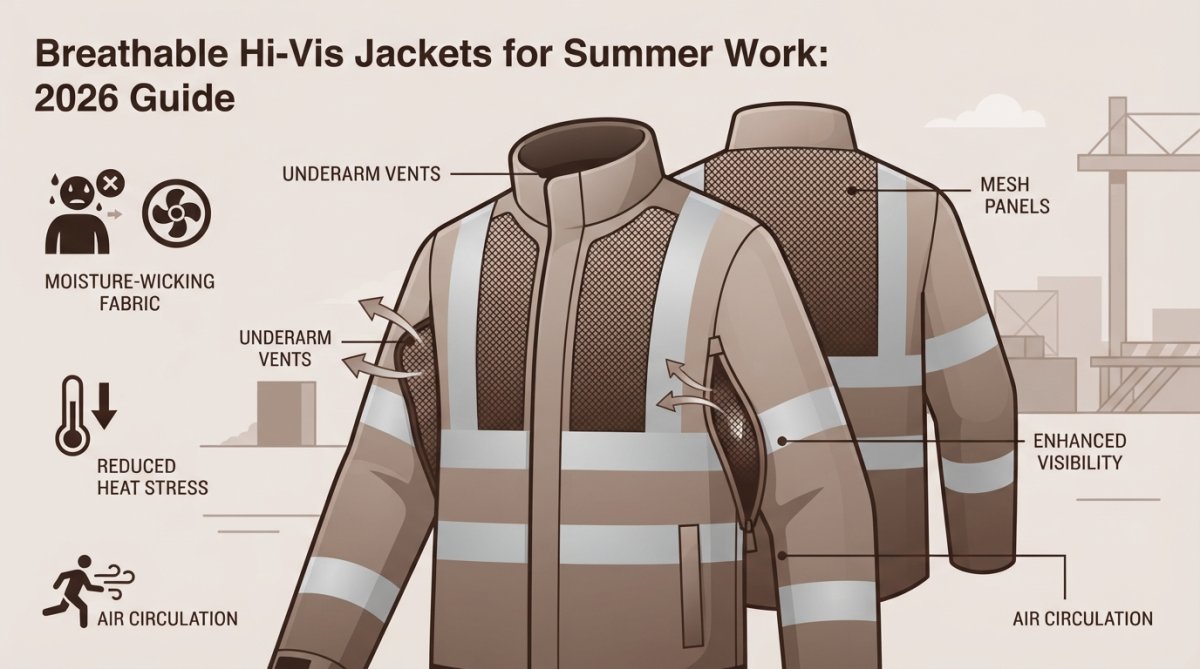
Reflective tape placement and durability affects both visibility and comfort. Tape positioned along seams can create friction points during movement; tape positioned across fabric panels distributes movement stress more evenly. Width matters too, 50mm tape provides better visibility than narrower alternatives while remaining flexible enough to accommodate body movement.
Segmented tape (as used in the Hard Yakka Koolgear with their ReflecTec 50mm segmented design) offers superior flexibility compared to continuous tape, reducing restriction during arm movement.
Collar design influences heat dissipation significantly. Extended collars provide sun protection but can trap heat around the neck, a major thermoregulation zone. The KingGee Workcool 2 uses a three-piece collar with extension, balancing protection with airflow. Some jackets incorporate mesh collar inserts that maintain sun protection while allowing air circulation.
Zip construction affects breathability during partial opening. Coil zips (plastic teeth) allow air to pass through slightly when partially opened, while metal zips create a tighter seal. For summer jackets, coil zips are preferable. Heavy-duty YKK zippers (as used in premium options like the 5.11 Tactical) prioritise durability but sacrifice the slight airflow advantage of coil zips.
Care and Maintenance: Extending Hi-Vis Longevity in Australian Heat
Breathable hi-vis jackets require specific care to maintain both safety compliance and longevity. Australian heat and humidity create conditions that accelerate fabric degradation and reflective tape failure if not managed properly.
Washing procedures directly impact breathability preservation. Machine wash in cold water (below 30°C) using mild detergent, hot water degrades both the fabric's moisture-wicking properties and the adhesive bonding reflective tape. Avoid fabric softeners, which coat fibres and reduce breathability.
Dry naturally in shade rather than machine drying; heat accelerates synthetic fabric degradation and reflective tape peeling. For jackets with sealed seams, avoid wringing or aggressive agitation that stresses seam integrity.
Reflective tape requires particular attention. Inspect tape regularly for peeling or discolouration, faded or peeling tape compromises compliance. If tape begins to lift, replace it with quality tape from established manufacturers rather than attempting to re-adhere the original. This is more cost-effective than replacing the entire jacket and ensures compliance is maintained.
Storage matters in Australian conditions. Store jackets in cool, dry environments away from direct sunlight. UV exposure causes fading even when the jacket isn't being worn. Humidity accelerates mould growth on stored fabrics. In tropical or humid regions, consider breathable storage bags that allow air circulation without dust accumulation.
Sweat and salt residue accumulate on fabrics during summer work and attract moisture, accelerating degradation. Rinse jackets with fresh water after heavy sweat exposure before washing with detergent. This removes salt and sweat solids that would otherwise bond to fibres during the wash cycle.
Inspect seams and mesh panels regularly. Small tears in mesh panels can be repaired with fabric adhesive patches before they expand. Seam separation near high-stress zones (shoulders, underarms) should be addressed immediately, once seam integrity fails, waterproofing and structural support are compromised.
For jackets with removable liners or panels, follow specific care instructions for each component. Some liners are machine-washable while the outer shell requires hand-washing. Mixing care procedures can damage components or reduce effectiveness of moisture-wicking treatments.
Summer heat and workplace visibility don't have to be competing priorities. The right breathable hi-vis jacket maintains safety compliance while keeping workers cool and alert throughout their shift. Hi Vis Work Clothes offers customisable hi-vis solutions with reflective tape options and quality construction that withstands Australian conditions.
Whether you need standard compliance or enhanced UPF protection, breathable designs keep your team safe and comfortable. Get a Quote from Hi Vis Work Clothes to find the right jacket for your team's specific requirements and budget.
Frequently Asked Questions
What makes a breathable hi-vis jacket suitable for summer work in Australia?
Breathable hi-vis jackets for summer combine lightweight fabrics with strategic ventilation features, mesh panels, underarm eyelets, and moisture-wicking technology, that allow sweat to evaporate rather than trap heat.
Look for jackets with MVTR (moisture vapour transmission rate) ratings of 3,000 or higher, mesh inserts in high-heat zones (back, underarms, sides), and fabrics under 200gsm. These features maintain AS/NZS 4602.1:2011 compliance while preventing heat stress on the job.
Do lightweight hi-vis workwear options in Australia still meet safety standards?
Yes. Lightweight hi-vis workwear designed for Australian conditions fully complies with AS/NZS 4602.1:2011 when it includes proper reflective tape (50mm minimum width, 3M Scotchlite or equivalent) and correct hoop or segmented patterns.
Brands like Bisley and KingGee engineer their summer ranges specifically to meet Day/Night visibility standards while using breathable 100% cotton or polyester mesh fabrics. The key is the reflective system, not the jacket weight.
What's the difference between moisture-wicking and waterproof in hi-vis jackets?
Moisture-wicking fabrics pull sweat away from your skin so it evaporates, keeping you dry during physical work in heat. Waterproof jackets repel external water (rain) but can trap internal moisture if not breathable.
For summer work, you want both: a waterproof outer shell (12,000-15,000mm rating) paired with high breathability (3,000+ MVTR) to shed rain without trapping body heat. Jackets with concealed hoods and underarm vents balance protection and cooling.
How do UPF 50+ hi-vis jackets help during long outdoor shifts?
UPF 50+ rated hi-vis jackets block 98% of ultraviolet radiation, reducing skin damage and heat absorption from direct sun exposure. This is critical for Australian outdoor work where UV index is high year-round.
Fabrics with UPF protection, like Hard Yakka's polyester grid knit with antimicrobial finish, stay cooler because they reflect rather than absorb solar energy. Extended collar designs add neck protection without bulk, making them practical for all-day summer shifts.
What's the best way to care for breathable hi-vis jackets to prevent reflective tape peeling?
Wash in cool water (30°C or below) inside-out to minimise friction on reflective tape. Use mild detergent, avoid bleach, and skip fabric softener, these degrade the adhesive. Air-dry flat or hang; never tumble-dry.
High heat weakens the 3M Scotchlite bond. Check seams and tape edges monthly for lifting, especially after heavy sweating or high-friction work. Proper care extends reflective durability by 12+ months, protecting your investment and maintaining day/night compliance on site.
This article was written using GrandRanker
Recent Blogs
July 27, 2026
Breathable Hi-Vis Jackets for Summer Work: 2026 Guide
Find the best breathable hi-vis jackets for summer work in...
July 27, 2026
Breathable Hi-Vis Jackets for Summer Work: 2026 Guide
Find the best breathable hi-vis jackets for summer work in...
July 27, 2026
Breathable Hi-Vis Jackets for Summer Work: 2026 Guide
Find the best breathable hi-vis jackets for summer work in...